Cartoons aren’t real.
There. We hate to be the ones to break it to you. But it’s important to establish that rabbits aren’t wisecracking smart-alecks from Flatbush, there is no 12-year-old who can bend the four elements with his mind, and dogs don’t talk (no, not even to say “ruh-roh”).
And, sometimes, the coyote catches the road runner.
In the classic “Looney Tunes” cartoons featuring the Road Runner and Wile E. Coyote, which first appeared in 1949, the coyote is foiled again and again in his efforts to catch the puckish bird in the deserts of the American Southwest.
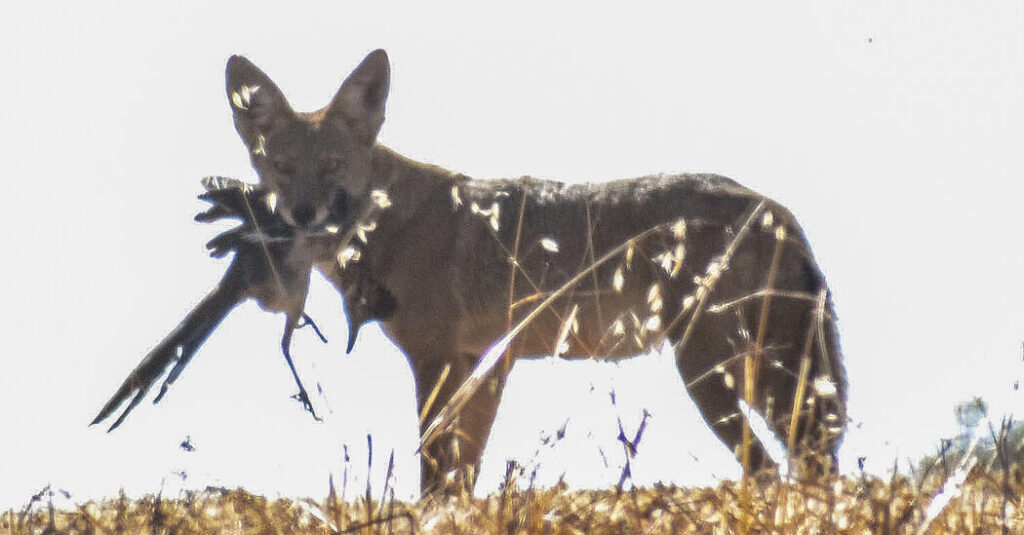
But a photographer in the Chatsworth Nature Preserve in Los Angeles on Saturday captured a real-life image of something you would never see in that cartoon: a coyote who successfully nabbed a road runner, instead of falling from a cliff, getting hit by a train or having an anvil land on him.
The photographer, Alexander deBarros, snapped the photo while out with a survey team from the San Fernando Valley Audubon Society for a monthly check of the ecosystem at the preserve, a 1,325-acre space in northwestern Los Angeles. (The photograph was first reported by the Los Angeles TV news station KTLA,)
There is no indication that this coyote effected the capture through the use of an Acme jet-propelled pogo-stick, Acme rocket-powered roller skates, or Acme dehydrated boulders (“Just add water!”).
Also, there were no reports of the road runner saying, “Beep, beep.”
While the image proved that coyotes do sometimes come out on top against road runners, it’s not a common occurrence. “It is considered very rare for a coyote to catch a road runner,” said Scott E. Henke, a professor at the Caesar Kleberg Wildlife Research Institute at Texas A&M University, Kingsville.
Road runners can run about 20 miles an hour and are agile, he said. “Physically they can outrun a coyote,” he said, and they “can fly up into tree branches to escape attacks.”
Mr. deBarros said in an interview that he initially thought the prey might be a ground squirrel. “When we confirmed that it was, in fact, a road runner in that coyote’s mouth, we freaked out a little bit,” he said. In 17 years of birding, he said, it was the first time he had seen the cartoon antagonists together.
When Mr. deBarros spotted the coyote, it already had the road runner in its mouth. He did not see any chase or kill.
Dr. Henke said this particular road runner might have been caught because it was distracted hunting its own prey, or perhaps it had been hit by a vehicle and was scavenged by the coyote.
Scavenged? Maybe Wile E. didn’t catch the road runner after all.
Another coyote expert, Stanley D. Gehrt, a professor of wildlife ecology at Ohio State University, agreed that the scavenger theory could be true. “But I have learned to never underestimate coyotes,” he said. “They can do anything, even catch a road runner.”
In an odd coincidence, Mr. deBarros’s father, Brian Mainolfi, is an animator who worked with Chuck Jones, a creator of the coyote-road runner cartoons, on the 1994 cartoon “Chariots of Fur.”
Mr. Jones once said he got the idea for the coyote character from a travel book by a classic novelist. “I first got interested in the coyote as an animal while perusing Mark Twain’s ‘Roughing It’ at the age of 7,” he said in an interview with The New York Times. “I thought of it as a sort of dissolute collie. And actually, that’s just about what a coyote is! No one saw it more clearly than Mark Twain.”
The cartoon has been back on the radar after the American release last Friday of the movie “Coyote vs. Acme,” in which the coyote sues the Acme Corporation for its defective products.
(It is fictional.)
(Oh, and by the way, cave men didn’t propel cars made of rocks with their feet, either.)
Georgia Gee contributed research.
The post Photo of Road Runner Snagged by Coyote Shows That Cartoons Were a Lie appeared first on New York Times.