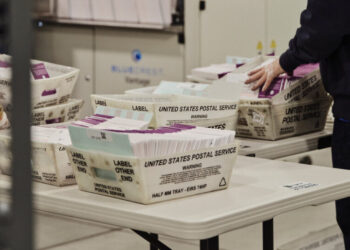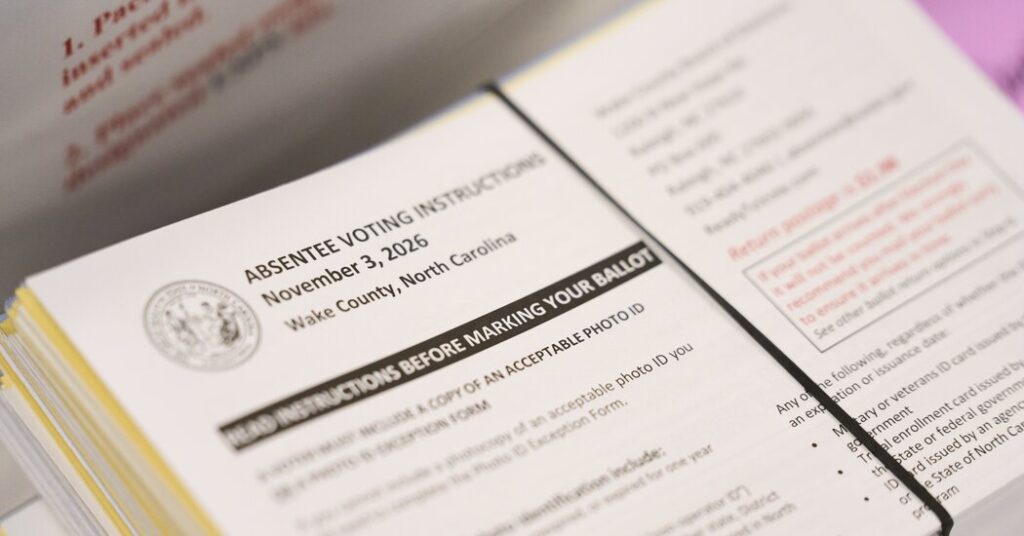
The North Carolina State Board of Elections added new restrictions to its vote-by-mail program on Friday morning, making it easier for local election officials across the state to discard ballots.
Just hours after counties in the state began sending the nation’s first batch of mail ballots for the fall election, the five-member state board, which is controlled by Republicans, split on party lines to approve the changes. The new rule requires officials to disqualify ballots with an unsealed envelope and limits who can drop off mail ballots on behalf of another voter.
The changes are almost certain to cause some votes to be tossed. They come at a time when President Trump and his allies have repeatedly promoted false claims of widespread fraud in mail voting, and used those false claims to justify strict new voting policies.
On Friday, the three Republican board members sought to cast the changes as both procedural and necessary to ensure the integrity of state elections, echoing Mr. Trump’s arguments.
“It’s a ballot security issue to make sure the voter’s will and intent is being followed through,” Stacy “Four” Eggers, a Republican member of the board, said at the virtual meeting on Friday.
In part because of such claims, Democrats in recent years have voted by mail in higher numbers than Republicans, meaning that restrictions to mail voting are more likely to disenfranchise Democrats than Republicans. Mr. Trump has stated publicly that he believes restricting the practice would benefit his party in the fall midterms.
In North Carolina, roughly 5 percent of voters cast their ballots by mail in the 2024 presidential election, a far lower rate than many other states. But with a Senate race that could help determine which party controls the chamber, small margins could make the difference.
As of Friday afternoon, election officials in the state had shipped more than 47,000 absentee ballots, according to Jason Tyson, a spokesman for the state elections board. More than 42 percent of voters who requested the ballots were registered Democrats, according to preliminary data provided by Mr. Tyson. About 38 percent of the voters were unaffiliated; more than 18 percent were Republicans.
Democrats in the state, including those on the board of elections, argued that the changes sow confusion and could disenfranchise voters with disabilities or without internet access. They also criticized the Republicans for pushing through a new rule just nine weeks ahead of Election Day.
“North Carolina voters deserve transparency in their elections, not last-minute workarounds that could keep their vote from counting,” said Governor Josh Stein, a Democrat, in a statement. “I will continue to stand up for voters’ access to the ballot box.”
One of the Democratic members of the board, Jeff Carmon, appeared at the Friday meeting with a virtual background that depicted John Lewis, the late civil rights leader. The other, Siobhan Millen, criticized her Republican counterparts for characterizing the new rules as simply technical changes.
“This does affect the voter,” she said. “It affects whether your ballot counts. That’s huge. So an effort to say this is just a process thing, I think is incorrect.”
The new rules specify that in most cases, only a voter’s “near relative” or legal guardian can deliver their mail-in ballot in person on their behalf. If election officials find that the envelope is not adequately sealed and the voter is not present to do so, the rule requires county board staff to discard the ballot and issue a new one.
The board had voted earlier this summer to approve a broader array of changes that would have made it easier to discard certain ballots. But enough state residents filed written objections to trigger a process under state law that gives the final say to the state legislature.
The board’s action on Friday amounted to an administrative directive, which is a workaround allowing changes to election practices even as a more formal and expanded version of the rules has stalled in the General Assembly.
The post North Carolina Adds New Restrictions to Vote-by-Mail Program appeared first on New York Times.