They had become, in an instant, two indiscernible specks stranded in a dark and boundless sea.
The jet skis that had carried them past the breakwater had been swept away. The shore of Long Beach, Calif. — where their evening jaunt had begun — was no longer in sight.
Now the longtime friends clung to life jackets while choking on fierce waves, their bodies dangling in the Pacific Ocean. It was Aug. 16, and the last rays of sun had faded. It was not clear if help was on the way.
“You have to swim, man!” Donna Dubray shouted to Paul Carbullido Jr. She had spotted a twinkle of light, and she tried pushing Mr. Carbullido in that direction. “You have to move your arms!”
Mr. Carbullido, however, was dazed. He had been thrown from his jet ski and landed on his back, the wind knocked out of him. He appeared unable to comprehend the urgency of the situation.
Ms. Dubray cried as she pleaded with her friend, her panic rising. Finally, she said, “I’m going to get help.” Her voice shook. “I’ll be back to get you.”
At 47, Ms. Dubray was a strong swimmer; it was not unusual for her to go into the ocean every day of the week, even to take her kayak out at night. After decades of battling a drug addiction, she considered the open water a sanctuary, the distraction that had helped keep her sober in recent years.
But as she left Mr. Carbullido and set off for the glimmer in the distance, the water churned with an unfamiliar terror. Every few strokes, she shouted her friend’s name so he could hear her voice. She heard no response.
‘You have an hour on the sea.’
It had been a spur-of-the-moment idea, one inspired by a searing summer that has felt unusually relentless for Southern California. Like many in the region, Ms. Dubray and Mr. Carbullido were looking to entertain themselves on the water.
“Why don’t we rent jet skis?” Ms. Dubray had offered, though neither had ridden one before.
Mr. Carbullido, 53, seemed up for trying something new. He was comfortable in the water, having spent childhood summers at the beach and lived in Hawaii when his father, a Marine, was stationed on Oahu.
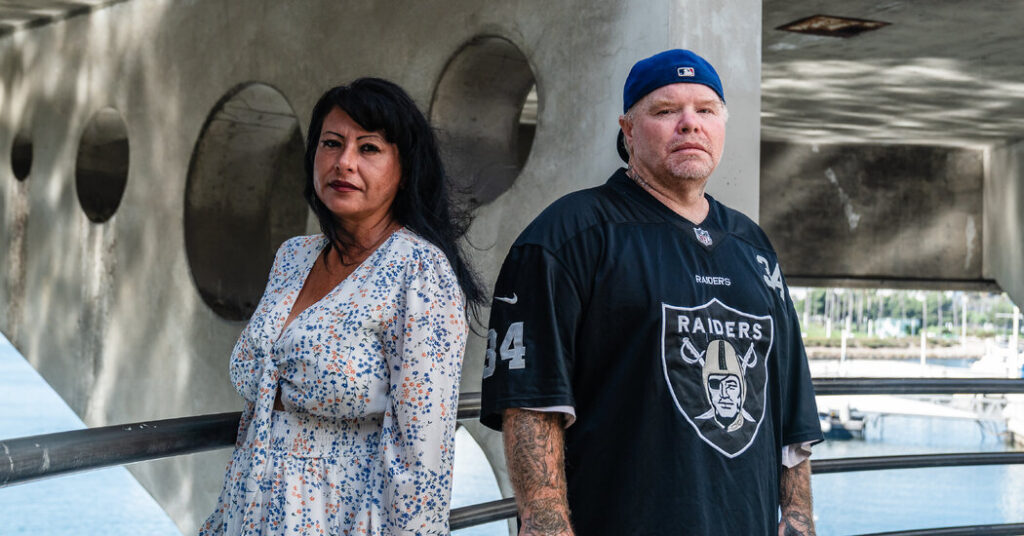
Ms. Dubray had known him for more than 20 years, and they were once roommates. Recently they had started living together again, sharing a house with another friend. Both worked at the Port of Los Angeles, where Mr. Carbullido was a forklift operator for a logistics company and Ms. Dubray tracked shipping containers.
After searching online, Ms. Dubray tried to book with Shoreline Jet Skis but was told there were no immediate openings. Within minutes, however, she received a call from an unknown number. It was a vendor named Airbnski with good news. It had a slot for 7 to 8 p.m.
Ms. Dubray and Mr. Carbullido paid for the rental, unaware of a state law that prohibits operating personal watercraft after sunset, which was expected that day at 7:38 p.m.
They arrived at the dock in Long Beach 15 minutes early. Mr. Carbullido wore a black long-sleeve T-shirt, oversized sweat shorts and sandals. Ms. Dubray had on a gray tank top and biker shorts.
Two men appeared and handed over a Yamaha WaveRunner VX Cruiser and a Sea-Doo GTI SE. The men were late and offered scant instructions, according to Ms. Dubray. There was no paperwork.
“The guy told us, ‘You have an hour on the sea, hurry up, go,’” she recalled. “He didn’t explain to us how to start it, how to operate it, what to do if we fell off, how far we can go out or anything.”
The hasty exchange gave the friends the sense that their outing would be easy.
At first Mr. Carbullido grinned while doing doughnuts near the Queen Mary, the retired ocean liner that draws tourists to the harbor. But when he streaked past the breakwater, he entered turbulent territory.
Hurled aside, he was unable to climb back onto his jet ski, and it drifted out of reach. Ms. Dubray tried to help, but then could not get her own jet ski to turn back on.
She grabbed her phone from the waterproof compartment and called the rental company, thinking it would offer a quick fix and get her moving again. A man said he would send assistance.
Mr. Carbullido then began to shout, and his head bobbed under the water. Alarmed, Ms. Dubray jumped in to swim toward him.
Her jet ski went the opposite way, along with her phone.
Swimming toward the light
As Ms. Dubray swam toward the light, her heart slammed inside her chest. She alternated between front crawl, backstroke, dog paddle, anything to get to that glimmer. She stopped when she heard strange noises. And when her limbs stiffened, she floated.
She pictured the daughter she had been unable to care for when she was in and out of jail and living on the streets. The two were finally bonding; there was much to live for now. She thought of Mr. Carbullido suffering alone and her promise to get help. She pushed herself for one hour, then another.
The light, she eventually realized, was from an oil rig. It guided her to the breakwater, where the waves slammed her into the rocks. Her bruised body shaking, she clawed her way up but slipped, and her foot became trapped.
Her cries were heard by someone aboard a 20-foot powerboat who called 911 around 10:30 p.m., according to the Long Beach Fire Department. Lifeguards with the agency responded and wrapped her in a blanket before putting her in a boat.
Ms. Dubray was frantic. “You’re going the wrong direction,” she said, crying. “My friend, we need to save him, he’s still in the water!”
She was taken to a hospital and treated for hypothermia. By then it was about 1:30 a.m., but she asked a friend to pick her up and take her back down to the beach to see if she might be able to assist the search.
The shore, however, was empty. Anxious, she went home and paced. The jet skis had been tracked down and impounded, but there was no trace of Mr. Carbullido.
When the sun announced a new day, Ms. Dubray had heard no updates. The local news provided a description of Mr. Carbullido that sounded foreboding — 280 pounds, red hair, a Lakers tattoo on his upper back — as if the details would be used to identify a body.
The authorities reached out to Ms. Dubray, wanting to see if she recognized photos of ships in the area. Because her cellphone was lost, communication had to go through her other roommate.
By 11 a.m., they had a missed call. It was the U.S. Coast Guard. Ms. Dubray called the number back and braced herself.
“We found him,” an officer said. “He’s alive.”
‘Fight, I got to fight.’
Mr. Carbullido had spent the last 15 hours fearing death.
After Ms. Dubray swam off, he eventually grasped his dire circumstances. The black sky, the sinister sea, the moon his only witness.
He called out for help, but his screams evaporated. Spotting a faint light, he dog-paddled toward it, but it seemed to get smaller and change directions. Waves slapped his face, filling his windpipe with brine. His life jacket barely kept his head up, while his sweat shorts weighed him down.
He recalled Ms. Dubray saying she would get help and wondered if it was better to stay where he was. The current pulled him where it wanted.
An hour passed, maybe two or three. He filled the void above him with noise, cursing himself out, shouting until his throat hurt. He wept.
“Fight, I got to fight,” he told himself. “I can do this.” He thought about his four children, his friends. But his mind also began to run wild.
Mysterious sounds, he feared, belonged to an encroaching predator. At one point something that felt mammal-like touched his leg. He tried to remain still. But his teeth were chattering, and a chill had crept into his bones. The only way to warm up was to kick into the abyss.
The night dragged on with waves sweeping incessantly over his head, his skin turning raw. Exhaustion took over, and he could feel his will crumbling. Drowning or starving seemed a maddening fate. Maybe, he thought, I should bite my arm, let the blood draw the sharks so this can be over.
Regrets of his life marched across his brain, particularly the 25 years he spent addicted to meth, during which he was convicted of attempted burglary and selling drugs. He went to prison more than once, disappointed family members time and again. The sobriety he had championed for the last 10 years was suddenly too brief. If only he had changed earlier, that the line of those he hurt wasn’t so long.
He begged for a sign of encouragement, anything to cling to. He prayed and promised to go to church.
At one point he thought he saw his father, whose death from cancer three years ago had been devastating. His deceased grandmother also appeared. Neither spoke, but their presence offered warmth.
“I don’t want to die this way,” he told himself. “But maybe it’s my time.”
Dawn arrived and offered what he saw as his final chance. Using his last surge of energy, he swam toward a caravan of cargo ships. He waved and shouted, pounded on the side of one — but the vessels rose impossibly high above him. No one onboard took notice. A rip current eventually pulled him away.
Dehydrated, he faded in and out of consciousness. His floating body appeared lifeless.
When he heard a familiar thrumming in the sky, it seemed a mirage. But then it lingered. Suddenly buoyed by hope and the prospect of relief, he mustered all of his strength to lift his head and raise an arm.
The rescue mission
Crew members aboard a U.S. Coast Guard helicopter, part of a multiagency rescue operation that worked through the night, located Mr. Carbullido about three miles out from a pier that is seven miles south of where he first boarded his jet ski.
When airlifted up, his swollen body was pale and bluish, his face sunburned.
His body temperature had dropped to around 85 degrees, but he had been aided by the unseasonably warm water and life jacket, said Sandy Needle, who helped manage the Coast Guard’s search and rescue mission. The agency looks at a variety of factors to determine the chance of one’s survival, including physiology, wind speed and air temperature, Mr. Needle said.
“What is not quantifiable is a person’s will to live,” he said.
David Bacon, a vessel captain licensed by the Coast Guard and a boating safety consultant, said that jet skis were not generally equipped with lights and not intended for nighttime use. The inexperienced, he noted, should stay close to shore, as the open water is rife with wind waves, swells and high-speed boating activity.
Mr. Bacon also pointed out that operators of jet skis must obtain a state boater card, which requires passing a safety exam. Renters, however, are exempt.
Michael Jiles, the owner of Shoreline Jet Skis, said he had passed Ms. Dubray’s number to Airbnski, which does not appear to have a website or storefront, nor a local business license. Ralph Manning, who had been Ms. Dubray’s point of contact with Airbnski, said he had sent people out to search for her. He did not call 911, he said, because it was not his responsibility. (As is generally the case, according to the Coast Guard, none of the parties involved have been held financially responsible for the search-and-rescue mission.)
Mr. Carbullido and Ms. Dubray are upset with the rental vendors, but they are also frustrated with themselves. It doesn’t help that people have made smug critiques on what the two should have known about an activity they had never previously experienced.
The days after their ordeal have been a confusing jumble of sleeplessness and nightmares coupled with gratitude and a respect for life.
They have tried to calm their emotions about the trauma with simple activities: watching movies, going to the park, visiting family. Mr. Carbullido took himself to church. Ms. Dubray focused on work.
Neither is sure about ever returning to the ocean.
The post ‘I Don’t Want to Die This Way’: Stranded for 15 Hours at Sea appeared first on New York Times.