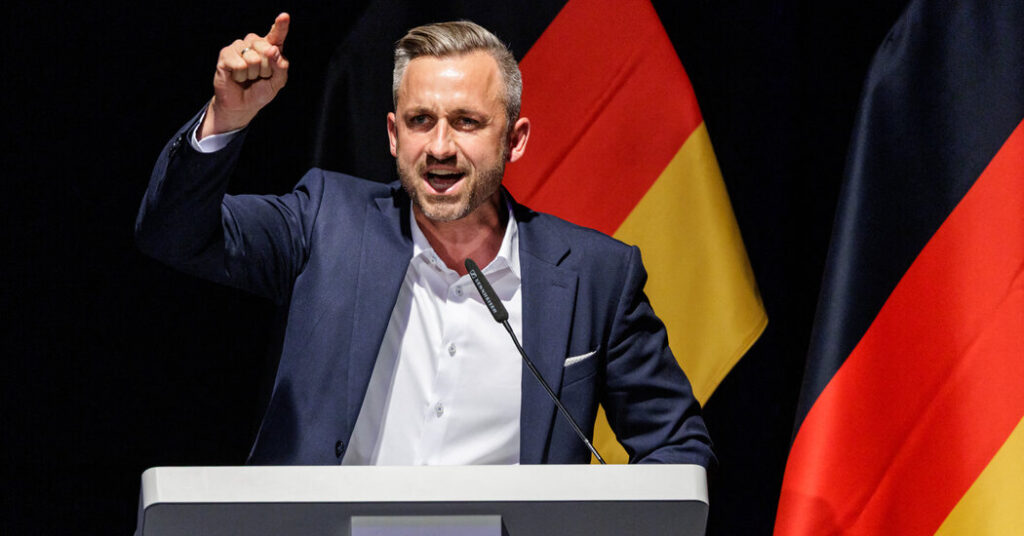
In a recent social-media video, the top far-right leader in the German state of Saxony-Anhalt rode a powder-blue moped down a sunny country lane. It was the sort of optimistic, genial clip that has helped that leader, Ulrich Siegmund, appeal to centrist voters and has made his party the strong favorite to win state elections on Sunday.
The head of the media company behind the post has a very different image.
The company, Filmkunstkollektiv, is led by a far-right activist with the Identitarians, a movement that Germany’s domestic intelligence agency has accused of extremism for promoting an ethnically homogenous state that excludes Germany’s minorities.
The production fits a pattern. Despite trying to project a softer image with such sunny social-media campaigns, Mr. Siegmund and the Saxony-Anhalt chapter of the Alternative for Germany party — a far-right party, widely known as the AfD, that has long been accused of extremism — are still privately working with people with links to the furthest extremes of German politics. Those include a campaign spokesman and party lawyer who were part of a youth group inspired by the Hitler Youth.
Mr. Siegmund did not respond to requests for comment. Speaking to other outlets, he has brushed off criticism of his close colleagues, saying in one interview that he didn’t care if someone visited a “summer camp” years ago, in a reference to the youth camps run by the Hitler-inspired group.
The nature of Mr. Siegmund’s relationships are increasingly important because they show who may have influence over him if AfD takes power in Saxony-Anhalt, a sparsely populated and relatively poor state in what was once East Germany. If the AfD wins a majority of seats in the election on Sunday, it would be the first time since the end of the Third Reich that a far-right party held such authority in a German state.
To win that election, Mr. Siegmund has carefully projected an image of friendliness and optimism, even when discussing the most contentious issues in his party platform, which includes banning gay pride flags in schools and deporting refugees.
His approach has helped popularize the AfD, even though German intelligence has labeled its local chapter in Saxony-Anhalt as “confirmed” extremist and the national party as “suspected” extremist. (The agency has accused the party of promulgating a “racist” idea of nationhood that contradicts the German Constitution, as well as hostility to foreigners and Muslims. The group denies it is extremist, saying such accusations are politically motivated.)
Mr. Siegmund’s tone has also helped to distinguish him from AfD leaders elsewhere in Germany, who have variously questioned the significance of the Holocaust, used Nazi slogans and maligned foreigners.
Yet Mr. Siegmund’s relationships with extremists reflect how his party retains many of its hard-line roots. And his high poll numbers suggest, researchers say, that extremist ties no longer weigh on some German voters as they used to. In Saxony-Anhalt, many residents say that the AfD could help alleviate unemployment, rising prices and the perception that their region has been ignored by the political establishment since the reunification of East and West Germany in 1990.
“In some parts of East Germany, right-wing extremism is the mainstream culture, and that is why there are no fears of being seen together in public,” said Johannes Hillje, who researches the far right and is a fellow at the Progressive Center, a left-leaning think tank in Berlin.
Until recently, the AfD rejected membership applications from people with previous ties to more extreme parties. While it still bars some neo-Nazis from membership, it began loosening those restrictions last year and removed more limits this summer.
In Saxony-Anhalt, Mr. Siegmund’s campaign team includes a spokesman and longtime confidant, Patrick Harr. He is one of the men who, roughly two decades ago, was part of the extremist youth group that was banned in 2009 because of its “inherent kinship with National Socialism, specifically with the former Hitler Youth,” according to the interior minister who oversaw the ban.
Mr. Harr oversaw procurement for the group, according to old party documents unearthed independently by German media outlets and extremism monitoring groups. Mr. Harr did not respond to a request for comment.
Laurens Nothdurft, a lawyer for the AfD’s local chapter, used to be one of that group’s leaders, according to domestic intelligence, as well as an activist in a second neo-Nazi party. In a written statement, Mr. Nothdurft did not defend his actions, but pointed out they occurred years ago. “Preserving and strengthening democracy is a cause close to my heart,” he wrote.
In 2017 Simon Kaupert, who runs the video production company, joined other Identitarians on a ship off the coast of Libya to stop migrants. Paul Klemm, another senior member of the production company, is also a senior reporter for Compact, an extreme-right news outlet that German intelligence said promoted a “racist and nationalist concept of society.” Neither man responded to requests for comment.
The AfD’s opponents, struggling to slow Mr. Siegmund’s rise, have sought to criticize him for these associations.
“The danger comes from who he surrounds himself with,” said Sven Schulze, the center-right incumbent state governor, during a recent debate. “I see who he surrounds himself with — these people are dangerous for Saxony-Anhalt and Germany,” he added.
The overt acceptance of such figures — including the Identitarians who made Mr. Siegmund’s campaign video — is a recent shift for the AfD.
Three years ago, an adviser to the AfD’s national leader was forced to resign after it emerged that he had met with the leader of the Identitarians. Mr. Siegmund was forced out of a key committee position at the statehouse, where he is a lawmaker, because he was also at that meeting.
Win or lose the election on Sunday, Mr. Hillje said, the AfD has to some extent already succeeded in normalizing such associations.
“One of their goals is that their narratives gets into the mainstream,” he said.
The post Germany’s Far Right, Edging Close to Power, Remains Close to Extremists appeared first on New York Times.