George Joseph came of age during the Great Depression, a calamity that left with him with a stated desire to always have plenty of work to do.
The billionaire insurance executive was busy enough during a career that lasted more than 70 years, highlighted by his founding of Mercury General Corp., which became one of California’s largest property and casualty carriers.
But the unyielding free market advocate likely became just as well known for his opposition to Proposition 103, the landmark 1988 insurance initiative that regulated the industry following a period of skyrocketing auto premiums.
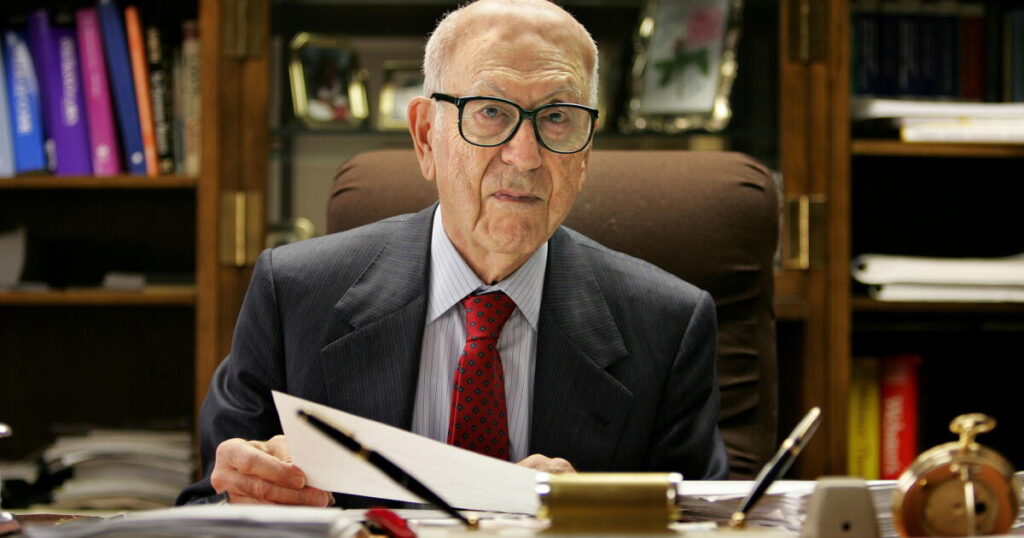
Joseph, a longtime Hancock Park resident, died Aug. 26 at the age of 104. He was still chairperson of Mercury General, which is publicly traded and operates in 11 states. Forbes estimated Joseph’s net worth at $2.6 billion.
“George Joseph was a lion of the industry,” said Brian Sullivan, executive editor of Risk Information. “He believed that good companies would make money. Bad companies would fail. And consumers would get fair prices from fierce competition.”
Details of Joseph’s death were not released. Company chief executive Gabriel Tirador was named to succeed him as chairperson.
He was born on Sept. 11, 1921 to Lebanese immigrant parents and raised in Beckley, W. Va., a coal town where his father worked as a storekeeper and miner. He volunteered for military service during World War II and, with an affinity for math, served as a navigator on a B-17 bomber that saw heavy action.
Joseph attended Harvard University on the GI bill and completed majors in math and physics in just three years. He got a job as an actuary working for a life insurer and later became a sales agent and broker.
In 1962, he started Mercury — named after the Roman god of speed and commerce — with $2 million in capital he raised, six employees and 90 agents. His business model was to offer coverage to all drivers, who would pay different rates based on their risk profile, an unusual idea at a time when insurers specialized in one end of the market or another.
“My thought was, there must be a proper rate for all these exposures — why not all in one company?” he explained to The Times in a 2006 profile. The company went public in 1985.
George settled on the use of ZIP codes as a primary predictor of risk, setting the stage for a series of battles with consumer advocates that began amid the rising premium rates in the 1980s and 1988’s passage of Proposition 103.
The ballot measure requires a motorist’s driving record, years behind the wheel and annual miles driven to be the primary factors in setting rates, relegating residency to a relatively minor role — which advocates said is only a matter of fairness.
The measure, which also established an elected insurance commissioner with the authority to review rates, passed with 51% of the vote. A competing industry measure supported by Joseph that would have established a no-fault auto insurance regime with limits on damage claims failed by a large margin.
In 2006, Joseph pursued ballot measures that would have amended Proposition 103 amid an effort by John Garamendi, the insurance commissioner at the time, to tighten the ZIP code regulations established by his predecessor.
However, Joseph withdrew the measures after the author of 103, attorney Harvey Rosenfield, threatened to put a counter measure on the ballot.
“He was committed to overturning Prop. 103 and never was able to do so. But he put more into it than any other insurance company,” said Rosenfield, founder of Los Angeles advocacy group Consumer Watchdog, the proposition’s leading defender.
Joseph’s free market approach inevitably was at odds with Rosenfield’s advocacy of a state-regulated industry, Sullivan said. “The two of them spent the better part of several decades sparring,” he said.
Joseph also was known as an executive who liked to get into the weeds.
In a 2010 interview with Times columnist Steve Lopez — when he was bankrolling yet another proposition that would have amended California’s insurance laws — his office was described as crammed full of knee-high stacks of documents he would check to prove his points.
“You can’t debate it in the newspaper,” Joseph was quoted as saying, acknowledging that insurance can be technical and complicated.
Joseph’s tenacity could come back to haunt his company, which clashed with California regulators over how it handled claims and other issues.
In 2019, Mercury ended a two-decade battle with the state about fees of up to $150 customers were charged from 1999 to 2004, on top of their premiums. The company maintained the fees were legal because they were charged by independent brokers, but regulators said the brokers operated as company agents and the fees amounted to premiums, with customers thinking the policies were cheaper than they actually were.
The $41.2-million settlement — the largest in state history with an insurer — came after the state Supreme Court declined to hear an appeal of a lower-court decision, which Mercury called “poorly reasoned.”
Joseph had stepped down as the company’s chief executive in 2006 but maintained involvement in Mercury for two more decades as chairman.
“At 85, I thought it was time for a younger person to take the baton,” Joseph dryly told The Times regarding his departure.
He is survived by his wife, five children and 10 grandchildren. His son, Victor Joseph, is Mercury’s president and chief operating officer.
The post George Joseph, pioneering Mercury General founder, dies at 104 appeared first on Los Angeles Times.