Soaring out of “Burgundy” on a champagne high — even if crémant would be more regionally apropos, I suppose — a French festival director turned to me, laughing: “How did two New Yorkers understand us so well?”
He wasn’t just talking about nationality. That “us” was narrower and, at the same time, far more inclusive — encompassing everyone who spends an unreasonable amount of time thinking about the grape. That includes him, me and surely the filmmakers themselves. Consider this a heads-up to fellow oenophiles: in “Burgundy,” you will feel seen.
Unlike New Yorkers Michael Dweck and Gregory Kershaw (“The Truffle Hunters”), however, the subjects of this playful and oddly profound doc contend with a far more conservative AOC — the Appellation d’Origine Contrôlée, the rigid wine certification system that structures and regulates French viticulture along deeply parochial lines. In “Burgundy” and in Burgundy, conformity is the price of success.
Even then, advancement is no guarantee. But let’s not get ahead of ourselves — the filmmakers don’t serve the bitter before the sweet. Instead, they lean into the same fantasy common across labels the world over: the estate as a land of pastoral luxury meant to bottle pleasure. “Everything that follows is true,” reads a winking opening title. “Exactly as we dreamed it.”
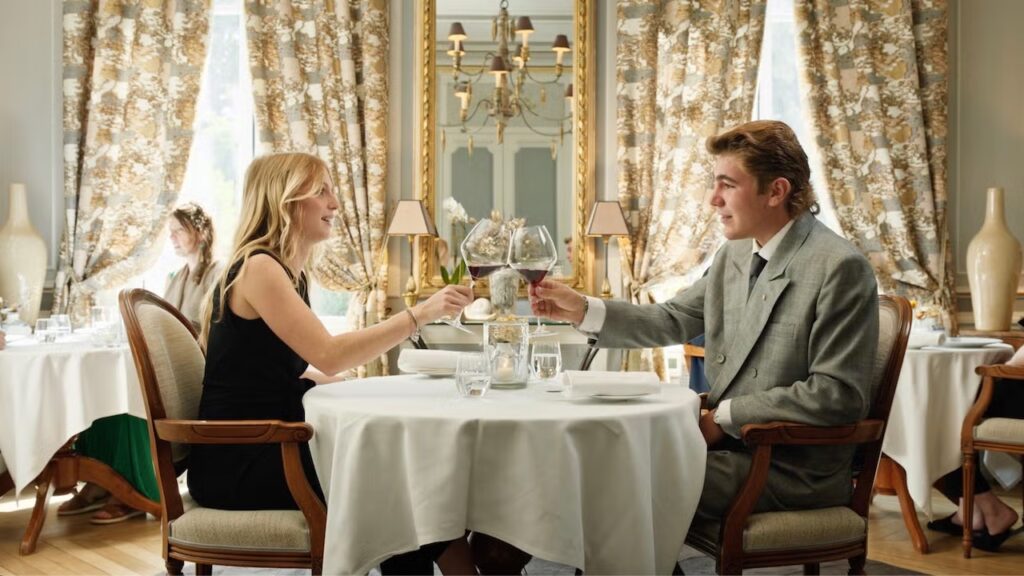
That dream extends well beyond the vines, giving local merchants, maître d’s, scions and sommeliers the chance to play heightened versions of themselves in exactingly lit and composed frames pitched more Roy Andersson than Wes. Here, the filmmakers push further into fantastical affect than in previous work, especially in a number of 8mm interludes following a pair of young lovers with decidedly retro stylistic and entertainment choices — even if that throwback aesthetic echoes the arrested mentality of an Old World region where the 1960s still feel shockingly modern.
That change arrives at a snail’s pace, which should come as little surprise in a region that fetishizes the escargot and that hews to the old conservative dictum to stand athwart time yelling stop. Human lives, however, aren’t afforded such luxury, making the act of transmission all the more essential. We see as much in one narrative strand, as a retiring maître d’ trains his final apprentice; and in another, as a sommelier confronts the limits of his own human touch, trying — and failing — to do the same.
The mentor succeeds thanks to a simple realization: whether he’s a maître d’ relaying that night’s menu to a hungry table or a teacher passing down his craft, his role as a conduit is the same. Thrillingly, the filmmakers understand that great wine serves much the same purpose. For a newly divorced professional taster, it becomes a means of understanding his own wants and desires as he rebuilds his life in middle age. “When you drink your birth year, you drink your whole life,” he says on a date. (That we later see him dropping different bon mots with another woman might suggest that particular pairing didn’t quite match.)
For a young fieldworker, wine becomes a means of understanding the world. In a film full of baroque, colorful compositions, one relatively understated image lingers longest: the young worker idling against a wall beside a friend, taking in the literal fruits of their labor. They swirl and sniff, then share the tastes that emerge — among them the very wildflowers that bracket the two in the frame. Through time, toil and ache, these hired hands have become alchemists, coaxing the landscape into the glass. What’s not to love?
Turns out, quite a bit! Without ever losing its storybook style, “Burgundy” grows sharper once that young worker steps into the fore. He goes by Enzo, speaks with an accent that locates him somewhere more rural and less affluent, and styles himself with an Elvis Presley pompadour and the affect of a young Jean Gabin. “I started to get old very young,” he says, partly to flirt with girls his own age, but mostly to project — in a hilariously adolescent fashion — a sense of gravitas to the old-world, old-money patriarchs who hold the keys to his future.
And it works, up to a point, landing Enzo in front of landed gent Bertrand, who offers the boy an education only money can buy. Grand Crus are a luxury product, of course, and as with all such items, their value derives from, shall we say, more intangible factors. Marrying young might prove Enzo’s seriousness to Beaune’s patriarchs, but seriousness doesn’t buy an aristocratic title or bank account — and without either, his own domain is almost certainly beyond reach.
With little overstatement, “Burgundy” relays a nuanced political bent by guiding us through a cloistered demimonde that runs counter, in every conceivable way, to the more cosmopolitan connotations of AOC. Lily-white and practically feudal, this depiction of Burgundy is the land most trads dream of; it also produces the bottles that take pride of place in progressives’ home cellars, earning such high prices through the promise of unbroken tradition. What at first seems like a hazy snow-globe might come into sharper focus as a world of glass ceilings, kept in place as an ornament for the global market.
Dweck and Kershaw never lose their sense of whimsy, often relaying the film’s sharper jabs with the most pleasure of all. I could not in good conscience spoil the film’s most hilarious sequence other than to say that over the course of three edits featuring three rather different activities, the filmmakers had the American to my right in stitches and the Frenchman to my left murmuring to himself in doleful recognition: “Burgundy eats its young.” Wine is a conduit. Why shouldn’t it evoke every emotion and contradiction?
The post ‘Burgundy’ Review: Complex Doc on French Wine Region Leaves a Champagne High appeared first on TheWrap.