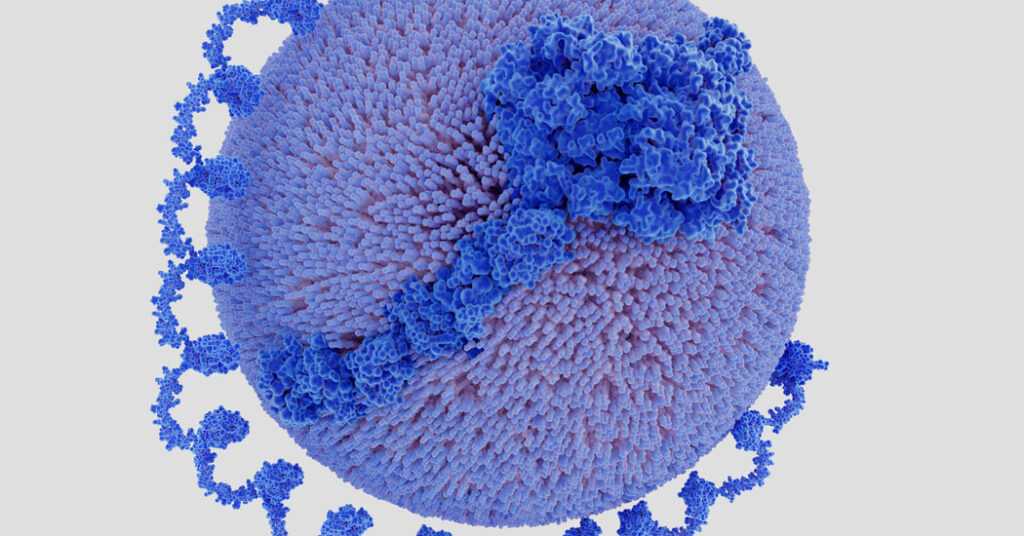
Novartis announced on Friday that its experimental drug, pelacarsen, widely assumed to be the vanguard of a new era in preventing heart attacks, strokes and cardiovascular deaths, had failed.
The announcement gave no further details, but it came as a shock to the field of cardiology.
“Oh no — oh no,” said Dr. David Maron, president of the American College for Preventive Cardiology. “This is a huge blow. I hardly know what to say.”
Dr. Harlan Krumholz, a Yale cardiologist, exclaimed: “This is extremely disappointing news. We’ve all been looking forward to celebrating.”
The drug blocks a protein called lipoprotein (a) that is a powerful risk factor for heart disease. Every study short of a randomized clinical trial indicated that lowering Lp(a) would protect people from developing the disease.
Cardiologists widely expected that Lp(a) drugs would be the missing link in attempts to prevent heart attacks that can occur in people who do everything right — keep their cholesterol levels and blood pressure down, don’t smoke, exercise and do not have obesity. Doctors held high hopes that the drugs could be as important as statins.
“How much money has Novartis spent in the last two years promoting Lp(a) every which way?” Dr. Krumholz said after expressing his complete disbelief.
Amgen and Eli Lilly have been pursuing similar drugs and conducting large clinical trials, raising questions about the entire enterprise.
The Novartis study lasted seven years and involved 8,323 people who had high Lp(a) levels and pre-existing heart disease. They injected the drug or a placebo once a month with a pre-filled syringe, much as obesity drugs are administered.
One in five people have elevated Lp(a) levels. Worldwide, 1.4 billion to two billion people are affected.
The highest levels of Lp(a) — above 250 nanograms per deciliter of blood, found in 10 percent of the global population — are associated with a doubling of a person’s risk of a heart attack or stroke. Even levels slightly higher than normal have an effect, increasing risk by 25 percent.
Yet unlike cholesterol, whose levels are affected by diet and obesity, there is no diet or lifestyle change that can affect Lp(a). It is determined by genes, and it does not fluctuate throughout life.
In an earlier study, the Novartis drug reduced Lp(a) levels by 80 percent, making it seem a foregone conclusion that it would prevent heart attacks and strokes.
For the clinical trial, Novartis simply reported the failure, complying with federal regulations requiring it to reveal results that could affect stock prices. The complete data set will be presented in November at the annual meeting of the American Heart Association, concurrently with a paper that will be published in a leading medical journal.
There’s a sobering lesson here, Dr. Krumholz said. All the studies finding strong evidence of an association are not proof of a cause and effect. It is always possible that what looks like a cause of heart disease is instead a marker, just as wrinkles are a marker of aging.
Cardiologists have seen this sort of failure before: In April, they were shocked when a drug that reduces inflammation failed to protect against heart disease.
For years, cardiologists also thought that raising levels of HDL, the so-called good cholesterol, would protect people from heart disease. There was a promising drug, torcetrapib, that stunned people when it failed in a large clinical trial. (It actually increased risks.) High HDL levels were a marker, not a cause, of reduced risk.
The C.E.O. of Pfizer, Dr. Krumholz said, “thought the whole future of his company would be built on this drug.”
Two days before discovering the failure Pfizer had told the Food and Drug Administration it would be applying to market the drug.
But there still may be hope for the Lp(a) hypothesis. Maybe the other large clinical trials by Amgen and Lilly will find a benefit to lowering Lp(a).
But, Dr. Krumholz added, “This leads you to question whether this is a fruitful area to continue on.”
The post Another Heart Drug Fails, Shocking Cardiologists appeared first on New York Times.