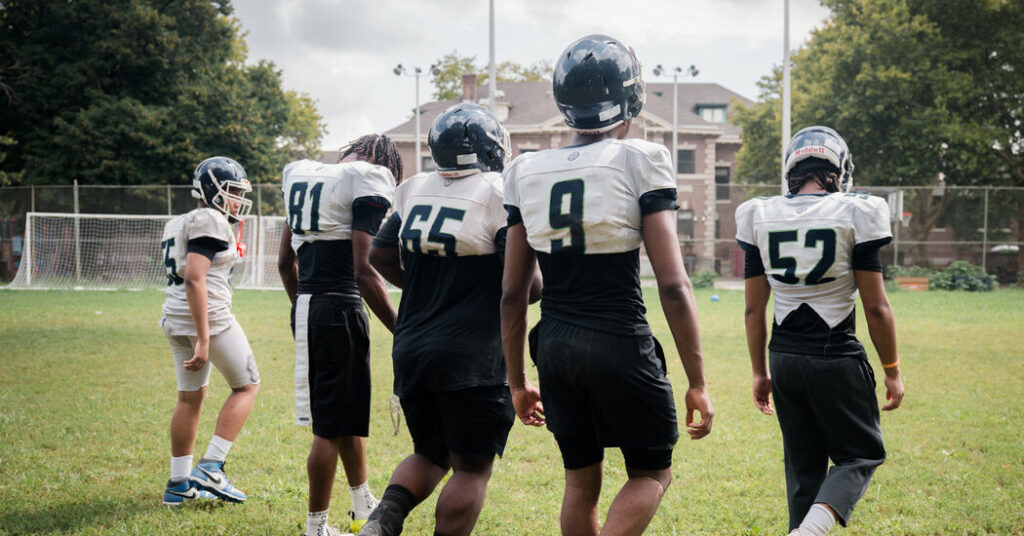
As head football coach at Martin Luther King High School in Philadelphia, Jordan Alexander faces dual challenges as the team begins its fall season.
His players are looking for a turnaround, after losing nine of their 10 games in 2025.
But Coach Alexander says most of the 60-man team has also experienced a loss at home, or a friend shot, or a parent sent to prison. He regularly takes phone calls from players dealing with housing instability or brushes with the law.
So this year, he’s hoping to tackle both challenges. He is among dozens of Philly-area football leaders who have been trained on trauma-informed coaching methods that teach players to pause before their emotions spiral into disorder or, in the worst case, violence. The coaches, some of whom are also educators, receive a stipend and a continuing education credit in exchange for taking 30 hours of cognitive science coursework.
Coach Alexander hopes that it will help his players improve not only their game, but also their lives.
Football remains the most played sport by American teenage boys. But in recent years, it has drawn more attention for its potential to provoke trauma than to address it. As legal battles continue over traumatic brain injuries in the N.F.L., new research has found that they are significantly more common than previously known. A recent study, which analyzed the cases of hundreds of former professional players, found that roughly one in four players had chronic traumatic encephalopathy. Some studies have shown that people who play heavy contact sports in their youth are more likely to commit violence later on.
Valencia Peterson, known as Coach V by the teams she works with, is a longtime Philadelphian and football lover who saw an opportunity to change the sport and save lives. Her father killed her mother when she was a child, which led her to later form Open Door Abuse Awareness Prevention, the organization leading the training program for coaches.
Five years ago, Coach V became certified as a trauma-competent professional. She designed her football program based on coursework from multiple experts and organizations that teach about trauma and emotional regulation.
“I put it in what I would call ‘layman terms for the hood,’” she said. She has trained 30 coaches through the program and has 15 more signed up for this fall.
Some Philadelphia youth coaches say they’re unlearning bad habits gleaned from leaders who yelled at or antagonized players to get them to perform.
At Cheltenham High School, about 40 minutes north of Philadelphia, four former coaches are facing criminal charges for not acting after learning about a pair of alleged locker-room assaults on a player.
Megan Bartlett, founder of the Center for Healing and Justice Through Sport in Illinois, described football as “ground zero for some of what’s wrong in sport coaching” because of its “inherent orientation towards violence.”
She has seen youth violence prevention programs in other sports, but she believes Coach V’s is one of the few that are focused on changing football culture.
“There are some things you have to rectify in football that you don’t have to address in cross country,” Ms. Bartlett said. “Convincing football coaches that this is necessary is harder work than it is in some other sports.”
Acknowledging emotions, teaching control
Some of the changes Coach V and her trainees hope to achieve on Philly’s high school football fields have already begun at the national level. Trauma awareness is popping up in professional football discussions, sometimes couched in terms like “mental toughness” or “mental performance.”
In March, the N.F.L. began requiring every team to hire a full-time mental health clinician, a step up from its 2019 mandate for part-time mental health staff members.
But Wade Gilbert, a professor at Fresno State and a former Olympic-level mental performance coach, said the model is more difficult to pull off in the high school and youth world, where many coaches are also educators making substantial sacrifices to keep teams afloat.
Coach V said that’s a big part of why she’s trying to support coaches, especially the ones in Philadelphia’s roughest neighborhoods, who deal with problems way bigger than football plays.
Her program echoes efforts like the Becoming a Man program in Chicago, which teaches young people impulse control and “positive anger expression.” It reduced violent crime arrests among participants by about 50 percent and increased graduation rates by nearly 20 percent, according to an independent study from the University of Chicago Crime Lab.
Though Becoming a Man isn’t a football program, Jens Ludwig, a lead researcher on that study, said sports create a perfect environment for putting youth in situations that “feel high stakes.” With the right training, coaches can turn arguments that erupt on the field into teaching moments, he said. The hope is that players use the same stop-and-think strategies on the streets.
“They’re giving you practice at navigating those difficult moments and giving you feedback where there’s no real risk,” Dr. Ludwig said.
In Philadelphia, arguments were the motive for about half of shootings, according to a 2022 analysis from multiple city agencies.
This is why at Vaux Big Picture High School in North Philly, Coach Jordan Holbert is more set on getting his players to graduation with decent grades than he is on getting them to the pros.
In 2024, one of Coach Holbert’s players was shot and killed while riding his bike. Since then, another player has been shot in the leg. And at one practice, Coach Holbert had to confront and calm a young person who showed up at the field with a firearm.
This year, a mother was shot dead at the corner store where the guys like to stop before and after practice.
Coach Holbert took Coach V’s course to learn how to respond to this kind of situation, and take care of himself in the process.
At a recent practice, his players sat down at desks and placed their helmets neatly next to their notebooks. Coach Holbert passed out a handwritten list of emotions and told the players to circle those that resonated with them most. “If you can identify your emotions, experience your emotions, then move with logic, then you are better than everyone else,” he said.
He hopes that players learn to get ahead of their feelings and express them calmly, instead of bottling them up and letting them explode at a later time. Coach Holbert’s players agree that managing their emotions keeps them safe. They also think it improves their game.
“Outside of football, if you is involving yourself in violence, if you got the wrong mind-set and you outside,” said Semaj Pridgen, a 17-year-old Vaux wide receiver, “it’s gonna get to you once you on the field.”
Jadon Bracy, an 18-year-old lineman and edge rusher starting his senior year at Vaux, said he used to be a hothead. But working with Coach Holbert helped him better manage his emotions.
“Me using anger as my motivation, it was a lot of mistakes,” he said. “You take out the anger on yourself, or maybe take it on your teammates, and it really messes up the dynamic, messes up the teamwork.”
As they bounce back from a challenging season, the players at Martin Luther King High School have embraced that approach as well. “Last year, people had been caught up in their emotions, attitudes,” said Lacey Johnson, a 17-year-old wide receiver at M.L.K. “They were crashin’ out.”
Lacey’s mother died of an overdose last winter. He said he leaned on the weight room as a way to stay grounded.
“If you play from anger, you’ll mess up,” Lacey said. “It’s about disciplining yourself. If you control your emotions the right way, you can use it at the right moment.”
Can trauma-informed football win?
“When I first started coaching, I coached like people coached me,” Coach Alexander said. “Cursing kids out, yelling and screaming at kids, just not being supportive and understanding.”
Now Coach Alexander, who is also a dean of students and a father of three, shows up to practice ready to listen. He sits down with players who seem on edge or withdrawn and asks them what they need. He gives them breaks and tries to get them to refocus.
During Coach V’s course, coaches study psychological concepts such as secondary traumatic stress and acute versus chronic trauma exposure. Since taking it, Coach Alexander has started asking players: red or blue?
“The red brain is you’re in a very, very bad situation, you’re very upset, and now all of your decisions are being done through anger,” he said. “The blue brain means you’re calm, you’re collected, you can think.”
Mikaal Alexander, unrelated to the coach, is a 16-year-old M.L.K. offensive lineman. He lost a close friend to gun violence last year, and he has been around multiple other shootings.
He said his coaches always checked in on him and his teammates. “They say boys not supposed to cry,” Mikaal said. “If you got a mental problem, cry a little bit. It won’t hurt to shed a few tears.”
Coach V wants to expand her program as funding allows. She’s about to start applying it to boxing. But she doesn’t want to lose the tailored attention for coaches that’s at the model’s core.
“We do life with the people that we work with,” she said. “I’m bringing something I believe in to my little corner of the world.”
This article was published as part of a collaboration between The New York Times’s Headway Initiative and Chalkbeat Philadelphia, focused on gun violence in Philadelphia. This reporting is supported by the Stavros Niarchos Foundation, with the Local Media Foundation serving as a fiscal sponsor. Funders have no control over the selection, focus of stories or the editing process and do not review stories before publication. The Times retains full editorial control of the Headway initiative.
The post To Change Football Culture, High School Coaches Tackle Emotions appeared first on New York Times.