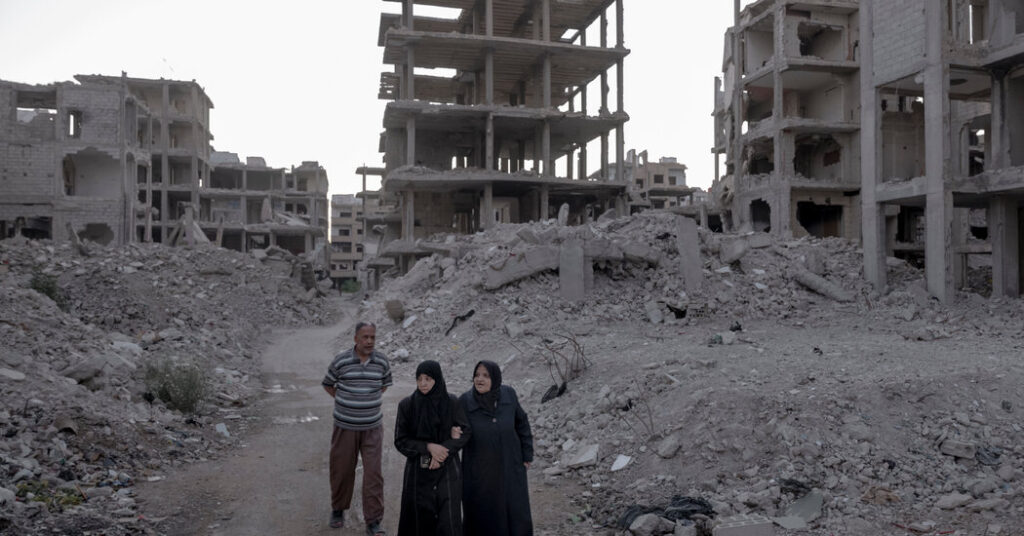
Children in dusty clothes played in the rubble in Damascus’s Tadamon neighborhood, the site of repeated massacres, searching for human remains as if they were scouting for seashells on a sandy shore.
“This is a rib bone,” declared an eager young boy in sandals, holding it aloft. Another child pulled at what appeared to be a femur with his right hand while holding another bone in his left.
When more than five decades of the Assad family dictatorship ended in 2024, Syrians who had been victims of the regime’s crimes — especially during the nearly 14-year civil war — wanted swift accountability. Many expected the new government to collect and use the evidence of mass killings in places like Tadamon in prosecutions.
But the rebels who overthrew President Bashar al-Assad and took power have sought to balance justice against peace, fearing that trying to hold everyone involved in war crimes to account would provoke more civil strife.
One of the first moves by the new president, Ahmed al-Sharaa, was to announce an amnesty for rank-and-file soldiers from the Assad era, while still vowing to go after those with “blood on their hands” — as in those directly involved in atrocities. The measure aimed to restore calm to the country. But it angered many who said they would never forgive.
Last year, the government set up an independent body, the National Commission for Transitional Justice, to oversee the transitional justice process.
The biggest challenge “is balancing between law and accountability, and civil peace and national reconciliation,” said Abdul Basit Abdul Latif, the commission’s head. “If you say in Syria, ‘I’m going to prosecute a million people’ you are saying, ‘Let’s have another civil war.’”
For many crimes committed during the civil war, the Syrian authorities will need to offer amnesties and reconciliation, said Mr. Abdul Latif and others involved in the process. Prosecutions should focus on the most grievous abuses, such as the former regime’s use of chemical weapons, the torture and executions rife in its prisons, and massacres, he said.
At least 580,000 people were killed during the war, according to the United Nations, which has cautioned that the figure is incomplete because tracking casualties during the conflict was difficult. When the Assad government fell, more than 24,000 prisoners were freed — far fewer than many expected, suggesting that many of Syria’s 140,000 missing people may have been killed in the regime’s prisons or elsewhere.
Prosecutions, Mr. Abdul Latif predicted, would give Syrians a sense of relief. But he said, “If there isn’t justice and accountability and the big criminals aren’t put on trial and prosecuted for the massacres they committed, we will continue to swirl in a vortex of revenge.”
The approach he advocates — one that would involve prosecutions, but also reconciliation and reparation efforts — would entail a long, complex process, and many Syrians have already begun to question how committed the government is to justice.
Increasingly in recent months, some Syrians have sought revenge against those they accuse of being collaborators or criminals associated with the deposed regime. Lynchings, beatings and vandalism have been on the rise. The names of alleged shabiha — regime thugs and gunmen — have appeared scrawled on Damascus walls, and leaflets distributed around the country have threatened regime informants and others implicated in its abuses.
The official effort to see justice done took a step forward last month, when a Syrian court convicted Mr. al-Assad and eight others on charges of murder, torture and crimes against humanity, and sentenced them all to death. Only one of them, Atef Najib, Mr. al-Assad’s cousin, is in Syrian custody. Mr. al-Assad himself is in exile in Russia.
The verdicts, which were the first in Syria related to the wartime period, were met with celebrations in the courthouse and in streets across the country.
Human rights experts raised questions about whether the proceedings were fair and transparent.
As the former head of the Political Security Branch in the southern province of Daraa, Mr. Najib was charged with overseeing the arrest and torture of schoolchildren for scrawling political graffiti, and with the use of brutal force against protesters. When he was brought into the courtroom, dressed in striped prison garb and placed in a large cage, the families of victims and others shouted mockingly at him. Chants broke out, warning that “Assad’s dogs” should be afraid.
“It’s exhibitionist justice more than transitional justice,” Anwar Bunni, a Syrian lawyer and founder of the Syrian Center for Legal Studies and Research, said at the time.
Beyond the spectacle, human rights experts also questioned whether the government was prepared to hold its first trial. Syria is still building a new legal system and in the process of establishing forensic teams, training judges and enacting laws covering crimes committed during the war.
“They want to show that they have started, and they don’t have the ability to start,” Mr. Bunni said.
The court that convicted those first nine defendants, and that is now trying others, has invoked international law as the basis for the proceedings, said Hiba Zayadin, a senior researcher for Human Rights Watch investigating human rights abuses in Syria. However, properly applying international law is not easy and puts a heavy burden on the judges, she said.
“There’s a genuine tension here,” Ms. Zayadin said. “Suspects can’t sit in detention indefinitely without trial, and there’s a real concern that without accountability, communities will seek justice outside the courts.”
“But transitional justice processes that work take years to build properly,” she added.
Firja Tu’ma al-Ali, 70, is among those eager for the closure that justice could bring. She believes the remains of her son, Omar Ahmed Hassan, are somewhere among the piles of bones in Tadamon or buried underground in one of several suspected massacre pits.
Her son disappeared in 2013 when he went to pick up his daughter from school. He never got there, she recounted. As she told her story, she paused often, weeping quietly.
While the government in April arrested a former regime intelligence officer named Amjad Youssef, a central figure accused of involvement in a notorious massacre in Tadamon of more than 40 people, Ms. al-Ali was not satisfied.
“What about the other criminals?” she recently asked. For many families, incomplete justice will never assuage their grievances.
One of the biggest challenges facing the country’s leaders will be convincing victims and their families to accept alternatives to criminal prosecutions, said Zahra al-Barazi, the deputy chair of the National Commission for Transitional Justice and an adviser in Syria’s foreign ministry. That could involve an approach like South Africa’s Truth and Reconciliation Commission, established after Apartheid, or compensation for suffering.
“We can’t imprison half a million Syrians. That doesn’t lead to Syrians being able to live together,” she said.
For some Syrians, the tension between justice and reconciliation is embodied in the case of Fadi Saqr, who once led the National Defense Forces, a pro-Assad paramilitary force, in Damascus. He has been accused by some Syrians of being involved in the force’s massacre of civilians in Tadamon.
Mr. Saqr has denied responsibility and said he was appointed to lead the militia after the massacre.
Mr. Saqr has worked with the Committee for Civil Peace, a governmental body that aims at easing Syria’s internal divisions and fostering transitional justice. The government hoped Mr. Saqr, a member of the Alawite minority that the Assad family belongs to and favored over its decades in power, could help reconciliation efforts between different minority groups. But his participation has provoked a maelstrom among some Syrians.
When he visited Tadamon last year, accompanied by security officials from the new government, Ms. al-Ali and other residents protested, saying he should be in prison facing trial. “I want his head. I want to see his blood,” she said at the time, according to a video posted online.
More than a year after his visit, a government civil defense team finally arrived in the neighborhood to collect bones and dig up one mass grave, gathering potential evidence for prosecutions. Residents say they believe many more bodies are still buried there.
Neighborhood children continue to unearth more remains — residents say no one from the government has returned to retrieve them.
The large hole left by the unearthing of the grave now lingers like a gaping open wound.
Muhammad Haj Kadour and Reham Mourshed contributed reporting.
The post Syrians Demand Justice for Assad-Era Abuses. Some Are Growing Impatient. appeared first on New York Times.