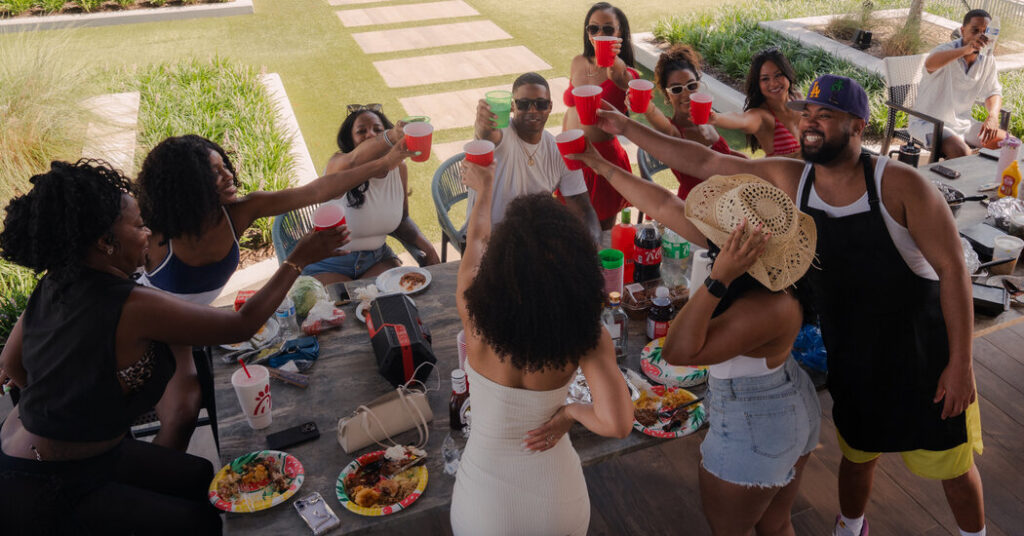
For generations of Black families, summer has had a familiar soundtrack: the sizzle of meat hitting a hot grill, the slap of dominoes on a folding table, the sound of children playing while music booms from a speaker.
The spread often stretches beyond burgers and hot dogs to grilled meats and seafood, macaroni and cheese, homemade banana pudding, and, of course, potato salad. There are unwritten rules about who can grill or prepare the food — a job usually reserved for one or two trusted relatives whose recipes have earned the privilege. Somehow, there is always more than enough food to go around, even for those who weren’t technically invited.
The ritual is so deeply ingrained in Black culture in the United States that it has been immortalized in popular movies, television and music. These gatherings are central to Black celebrations like family reunions, graduations and church events. They are also events where Black people can simply show up without having to code-switch, change how they speak, dress or behave to fit in, or manage racial microaggressions. It’s where Black people can build community and celebrate milestones on their own terms.
“Being with our own community in an informal setting is almost like a release,” said Adrian Miller, author of “Black Smoke: African Americans and the United States of Barbecue.” “It’s like our country club.”
For the new grilling guard picking up the mantle, the cookout as they once knew it may look a little different today: communal spaces instead of backyards and friends and strangers filling in for extended family. However they come together, a new generation is finding creative ways to preserve the joy and sense of belonging that have long made the cookout a distinct part of the Black experience.
After her father gave her his old grill, Krystal Turner, a 32-year-old insurance adjuster in Dallas, decided to renovate her backyard with an eye to hosting her first cookout as an adult. She had noticed that cookout invitations were declining among her peers and wanted to preserve the family traditions she learned growing up.
Money, among other things, was a concern, but she put her work bonus toward the event to help with the cost.
“I think it boils down to maybe we’ve lost the aspect of service,” Turner said, “like the aspect of giving without receiving, or the aspect of going out of your way or being inconvenienced because it is a lot of work.”
On the day of her cookout, her dad helped her on the grill (“I’m still not there yet,” Turner said), serving up chicken, hamburgers, brisket, sausages and a plethora of sides, including deviled eggs, corn on the cob and baked beans.
Earlier this summer, Julian Partridge, a 36-year-old investment firm associate living in Houston, manned the grill at his friend’s barbecue in her apartment’s common area.
“I grew up grilling,” said Partridge, who is originally from Chattanooga, Tenn., and learned how to grill from his father. “The way we grew up, we would have cookouts — we wouldn’t wait for holidays or birthdays. If it was a nice day coming up on a Saturday or Sunday, my parents were hosting.”
The Cookout Goes Mainstream
In the 1993 film “Poetic Justice,” a group of young Black people on a road trip to Oakland, Calif., spot a Black family reunion cookout and decide to crash the festivities despite knowing no one there. Lucky, played by the rapper Tupac Shakur, justifies their intrusion: “We Black. We all family. Especially when it comes to barbecue.”
Cookout representation can be found across Black culture. Songs like “This Is How We Do It” by Montell Jordan and “Before I Let Go” by Frankie Beverly & Maze have become synonymous with these gatherings. The event is so prominent that there’s a 2004 movie named after it.
And memes about remembering to pack your to-go plate or how the party typically starts hours after it was originally meant to are no stranger to the repost button online. Showing up to any other event might mean that you’ll get first dibs on food or parking, but at a Black cookout, it might also mean you’re part of the setup crew.
Tamara Jade, a 36-year-old singer and actress, is a first-generation American whose parents are from the Caribbean. She grew up in Bowie, Md., where she would attend cookouts in her community and guests would incorporate other dishes from across the African diaspora.
“Oftentimes they would want my family to bring rice and peas or some type of dish that is a Caribbean contribution that they all loved,” said Jade, who now lives in nearby Laurel, Md., adding that there were always “secret foods” like fried fish or ribs that were only for the adults.
The communal tradition has deep roots, dating back thousands of years to Indigenous communities that cooked meats and vegetables over a fire, with enslaved Africans later becoming early innovators of what we would now recognize as barbecue. The modern cookout emerged in the 20th century, as the Great Migration brought millions of Black Americans to urban cities, according to Miller.
“African Americans did not have a lot of space in their homes,” Miller said, noting that some people lived in homes without kitchens. Outdoor gatherings offered space to cook and build community.
But not everyone is invited. At a Black cookout, especially for someone outside the family or community, an invitation is a sign of trust. Even invited guests may ask: “Who all gonna be there?” — a half-joking way of vetting the guest list.
That exclusivity created the internet idiom “invited to the cookout,” a playful stamp of approval for non-Black celebrities, politicians and prominent figures that have earned the right to attend. It’s such a recognized badge of honor that the idea even surfaced in the finale of Marvel’s “The Falcon and the Winter Soldier,” when fans celebrated Bucky Barnes’s attendance at Sam Wilson’s family cookout in Louisiana.
But beyond the humor, Black gatherings have long faced scrutiny and disruption from outsiders. In 2018, a white woman, mockingly nicknamed “BBQ Becky,” called the police on Black people grilling in a public park in Oakland, Calif. A few weeks later, in an act of resistance, hundreds returned to the same area for an even larger celebration.
Because of incidents like this, some Black people aren’t as open to outsiders.
“For me and my house, all cookout invitations are on hold until further review,” Jade said of inviting new non-Black guests. “We can do other things together,” she added. “We can actually go do activism together.”
A New Generation Keeps the Charcoal Glowing
Replicating childhood cookouts can be harder when families are scattered, space is limited and gatherings require more planning. But Rashad Frazier, author of “Cook Out: Recipes and Tips for the Great Outdoors,” said keeping the tradition alive simply required intention and flexibility.
“The cookout was cool because it was egalitarian: You just ate what was there, you didn’t become the bougie-palate guy,” said Frazier, who grew up in Charlotte, N.C.
Priya Parker, author of “The Art of Gathering: How We Meet and Why It Matters,” said impromptu barbecues had become less common for some in part because of inequalities in income and time, more options for socializing and a growing acceptance of canceling plans.
“To be able to say, ‘Hey, come over,’ and have people actually arrive is really important for civic health,” Parker said. “Repeated rituals allow people to know when and how to show up.”
Black entrepreneurs are stepping in to fill a void and help build communities around the cookout.
Alexis Toney, the 35-year-old founder of Brown Sugar Bounce, a New York City party series, started hosting a family-reunion-themed summer event in May 2021. After the isolation of the pandemic, Toney missed her family and wanted to “recreate the feeling” of the large cookouts she grew up attending in her hometown, Chattanooga.
The event has some elements of a traditional cookout: card games with cash pots, D.J.s, dancing and no V.I.P. sections. Tickets are typically around $10 per person, with food vendors selling barbecue and other Black Southern staples.
“The way I like to describe it is, This is the part of the night where Granny and Granddaddy gone home and all the cousins are parlaying,” she said.
Social media has also become another way that some are building their communities. In April, Kendrick Best shared an open invitation to a free cookout on Threads and welcomed friends, family and online strangers to his apartment’s common area in Charlotte.
“Basically, anybody that followed me from Threads or IG, you could just pull up,” Best, 32, said. He served hot dogs and burgers to the two dozen or so people who showed up.
Nikki Jenkins, a 37-year-old marketing professional in Baltimore, and her husband recently hosted a cookout with around 40 of her family and friends that was put together almost entirely with Black-owned businesses, from the cookware to the meats.
“I do think with cost rising, with people moving away, with people living in cities and having smaller amounts of space, yeah, all of that can impact our ability to get together,” Jenkins said. “But given the political climate and everything that’s going on, people are really trying to find community again.”
The cookout may no longer happen in a family backyard. It has expanded to apartment clubhouses and city streets, but the impulse to celebrate community remains the same.
“I think that’s just one of the things that Black Americans are great at,” she said: “coming back together even if we are being split apart.”
The post Keeping the Cookout Going appeared first on New York Times.