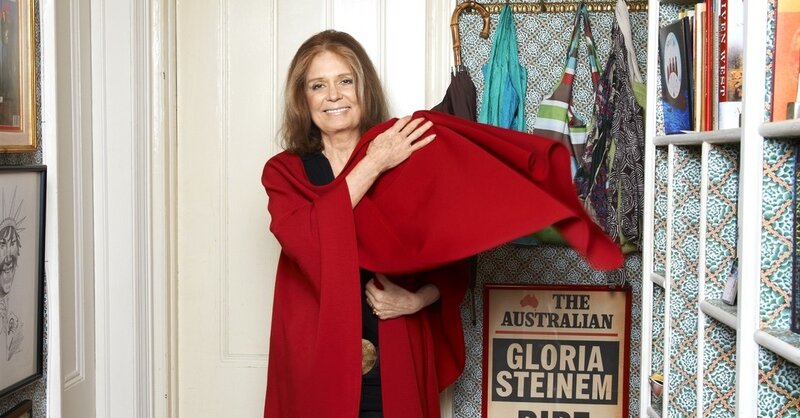
In 1964, Gloria Steinem, who died on Wednesday at the age of 92, found herself in a taxi sitting between two New York literary lions: Saul Bellow and Gay Talese. As if she were an object, and not a person, she would later recall, Talese leaned across her and said to Bellow: “You know how every year there’s a pretty girl who comes to New York and pretends to be a writer? Well, Gloria is this year’s pretty girl.” It was moments like this that made her an activist, but in the seven decades she spent in the city, Steinem never stepped away from what was her truest ambition — to write.
Over the course of her career she published 11 books, from the little known “Beach Book” to her 1983 collection of essays, “Outrageous Acts and Everyday Rebellions,” to the forthcoming memoir “An Unexpected Life.” It’s easy to shelve those books alongside celebrity memoirs and missives largely because somewhere between that cab ride and when she helped revive New York magazine and co-founded Ms. magazine in 1971, Steinem did become a celebrity. With her long blond hair and aviator glasses, she was and is the face of modern-day feminism. Is it possible that in that transformation, we stopped reading her closely because we were watching her so closely?
“It’s one of the ironies of trying to be a writer and an activist at the same time that just when you feel you have the most to write about, you have the least time in which to write it,” Steinem wrote in 1983, explaining the chasm between her fame and the solitary life writing demands. As we consider her legacy, it’s revealing to go back to her early work to witness her voice and passions beginning to take shape.
Despite the limited opportunities in the 1960s for young female aspiring writers, the period was a productive one for Steinem. I love “Outrageous Acts and Everyday Rebellions” — a collection of essays written across two decades — because it’s a testament to her early curiosity and hustle. Having grown up poor in Toledo, Ohio, where she had strong memories of debt collectors coming to her door, Steinem spent her first years in New York taking magazine assignments in order to cover the $62.50 a month she owed in rent for the studio apartment she shared with a roommate.
She profiled Dorothy Parker and Paul Newman for Ladies’ Home Journal, John Lennon for Cosmopolitan, Barbara Walters for The New York Times, Lee Radziwill for McCall’s. For Glamour she wrote pieces like “Funny Ways to Find a Man on the Beach” and the “Boy-Girl Morals Quiz” — which asked couples to answer such doozies as “A girl of 21 who is about to marry tells her fiancé that she is not a virgin. The fiancé should: A. Break the engagement. B. Condemn her for it, but marry her anyway. C. Break the engagement, condemn her or not, depending on the circumstances. D. Explain that nothing that happened before he met her matters. E. Consider that it would not have been quite natural for her to be a virgin at 21.”
What magazines mostly wanted from “girl reporters” like Steinem were articles about “feminine subjects,” and she obliged. In an April 1964 letter she reported to her editor at Vogue that she had scouted a photograph-worthy “immense bathroom-dressing room with red-and-white floral patterns, gold fixtures, an elegant bidet and a double-tiered hanging closet covered by electrically operated curtains.”
But she brought in politics whenever she could, noting in the Paul Newman profile that “His attendance at civil-rights rallies and demonstrations, for instance, occasionally caused his films to be banned in the South, but he couldn’t care less. ‘I’m a citizen as well as an actor,’ he said firmly, ‘and I’m damn well going to do what I want. A man with no enemies is no man.’”
Her success with these kinds of pieces earned her the go-ahead to write a major magazine profile of James Baldwin for Vogue in 1964. In it, Steinem interviews the 39-year-old writer, still reeling from the death of his friend Medgar Evers just months before, as he’s about to open his first Broadway play, “Blues for Mr. Charlie.”
“The death, or the spiritual death, of the young and talented has been as much a fact of Baldwin’s life as an obsession in his work,” she writes in a particularly beautiful passage. “‘Most of my friends,’ he says simply, ‘died before they were 30.’”
“Somewhere in all his books and most of his conversations there comes a mourning sentence like this one from the play,” Steinem writes, quoting: “He was a beautiful cat, and they killed him. That’s all. That’s all.” The line is such classic Baldwin and the way she conveys it shows how closely she had studied him and how much she was paying attention.
In an essay titled “Learning From Experience,” Steinem is frank about the indignities of trying to build a career in New York at the time: “the apartments I couldn’t rent because landlords assumed a single woman couldn’t afford it (or if she could, she must be a hooker); the political assignments lost to younger and less-experienced male writers.” She reveals the pay inequity she faced as a young writer from editors who believed “women didn’t really need the money” and “the well-meaning friends who kept encouraging me to marry any man I was going out with who had a little talent or a little money.”
Instead of marrying for security, she kept betting on her own tenacity and smarts. She wrote about Marilyn Monroe’s underappreciated talent. She wrote about the recently widowed Jackie Kennedy and about the porn star Linda Lovelace, who suffered sexual violence during the filming of “Deep Throat”: “Bruises are visible on Linda’s legs in the film itself,” she wrote, “supporting her testimony that she was a prisoner while she made it. Do viewers see the bruises — or only her smile?”
“Outrageous Acts and Everyday Rebellions” is a “portrait of the writer as a young woman,” as it were, showing how she balanced her ambition, pride and the practical need to make a living. The piece that made her famous is one she calls a mistake: the two-part series for Show magazine in 1963 in which she spent 11 days undercover as a Playboy Bunny. “That article quickly became the only way I was publicly identified,” she writes, adding that she was offered a sizable cash advance to expand the story into a book, which she declined.
And so the girl from Toledo became Gloria Steinem, a powerful figure on the national stage, not just because she was pretty and, as the old Hollywood saying used to go, “free, white and 21.” Her writing illuminates in ways big and small that she never stopped putting in the work. To the very end, she was — away from the cameras, the podiums and the marches — committed to reading deeply, and to connecting the dots in new ways. Her home in a brownstone on Manhattan’s Upper East Side, which you can tour online, is filled with books, including a shelf she dedicated to those by “Friends Who Write.”
She kept receipts for purchases she made from Doubleday Book Shop, and records of the books that shaped her worldview: Bellow’s “The Adventures of Augie March”; “The Color Purple,” by her dear friend Alice Walker; “The Woman Warrior,” by Maxine Hong Kingston; “This Bridge Called My Back,” an anthology of writing by women of color edited by Cherríe Moraga and Gloria Anzaldúa.
In 2022, Steinem told The Boston Globe: “I always wanted to be a writer ever since I was a little girl reading Louisa May Alcott. But I didn’t know how I was going to do that. I didn’t know how I was going to make a living. You know, it was really kind of spontaneous, one step at a time. I mean, planning is a form of power, I think. The ability to plan. And I never felt that, I just felt as if I was doing the best I could, day by day.”
What she built with those days, the endurance of more than 90 years of doing her best, turned into something truly extraordinary. As she got older, she remained dedicated to encouraging women to keep reaching for what might seem unattainable, and to draw on one another for strength. In addition to her many public events, she quietly invited women of all generations into her home for what she called “talking circles”: off-the-record conversations about everything from women in sports and women’s health to A.I. and sexual desire. It was her wish that these intimate gatherings would continue after her death, and that, with the help of her foundation, women writers and activists would continue to use her home as a space for the kind of work she struggled to do alone early in her career.
In those circles, she operated as a journalist: She spoke less than she listened, she urged the women to say more, to go deeper. She may have aspired once to be a woman of letters, to lead a more solitary life dedicated to the written word. But the time and the place she was born into did not have very many spaces like that for women. So again and again, she put aside her own comfort and her own literary aspirations and went out to do what she could to change the world.
The post Gloria Steinem Came to New York to Be a Writer. She Became a Movement. appeared first on New York Times.