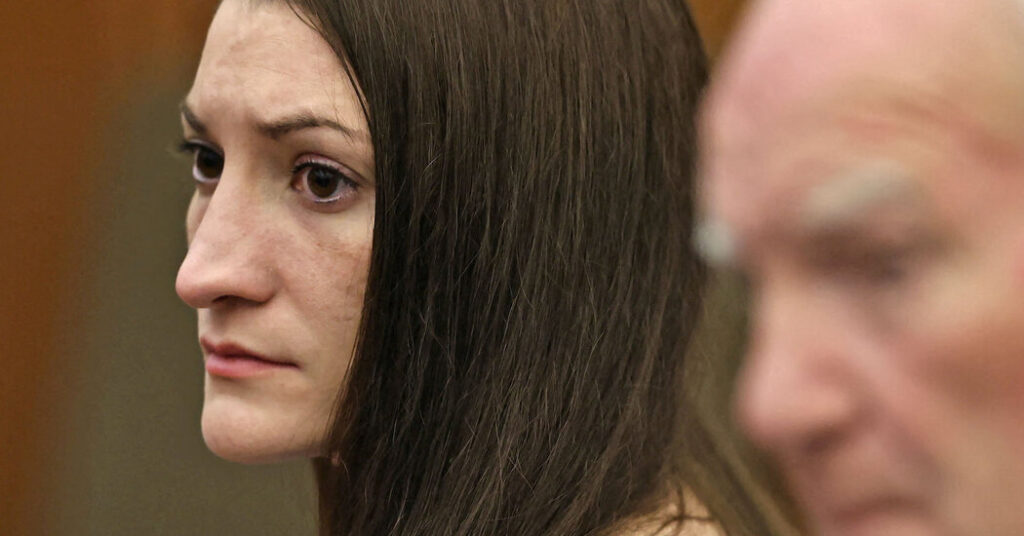
In a room somewhere deep within a courthouse in Plymouth, Mass., the 12 jurors in the Lindsay Clancy trial have spent the last week sequestered together. They have talked. They have argued. And twice since Monday morning, they have lost all hope that they will ever reach an agreement.
Whether the jury can resolve its differences will determine the fate of Ms. Clancy, 36, who is charged with first-degree murder in the strangling deaths of her three young children. And if the jurors cannot achieve consensus, the resulting mistrial will open a ferocious new round of debate about Ms. Clancy’s case, the tactics used by lawyers on both sides — and the mysterious dynamics inside that jury room.
“When you have 12 people, a cross-section of the community, who have to reach a unanimous verdict based on a very high standard of proof, it’s remarkable that hung juries are relatively rare,” said Paul Butler, a law professor at Georgetown University.
The jurors in the Clancy trial include nine women and three men. They represent a range of ages; most are white. Several looked visibly weary on Wednesday afternoon as the presiding judge, William Sullivan of Plymouth County Superior Court, read them a formal set of instructions known as a “dynamite charge” — designed to prod them toward consensus — and ordered them to return on Thursday for a sixth day of deliberations.
Hung juries occur infrequently, in an estimated 5 to 6 percent of criminal cases. But juries that repeatedly report an impasse are unlikely to engineer a breakthrough, several experts said. Deadlocked juries that are read a dynamite charge do sometimes return verdicts, said Jack Lu, a retired Massachusetts Superior Court judge who heard cases for almost two decades. When they do, those verdicts tend to come quickly.
“This ratchets up the pressure significantly,” he said of Judge Sullivan’s last-ditch appeal.
The pressure that could be felt by jurors to reach unanimity has made the use of such instructions controversial. Some states, including Massachusetts, have revised the language used to make it sound less coercive.
Saul Kassin, a professor emeritus of psychology at John Jay College of Criminal Justice, conducted a study in 1994 on the effects of the dynamite charge and found that its use caused jurors with the minority viewpoint to feel pressure to change their position.
For a jury entering its sixth day of deliberations, he said in an interview, the judge’s instructions, and entreaties to keep at it, may eventually produce a feeling that consensus is the surest path to freedom. “At what point do they start to believe, ‘We’re only going home if we reach a unanimous verdict’?” Dr. Kassin asked.
The deadlock itself should be telling, he said, indicating that the prosecution’s evidence was not enough to banish reasonable doubt from every juror’s mind.
“When a jury comes back twice to say it’s deadlocked,” Dr. Kassin said, “that is reasonable doubt.”
The testimony in the Clancy case, stretching over weeks, was unusually disturbing. It included days of detailed accounts about the killings of the three children and a recording of the 911 call made by their father as he discovered their bodies. Several jurors were emotional at times.
There is little research into jury dynamics and deliberations, for obvious reasons, experts said. The process is, by design, a black box, cloaked in confidentiality, and jurors rarely break their silence to shed light on it. Some social scientists run jury simulations, creating similar conditions with research subjects, to test how diverse groups strive to achieve consensus.
Those experiments have debunked the idea that hung juries typically result from one stubborn person who refuses to budge, Dr. Butler said. Much more likely to produce an unbreakable impasse is a group of three or four holdouts.
“It’s possible one adamant person can refuse to yield and cause a hung jury,” he said, “but the research suggests that if 10 or 11 all agree and one doesn’t, that holdout juror is likely to be persuaded.”
“That’s not a bad thing,” he added. “That’s what the process is supposed to be about.”
If the judge in the Clancy case reveals how closely divided jurors were in the event of a mistrial, that insight may guide prosecutors as they decide whether to retry the case.
Ms. Clancy’s lawyer. Kevin Reddington, said on Wednesday that he remained grateful for the jury and hopeful for a verdict. “Whatever happens with the case,” he said, “nobody can say that they haven’t given it their all.”
There is no doubt that resentments simmer in jury rooms, most forever unseen by the public. Cindy Lavoie, the forewoman of the jury in a 2023 double murder trial in Massachusetts that ended with a hung jury, told reporters after the mistrial was declared that she felt the holdout juror had not fully weighed the evidence, because of her belief that the defendant had been psychotic at the time and should not be found guilty.
“I was upset with her,” Ms. Lavoie said in an interview with Boston 25 News. “She did not follow the process, all the instructions the judge gave us to look at the facts.”
Steven Haney, a defense lawyer, represented Jonathan Rinderknecht, who was charged with arson in connection with the Palisades fire in California, in a federal trial that ended with a hung jury in June. The jury was divided 10-2, with the majority in favor of acquittal, Mr. Haney said. The judge declared a mistrial after three days of deliberations.
“A lot depends on the judge’s sense of how deadlocked they really are,” Mr. Haney said in an interview. “In our trial, there was no question, based on the statements from the foreman — he underlined the words three times, ‘We cannot.’’
For Mr. Haney, there was some satisfaction in coming so close to a win, but also deep frustration that the case will be tried again, beginning in November.
“You just have to be better at the second trial,” he said. “In some ways, it gives you more motivation.”
Maia Spoto contributed reporting.
The post Can the Lindsay Clancy Jury Break Its Deadlock? appeared first on New York Times.