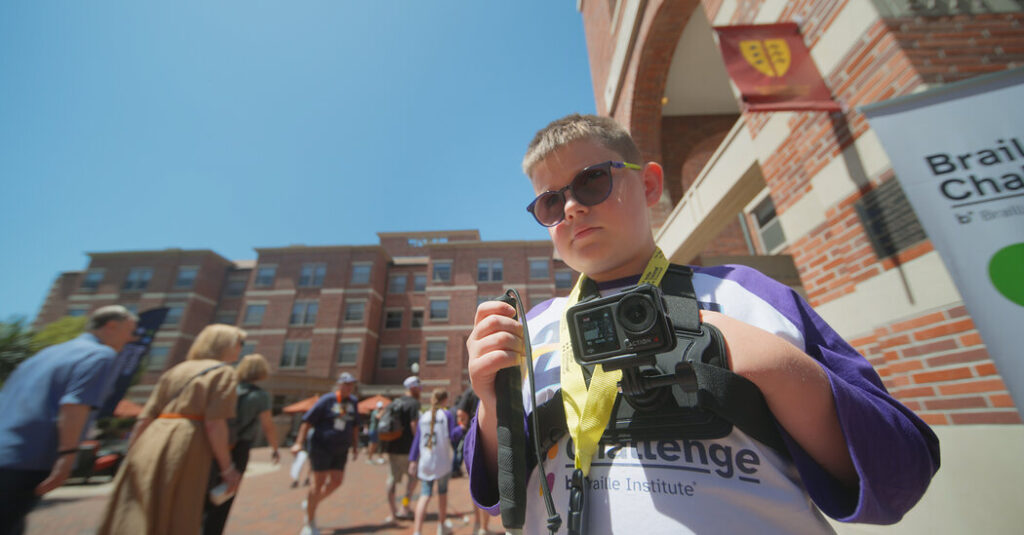
The Braille Challenge is an annual competition in which blind and low-vision students under 18 test their dictation and reading comprehension skills. The documentary “Brailled It” traces the events of this challenge, relying almost entirely on footage captured by Go-Pro-like cameras mounted on three young competitors.
It’s impossible to see the world exactly as our subjects perceive it, but that doesn’t mean we can’t feel what they’re going through — a case this singular film makes by simply giving them control of part of the narrative.
Though conceived and assembled by David Grabias and Christopher Morgan, the documentary gives director credits to its three subjects: Salome Cummins, a chatty high school student from Missouri who is competing at the Junior Varsity level for the first time; Christopher Morgan, a levelheaded Braille Challenge winner from Atlanta; and Isaiah Gauthier, an 11-year-old from Canada.
We follow this eager group from their arrival at the event hotel in Los Angeles through their interactions with their families and other Braille users, and up to the awards ceremony that has Salome, in particular, trembling in her seat.
The images in the documentary are often choppy and out-of-focus, but these frustrating visuals encourage sighted filmgoers to adapt. What are we hearing? What do the camera’s movements tell us about the subject’s body language and emotions?
While not as introspective and visually poetic as Reid Davenport’s “I Didn’t See You There,” another recent documentary that experiments with film language to communicate a disabled person’s experience, “Brailled It” still establishes a touching intimacy — the kind that comes from spending time with someone.
Brailled It Not rated. Running time: 1 hour 13 minutes. In theaters.
The post ‘Brailled It’ Review: A Matter of Perspective appeared first on New York Times.