President Donald Trump said that he “revived” and “saved” America’s auto industry through tariffs. But industry data and experts on both sides of the U.S.-Canada border suggest a different version of events.
“I’ve revived, and indeed saved, the Automobile Business in our America,” Trump wrote Sunday on Truth Social. “That’s because of what I’ve done with TARIFFS.”
Manufacturers, however, have reported substantial tariff-related costs, and the auto industry’s production, sales, and employment have all declined since Trump returned to the White House.
Experts tell TIME that Trump’s escalating trade war with Canada could put further pressure on a $1.2 trillion industry, weakening its global competitiveness.
Read More: ‘We Don’t Need Canada’: Trump Escalates Trade War With Threat of 50% Auto Tariffs
Trump’s claim highlights a fundamental tension within his trade policy: Tariffs intended to protect American automakers increasingly target Canada, whose factories and suppliers have for decades been deeply integrated with the U.S.
Trump now plans to double existing tariffs, despite warnings that doing so could drive up production costs and undercut a vital American industry.
“The U.S. auto industry didn’t need saving in 2024. Americans bought roughly 16 million vehicles and the industry was profitable,” says Flavio Volpe, the president of the Automotive Parts Manufacturers’ Association, which is based in Canada. “Since then, tariffs and uncertainty have increased costs and disrupted investment, and 2027 now carries substantially more risk than it did before this trade war.”
Will the new auto tariffs on Canada help or hurt the U.S.?
When Trump introduced 25% tariffs on imported automobiles and parts in March 2025, the news immediately sent global markets roiling. But qualifying auto parts were exempt in accordance with the trilateral United States-Mexico-Canada Agreement (USMCA).
This month, he rescinded that exemption as part of a trade war with Ottawa, raising automobile and auto parts tariffs to 50%—a move that is expected to be consequential to both nations’ economies when it goes into effect Jan. 1, 2027.
“They feel entitled, and yet, we don’t need Canada, they need us!” the President said in a Truth Social post on Aug. 24, adding an oft-repeated accusation that “Canada has been ripping off the United States of America for years.”
Trump has argued that the trade dispute will hurt Canada while benefiting the U.S. But automotive experts say the two industries are too closely connected for either country to avoid consequences.
“If Trump goes ahead with a tariff on auto parts, the industry on both sides of the border would shut down,” says Volpe.
Canada is the largest export market for U.S. auto products, accounting for more than the next 10 markets combined, according to an analysis published last week by the Royal Bank of Canada (RBC). Auto trade between the two nations totaled $100 billion in 2026, making it a significant part of their nearly $900-billion-per-year trading relationship.
“President Trump can say the United States doesn’t need Canada, but 60 years of industrial integration says otherwise,” Volpe says. “In autos, neither country can seriously damage the other without imposing significant costs on itself.”
That integration is visible throughout the production process. Automotive parts often cross the border up to eight times before a vehicle is assembled, according to RBC.
Increased tariffs could incentivize Canadians to take a bigger share of their business to sellers abroad. The shift has already started.
In the decade before 2025, 49% of vehicles imported to Canada were manufactured in the U.S., according to RBC. But during the first 10 months of 2025, that number dropped to 36%, as a portion of Canadian vehicle purchases moved to South Korea and Mexico.
“If even higher tariffs come into effect, that trend may continue,” the RBC report said.
That would undercut what had long been a promising trajectory for the U.S. market, according to Sam Fiorani, vice president of Global Vehicle Forecasting at AutoForecast Solutions, LLC.
“The North American automotive industry has evolved over the last three decades into a globally competitive machine,” he says. “Without the resources that Canada and Mexico bring to the table, the U.S. has a tough time competing with the likes of the EU and definitely falls further behind China.”
But Trump reiterated his stance on Sunday, saying: “I don’t want Canadian cars, I don’t want Canadian parts, I don’t want Canadian anything.”
Canada has responded with reciprocal tariffs of up to 50%, which go into effect Sept. 8, 2026.
The countertariffs will raise costs for Canadian importers and could reduce demand for American exports—with key manufacturing states, like Michigan, taking the brunt of financial losses.
How has Trump’s presidency affected business in Detroit?
Michigan is expected to be one of the states hardest hit by the trade war, according to CBS News. It sits at the center of the U.S. auto industry, accounting for 18.1% of national vehicle production in the second quarter of 2026, and it is among the states most dependent on the integrated U.S.-Canada trading relationship.
Notably, Michigan is home to the “Detroit Three,” a moniker given to the trio of leading auto manufacturers in the country—Ford, General Motors, and Stellantis—all of which have headquarters in or near Detroit.
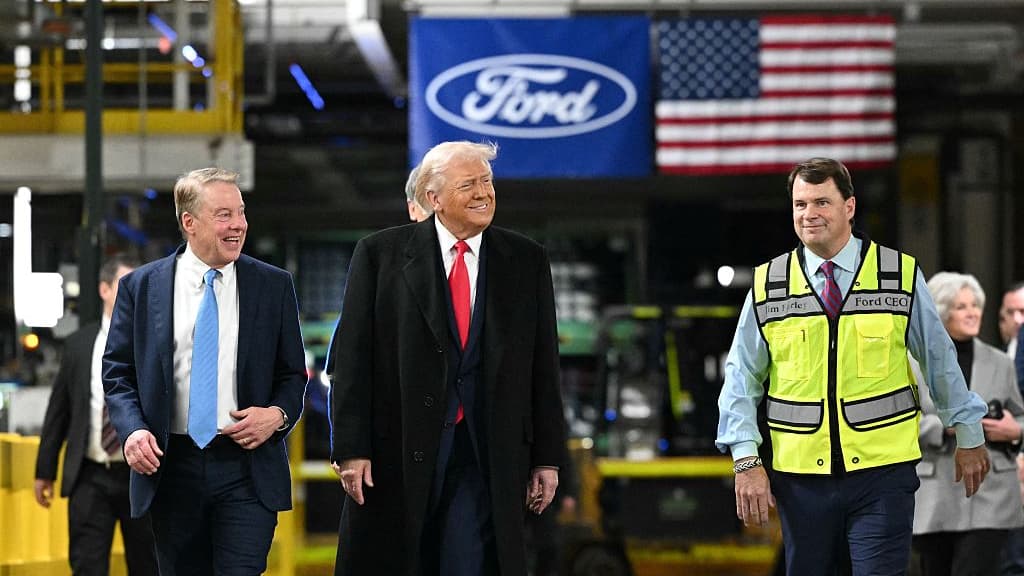
Trump cited the Ford factory in Detroit as an example of how his influence has bolstered the auto industry. He suggested that the plant would have closed if he hadn’t been elected in 2024 and said it was now flourishing under his Administration.
“When I announced that I was running in the 2024 Presidential Election, right at the beginning, Ford was getting ready to close their Big Factory, in Detroit,” he wrote.
He said Ford decided to keep the plant open to “see what happened” after realizing that he was leading in the polls and claimed: “Now it’s running 24/7, and it’s one of the most profitable Car Plants in the World!”
Trump did not identify the factory, but his remarks appear to reference Ford’s Dearborn Truck Plant, just outside of Detroit. There is no evidence that Ford was preparing to close the plant in 2022, when Trump announced his campaign, but it did announce in January that it was adding a third shift, expanding its operations to 24 hours a day, six days per week—one day short of Trump’s assertion.
The President attended the announcement at the Dearborn plant, where reporters asked how renegotiating the USMCA would benefit Ford. “It’s irrelevant to me,” he replied.
“I don’t even think about the USMCA,” he continued. “I mean, you know, I want to see Canada and Mexico do well. But the problem is, we don’t need their product. You know, we don’t need cars made in Canada.”
Trump declined to renew the USMCA in its current form on July 1.
Yet Ford—the company Trump held up as evidence his policies are working—is deeply tied to the North American market that he seems to downplay in his remarks. The company estimated that it would incur about $1 billion in tariff-related costs in 2026, according to Business Insider.
Its plants do consistently rank among the world’s most profitable, as Trump suggested, but the company’s broader results are more mixed. Ford reported a sales decline of 10% in the second quarter of 2026, which stayed on pace through July. It attributed the decline to “intentionally sunsetting select models.”
Its sales could face further pressure as Canada moves to decrease its dependency on U.S. imports.
Canadians spend nearly $110 billion annually on cars, with 90% of those vehicles built abroad, according to RBC. And they are reliable Ford consumers: The Ford F-Series have been the best-selling vehicle in Canada for 15 consecutive years, RBC said.
“Canada buys roughly 40% of Michigan’s exports,” Volpe says. “[Michigan] also hosts 55 Canadian-owned automotive parts factories with almost 20,000 workers. The real risk is Washington damaging Detroit in an attempt to damage Canada.”
Ford declined TIME’s request for comment.
Trump’s social media post also lauded the success of General Motors, another “Detroit Three” company. But like Ford, General Motors has reported a sales decline, decreasing 6.8% in the first half of 2026.
Fiorani believes that all of the area’s automakers are certain to feel the strain of new tariffs.
“General Motors, Ford, and Stellantis rely on suppliers in Canada for U.S. vehicle production,” he says. “Adding cost to those vehicles will have the biggest impact in Michigan, Ohio, Indiana, and Illinois—where the bulk of the Detroit Three’s plants are located.”
Foreign manufacturers based in the U.S. could end up better insulated than domestic brands, since their plants are clustered in the South and they are less reliant on Canadian parts.
“Plants in the American South focus most of their suppliers in that region, providing a cushion for companies like Toyota, Hyundai, and Honda,” he explains.
Like Ford, General Motors reported its strongest sales since before the pandemic in 2024—before Trump returned to the White House.
What is the outlook for the U.S. auto industry?
Apart from the trade dispute, the U.S. auto industry faces a difficult outlook. Sales growth is expected to plateau through 2030 due to “constrained consumer spending power and changing market preferences,” according to PwC.
“Vehicle production in the United States has been sliding for the last two years largely because of the stagnating sales,” Fiorani explains.
Affordability is a central concern. A June analysis by AlixPartners, a global consulting firm, predicted that new-vehicle sales will fall 2.5% in 2026. Inflation on everyday goods and the threat of increasing tariffs across other prominent sectors have left consumers with less money for major purchases and a more conservative approach to spending.
Cox Automotive also projected in January that used-vehicle retail sales and lease penetration would decline year over year, citing policy shifts, inflation, and a weak labor market.
And even before the Iran war brought on surging gas prices due to closure of the Strait of Hormuz, PwC reported in January that “fuel price volatility and changing regulatory landscapes have also introduced complexities” impacting the domestic demand for new or used automobiles in 2026.
These developments will also impact the auto industry workforce, Volpe says. “Higher costs and political uncertainty affect investment, sourcing, vehicle prices—and ultimately consumer choices,” he says. “Canada is the largest market for American-made vehicles, and it’s not even a close second. Losing Canadian market share means losing sales and production for American companies and workers.”
The industry’s workforce is also contracting. U.S. automotive employment has been declining steadily at a pace of about 1% to 2% annually since 2001, according to the U.S. Bureau of Labor Statistics, the decline has accelerated in 2025 and 2026, which show drops of 3% and projections upward of 2% year-over-year, respectively.
Even if production increases, Fiorani says that few new jobs will be created as U.S. automakers try to offset the increased costs of manufacturing.
Beyond North America, Trump’s tariffs are hitting the global auto industry hard, as well.
The Wall Street Journal reported in July 2026 that it had absorbed over $35 billion in losses since the tariffs took effect—its most catastrophic dip since the pandemic.
Recovery is possible, however, according to Fiorani.
“Expectations for a soft recovery of 1.2% next year are dependent on the balancing of relations with Canada and Mexico,” he says. “If that does not happen, the forecast will need to be lowered as consumers react to higher prices and reduced choice.”
The post Trump Says Tariffs Saved the U.S. Auto Industry. The Data Tells a Different Story appeared first on TIME.