You may have heard otherwise, so let’s set the record straight: People love going to the movie theater.
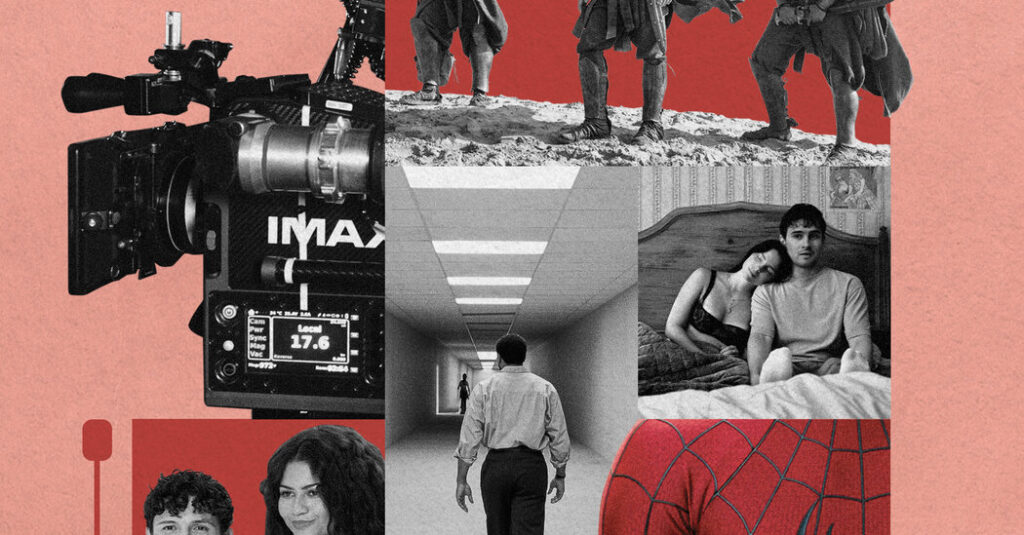
This anomalous summer, full of records and firsts and surprises, is proof. Here are a few examples: The movie of the season, based on an epic poem composed thousands of years ago, broke its director’s own record for ticket sales. “Spider-Man: Brand New Day” became the second-highest-grossing film ever at the domestic box office. Meanwhile, releases made by YouTubers — “Obsession” and “Backrooms” — shocked the industry by pulling stunning numbers into the theater, especially the coveted Gen Z demographic. By the end of the summer, the season’s domestic box-office returns were a whopping 26.6 percent higher than in 2025; strikingly, the summer box office was 9.4 percent higher than the pre-pandemic average.
Whenever something unusual happens in Hollywood, the industry takes note, and executives start brainstorming how to replicate that success. What brought people into these movies, and what will bring them in again?
Hollywood’s paucity of imagination means the answer is often the most facile: They liked sharks, so let’s give them more sharks. The business is obsessed with “content,” a word that always makes me think of a bunch of interchangeable blobs, meant to fill empty space. Streaming algorithms run on the logic of content. If you like this action movie with a strong female lead, you’ll like that one. If you dig tales of miserable wealthy people in beautiful places, here are 50 more. It’s all content to fill your day, one as serviceable as the next.
In movie development, this means we get copycats, usually of gradually degrading quality. After “Paranormal Activity” came a slew of surveillance footage horror films, while “Get Out” led to years of “elevated,” socially conscious horror. After “Barbie,” Mattel started developing movies based on Polly Pocket and Hot Wheels.
The results are rocky, and the pattern appears to be repeating again. Already there are stories of executives asking their younger staff to scour Reddit for the next “Backrooms,” and filmmakers as varied as Steven Spielberg and Zach Cregger are reportedly adapting online horror memes. I’ve heard suggestions that the lesson of “Brand New Day” is that people want more superheroes and sequels. There’s a good chance someone is trying to hunt down another ancient epic to produce for the big screen.
This is all wrong.
What we can learn from this summer — what the movie business ought to note — is that, to borrow a line from “The Odyssey,” the age of content is collapsing. We’ll live with it for much longer, of course. Algorithms aren’t going anywhere. But audiences, especially younger people, are looking for something different when they go to the movies.
They’re looking for human connection.
The factors that power the success of “The Odyssey,” “Spider-Man: Brand New Day,” “Backrooms” and “Obsession” may seem, on first blush, to be totally different from one another: Christopher Nolan casts lots of stars in his films. People love Spider-Man and his movies. The world of “Backrooms” had already gone viral. And fans saw “Obsession,” with no major stars in the cast, first because they knew its director from his YouTube shorts and then because their friends wouldn’t shut up about it.
But there’s a commonality here. Moviegoers show up for Nolan because they trust him: Whatever story this guy is telling, they want to see it. (His previous film was a period piece about a sad scientist, after all.) He’s built his audience over time by delivering, essentially, crowd-pleasing art films. Likewise the “Obsession” director Curry Barker and “Backrooms” director Kane Parsons cultivated an audience on the internet that turned out for their big-screen debuts. Audiences feel connected to the artists, whatever they want to do.
There’s a link here to “Spider-Man: Brand New Day,” too: While other superhero films have flailed lately, this one succeeded because people love its leads, Tom Holland and Zendaya, and that love is mixed into appreciation of their performances as the seemingly star-crossed Peter Parker and M.J. Their offscreen relationship has spawned a parasocial fixation for years, especially among young people, and it gives the onscreen one emotional heft.
So that’s Factor No. 1: People want to see something because they feel a bond or affinity for the people behind the film. It’s a common human connection, the sort that grows between musicians and fans, or authors and readers. Few major filmmakers enjoy this kind of relationship to mainstream audiences at this scale anymore — perhaps Greta Gerwig and Ryan Coogler, maybe Jordan Peele. They’ve all engaged in audience-building, which is what lesser-known emerging filmmakers like Parsons and Barker bring to the table, too.
And this is exactly why the lesson from this summer should be not to make more Reddit threads into movies. Instead, locate more creators — traditional or not so traditional — who have fostered a following and, as they say on TikTok, let them cook. Dictating content makes less sense than enabling artists to do what they do best for the audience they already understand.
There’s one other factor here. If it’s human-to-human connection that moviegoers are after, that doesn’t just extend from the seat to the screen. It’s also seat to seat.
You can see this once again in the “Backrooms” and “Obsession” phenomena, in which audiences far exceeded expectations — and, in the case of “Obsession,” actually kept growing from week to week. We wanted to be part of something that other people were talking, thinking and posting about. A trailer might get me interested, but it’s chatter and personal recommendations (and FOMO) that will actually get me in the door.
For this to work, movies need to spend more time in the theater, something studios have actively resisted in recent years. Reasoning — wrongly — that young people would rather watch movies at home or on their phones, they shrank the window between the theatrical and digital release. Of course, this devalues the theatrical experience. But it also means that by the time an audience hears about a movie, it’s already too late. For a film to pick up steam, it needs to be available. In the world we live in now, the longer release window has power.
That’s because people don’t just want to be part of a conversation; they actually want to be in the theater with other people. Crowds watching horror films treasure the feeling of yelping along with others. Audiences for “Spider-Man: Brand New Day” gasped and even cried together. Viewers fought hard to get tickets to “The Odyssey” on the biggest screens possible because the theatrical experience matters.
These four movies are not the only examples, but they’re compelling, and emblematic of what’s clearly emerging at the movies and beyond. We are living in a post-content age. Films no longer become hits because of what they’re about. They succeed because of who made them and who’s talking about them, because we want to feel connection. And a movie theater is built for just that need.
The post The Real Lesson of the Summer Box Office: Fans Want to Feel Connected appeared first on New York Times.