The last years of Yayoi Kusama’s life were some of her most profitable.
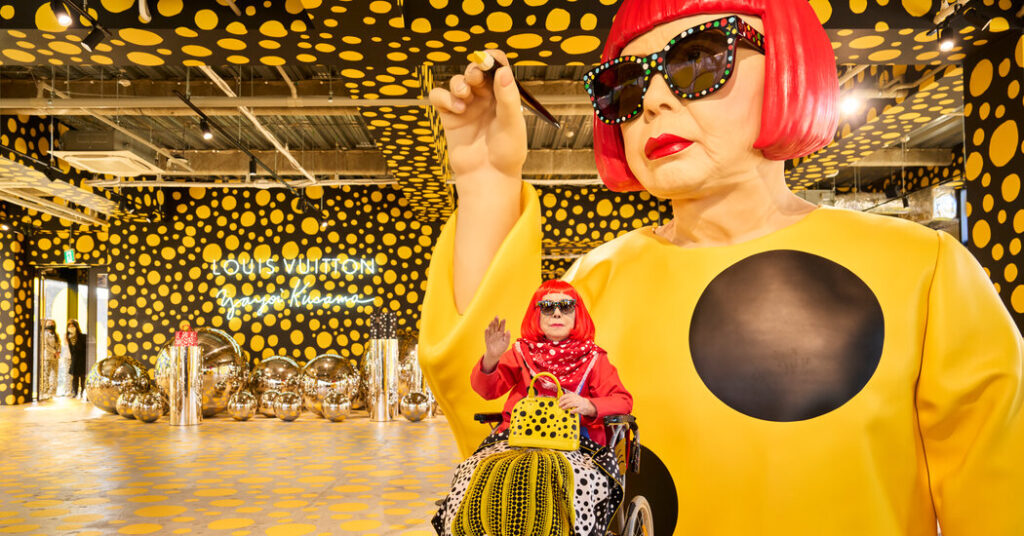
Before her death last month at 97, she had become one of the most coveted artists of our time. One of her abstract paintings sold at auction for $10.5 million in 2022. And under a 2023 partnership deal with Louis Vuitton, the Japanese artist’s designs graced a purse that cost more than $150,000 and a $50,000 surfboard. An unsettling robot version of the artist even appeared in storefront advertisements with the luxury brand.
In April, the gallerist David Zwirner will exhibit a selection of Kusama’s final works in New York.
“We’re so excited about the last decade,” the dealer said. “Arguably, this was the most extraordinary and successful decade of her career.”
It was also the most elusive, as the artist receded from view.
One of Kusama’s last public appearances was in 2017 at the opening of her museum in Tokyo. Longtime friends, curators and collectors said that she stopped receiving most guests in 2019 at the psychiatric hospital where she had lived for decades.
Yet her studio — a small group of assistants meant to carry out her artistic vision — was more prolific than ever, producing dozens of paintings and sculptures with her signature.
In 2024, a new pumpkin sculpture on the Yayoi Kusama Museum’s Tokyo rooftop prompted questions. Although it was signed and dated by the artist, it was created at a time when, according to those closest to her, she was mostly bedridden and making paintings with the help of assistants who carried small canvases to her.
It is normal for artists to outsource the fabrication of artworks while still being closely involved in the design process. Artists like Jeff Koons have become famous for their use of studio systems. But could a nonagenarian like Kusama have the capacity to oversee such a large-scale production?
“The last decade or so of Kusama’s life might be described as a riddle wrapped in a mystery inside a pumpkin,” said Thomas Danziger, a lawyer whose clients have vied for the artist’s works at auction. “Savvy buyers would be wise to ask as many questions as they can, recognizing that they are unlikely to get solid answers.”
Pumpkins were once a symbol of vitality for the artist.
It was a bountiful comfort of Kusama’s childhood in Matsumoto, a Japanese city about 100 miles northwest of Tokyo that was relatively untouched by the devastation of World War II. Despite having eaten pumpkins to the point of nausea in her adolescence, by her own account, the artist maintained an attachment to them into adulthood. She produced enormous, bronze, polka-dot sculptures honoring them.
Throughout her life, Kusama experienced auditory and visual hallucinations. She also had what she described as an obsessive compulsion to make art on her own terms.
Her newfound fame over the last decade meant that she was overseeing a multimillion-dollar business outsourcing the creation of her pumpkins to fabricators as far away as upstate New York.
“She first creates drawings and maquettes in her studio and her room, followed by production in collaboration with fabricators,” her foundation said in a statement on Sunday. “She personally supervises the production of the works and approves the finished sculptures.”
In 2017, Kusama appeared in a wheelchair and fiery red wig at the museum opening, across from the psychiatric hospital in Tokyo where she had lived for nearly four decades. When a reporter asked about the relationship between her history of mental illness and her art, a handler suggested the question was “too sensitive.”
But Kusama insisted on answering, saying that she had a compulsion to keep painting.
“I still see polka dots everywhere,” she said. “Art is everything for me and I have been struggling for art.”
Curators described Kusama as being very involved in organizing exhibitions through her 80s.
“She would change her selection four times,” said Marie Laurberg, the director of the Copenhagen Contemporary art center who organized the 2015 Kusama retrospective at the Louisiana Museum of Modern Art in Denmark.
Laurberg recalled Kusama as being warm and friendly. When she arrived at the artist’s Tokyo studio for a meeting with Kusama’s assistants, the artist herself appeared.
“She invited me for coffee on a whim,” Laurberg said. “I go downstairs and she is in a painting coat without the wig or anything.”
By 2019, some friends noticed a change.
Ryutaro Takahashi, a psychiatrist and prominent collector who has bought Kusama’s work since the 1990s, had a meeting scheduled with the artist that year.
“She was firing many of her staff, one after another,” said Takahashi, who described Kusama as “paranoid” during this time. “Then she told me: ‘Don’t come anymore.’”
She stopped attending the major, annual exhibitions around the world celebrating her work. Curators and collectors had access to her through the remaining assistants.
The artworks kept coming, including a 2020-21 series of soft sculptures, “Desire for Death,” a set of orange-tipped spikes that look like jagged teeth or a mountain range.
By 2023, Kusama was no longer living at the psychiatric hospital because it was undergoing construction.
“She stayed at another hospital,” her foundation said, declining to name the institution to protect her privacy.
“She remained actively engaged in making paintings from her hospital room” until July, her foundation explained, adding that some of those acrylic works would be on view at the Stedelijk Museum in Amsterdam for a solo exhibition opening this month.
Haruyo Saimaru, one of Kusama’s relatives and an artist herself, said that “the family members are under pressure by the foundation not to reveal anything” about the artist’s funeral service. Saimaru said it was conducted at a temple under someone else’s name so that the public wouldn’t know it was for Kusama.
The foundation said the funeral was private for close family members and friends, declining to disclose further details.
Kusama’s 2023 collaboration with Louis Vuitton had raised the artist’s profile again, even as longtime fans struggled to understand it. The fashion brand created an animatronic version of Kusama in New York and installed a towering version of the artist over its headquarters in Paris.
Kusama herself appeared in a promo for the collaboration, wearing large sunglasses inside one of the company’s Tokyo locations.
“She is an artist where her image and her persona has been such an integral part of her work,” said Natasha Degen, director of Sotheby’s Institute of Art in New York, who noted that most items in the Louis Vuitton collaboration recycled designs from old paintings. “At the time, people were questioning if she could have possibly signed off on over 450 handbags, shoes and garments.”
Kusama’s foundation said the last interview she conducted was by video in 2023. She spoke with Wakato Onishi, a senior staff writer at The Asahi Shimbun, a Japanese daily, for a series on geniuses. The article said that Kusama continued to paint but could no longer produce large pieces.
“It’s difficult to achieve evaluation in art history unless you keep trying to create good works for about 100 years,” she was quoted as saying. “I hope to create works which would be remembered by history.”
Hisako Ueno contributed reporting from Tokyo.
The post The Mysterious and Lonely Final Decade of Yayoi Kusama’s Life appeared first on New York Times.