Its water was never cold, it was “refreshing.” That’s what my Oma always said about the lake. In her soft Austrian accent she would declare it “refreshing,” even when it was so freezing we would gasp after jumping in.
My grandparents bought a plot of land right on that lake in upstate New York in the 1960s, and I have been going there since I was born. Some of my earliest memories are of Oma sitting in a lawn chair on the uneven deck, eyes closed, tanning herself to a burnished olive while Opa played chess with my brother at a table nearby.
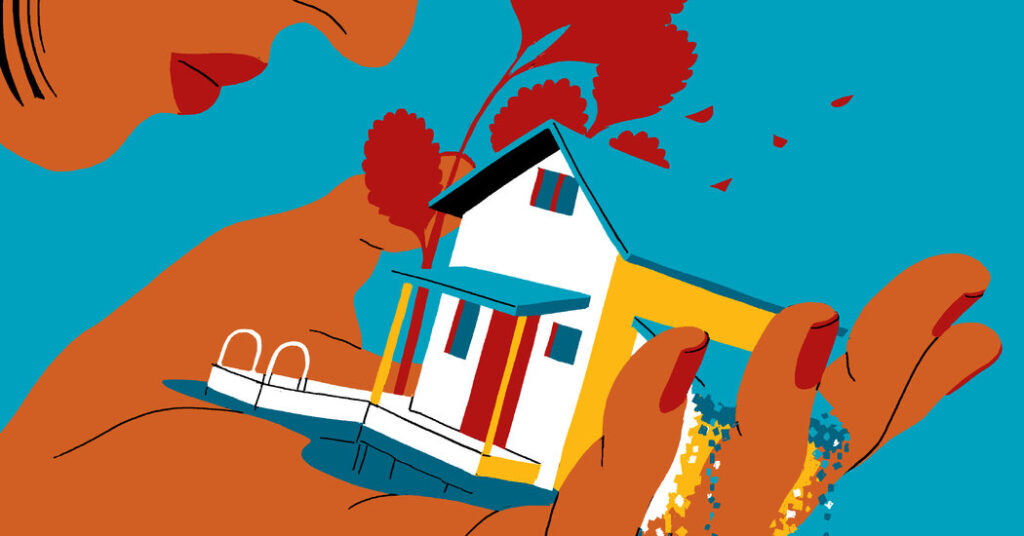
When they bought the land there was almost nothing on it, just a boat house and an outhouse. We would drive up for the day, and after Labor Day each year, my grandparents would close up the boat house until the next summer. Eventually, my parents built a house so we could stay overnight. This year, the house is being sold, and after six decades, we’re saying goodbye to the lake forever.
For my grandfather, this land was the physical manifestation of the American dream. He and my grandmother came here as refugees from Austria in the late 1930s. My grandfather grew up so poor that a Jewish charity sent him and his siblings to a farm near Amsterdam during World War I so they wouldn’t starve, and he used only public showers growing up. He and my grandmother spent their youth between the wars hiking around Alpine lakes. The fact that he owned not only a nice suburban home in the U.S. but also a perch looking out onto this glorious water was beyond his grandest childhood imaginings.
I am far sadder than I expected to be about the loss of this land. I am not a particularly sentimental person, and I was not raised by sentimental people. We don’t tend to relish objects. We don’t even give each other gifts.
I don’t even like being at the lake house very much anymore. My family and I spent a solid six months there with my parents in 2020. Don’t get me wrong — I remain forever grateful that my kids had someplace to go outside when it felt as if the whole world had closed. But it’s hard not to associate being in that small house with being afraid and feeling trapped. That spring, there was a blue jay that would ram its head into the same window over and over again until it got sick of it, or realized that it couldn’t fly through. I would awaken to the rhythmic thump of this bird on the glass, and when I sleep there I still hear it.
And yet, the sale of this house is about more than the experience of being there. It is the last material connection that I have to my grandparents. Their suburban house was sold long ago and my grandmother’s apartment in Vienna was taken from her family. They both lived into their 90s — my grandfather died in 2005, my grandmother in 2009. Even though I saw them often growing up, my most indelible memories of them are at the lake, where it felt that they were their most essential selves.
They seemed utterly at peace there. When I would complain about the spiders in the outhouse as a little kid, Oma would laugh. Her relaxed charm was infectious, and she made me get over myself and laugh, too — the spiders were our little friends. Opa would sketch “Sesame Street” characters for me and my brother. He was a family doctor, the kind they don’t make anymore. He made home visits and delivered babies and then he delivered the children of those babies decades later. But he was also a talented artist, and he was gentle and engaged with kids in a way that was unusual for a man of his generation.
It has always been a great sadness to me that they never got to meet my children. Oma would have said they were “little angels,” which is what she said about all her grandchildren, even when we were badly behaved. My grandfather would have sketched Peppa Pig for them and taken them out in the canoe.
That’s the version of my grandparents I think of whenever I’m sitting on the deck, looking out at the same lake that they gazed at 60 years ago. My mother and I both feel we are grieving them again by letting go of this place, even as we know it’s the right time to say goodbye; the expense of keeping up the property is too great, and my parents are getting older themselves and do not want the obligation.
The pain we feel now is a reminder that grief is not linear, and it’s a reminder that this home has been a true sanctuary. As much as it hurts, I feel lucky we have one last long weekend to honor Oma and Opa, and the respite they provided for generations of their family. They would have been so happy to know we lived at the lake for a while and that through their own hard work, there was someplace that could take us in. My parents pay it forward by spending so much time with my children, and I hope one day to take care of my own grandchildren, too. Care stretching across a lifetime is just another kind of shelter, one that can’t disappear when a house is sold.
End Notes
-
Another antique gossip recommendation from me: “The Bennetts: An Acting Family,” by Brian Kellow, which is about the sister stars of early Hollywood Constance and Joan Bennett. Their father, Richard, was also a famous theater actor in his day, and they had another sister, Barbara, who was a dancer. All the sisters had messy love lives, which is certainly my cup of tea. But my favorite part of the book is the fascinating early cinema history that I hadn’t known: Constance was a particularly savvy negotiator and Kellow describes the business dealings that made her the highest paid actress in Hollywood for a period.
-
I really enjoyed this season of the Netflix show “Tires,” a Shane Gillis-led comedy that takes place in a Pennsylvania tire shop. I had tried it previously because some of my favorite comedians (Steph Tolev, for one) are on it, but the first two seasons didn’t click for me. This season, the show’s third, felt more structured in a good way, and even though the stakes are often low and some of the laughs are cheap, that is also what is delightful about it. There is real friendship between the co-workers at the tire shop, and it is genuinely heartwarming to see them stand up for one another when it counts.
Feel free to drop me a line about anything here. Read past editions of the newsletter here.
If you’re enjoying what you’re reading, please consider recommending it to others. They can sign up here.
The post Selling My Grandparents’ Home Is Like Losing Them Again appeared first on New York Times.