Subscribe here: Apple Podcasts | Spotify | YouTube
In this episode of The David Frum Show, The Atlantic’s David Frum opens with a discussion of how Donald Trump has enriched himself and his family during his presidencies. David discusses how these ill-gotten gains bring up difficult questions about the future of American democracy.
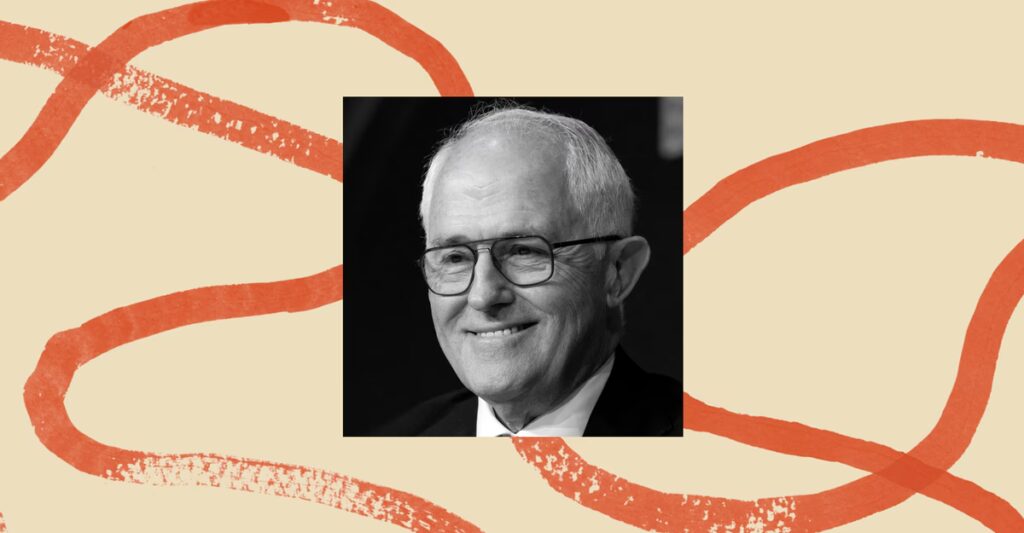
Then David is joined by former Australian Prime Minister Malcolm Turnbull to discuss the impact of the Trump presidency on America’s allies, its reputation around the world, and the politics in the Pacific.
Finally, David ends the episode with a discussion of Red Dawn Over China: How Communism Conquered a Quarter of Humanity, by Frank Dikötter.
The following is a transcript of the episode:
Malcolm Turnbull: The United States—not by accident or circumstance, but by design—has become a less dependable ally.
[Music]
David Frum: Hello, and welcome to The David Frum Show. I’m David Frum, a staff writer at The Atlantic. My guest this week will be former Australian Prime Minister Malcolm Turnbull, and we will discuss the deterioration of the position, the strategic and economic position, of the Western democracies in the Indian Ocean and Pacific Ocean in the presidencies of Donald Trump. The book this week will be Red Dawn Over China: How Communism Conquered a Quarter of Humanity. But before either the dialogue with Malcolm Turnbull or the book discussion, some opening thoughts about the question of President Trump’s wealth and what is to happen to it after he leaves office.
I wrote about this subject in The Atlantic this past weekend, and you can see my thoughts there in much more elaborated form. But there’s some major themes that I think really need to be stressed again in a very direct way, and I’d like to do that here with you now.
President Trump entered office in January 2025 as a wealthy man, as he has been almost all of his life: thanks to the great inheritance from his father, thanks to his earnings from The Apprentice and other TV programs, and thanks to some of his own business achievements. But his own business career has been one of sharp ups and downs, punctuated by bankruptcies of the businesses that he’s owned, losses to his investors. But there’s no question that he and his family are very, very wealthy today, with a fortune numbered in the multiple billions of dollars, accumulated in an astonishingly short time.
How exactly did he do that? Well, as I read it, there are three major streams of payments that he has received; three major sources of wealth that he’s received since he became president. The first takes the form of payments from people, governments, and entities with interests before the United States government. He has, for example, received large payments from American media companies. Famously, the payment from Amazon to make a documentary of his wife, Melania. Settlements from Paramount, Meta, and ABC News, money that will supposedly go to his presidential library.
He’s received gifts from foreign governments and entities as well. This stream of payments and gifts, worth many millions of dollars, has made Trump a rich man by any standard.
The second source of wealth to him has been his involvement in the cryptocurrency and other crypto-token markets, where the president has backed cryptocurrency-issuing companies. Many of the currencies and tokens that have been issued by these Trump-backed companies rapidly became worthless.
The third source has been a series of stock and other transactions in oil markets and other markets. This year, the president’s investment accounts, which the White House says are managed by third-party financial institutions, have traded oil and gas stocks. This has happened even as the president is deeply involved in the war in Iran, which has certainly had impact on this industry.
Now, America has a long tradition of letting bygones be bygones and of not looking very deeply at the activities of former presidents. But the enormous fortune that has been accumulated in such dubious ways in such a short time raises important questions. Not just about right and wrong, not just about whether individual economic laws have been obeyed, but important questions about the future of American democracy.
There are examples all over the planet of authoritarian rulers whose families accumulated enormous wealth in their time in office. The authoritarian ruler then loses power; some of the fortune is clawed back, but much is kept by the family, and that fortune becomes a basis for the family’s return to political power in a new generation. We’ve seen that in Peru with the Fujimori dynasty, in the Philippines with the Marcos dynasty. Could we see such a thing in America?
You know, the next generation of Trumps are going to inherit a lot of money, but they’re going to also inherit a lot of potential legal vulnerabilities. And one of the lessons they’ve learned from the presidency of Donald Trump is: When you have a large fortune with such a big question mark over it, one way to be safe is to reclaim political power and shut down investigations and law enforcement and accountability. And that way, the money that you achieved, whatever question marks are about it, well—no questions can be asked, because there’s no one to ask the questions.
While this enormous accumulation, rapid accumulation, of uncertain wealth remains, it continues as not just a question mark over the future of the Trump family, but a question mark over the future of American democracy. It’s a risk in a way that the wealth of the Fujimoris in Peru has been a risk, in a way that the wealth of the Marcos in the Philippines has been a risk.
Americans are not a backward-looking people. They don’t go in for retribution. In the Biden presidency, pretty clearly, Attorney General Merrick Garland wanted to stay well away from the whole Trump business, and to leave Trump as much alone as Trump’s record would possibly allow Merrick Garland to leave Trump alone.
But if there is a post-Trump administration that is concerned to restore American democracy, I don’t think that kind of averting-the-eyes method that was practiced by Merrick Garland and President Biden is safe or sustainable. To try to get to the bottom of the Trump fortune—to try to reclaim any part of it that was achieved in ways that are unlawful or improper—that’s not an act of retribution. That’s an act of democratic self-defense, and maybe, ominously, an indispensable act of democratic self-defense if the United States is not to follow the path of other failed democracies that took one blow from a first generation of an authoritarian kleptocratic family and suffered the decisive blow from the second generation.
And now my dialogue with Prime Minister Malcolm Turnbull.
[Music]
Frum: Malcolm Turnbull served as Australia’s 29th prime minister, from September 2015 to August 2018. His government legalized same-sex marriage in Australia, simplified Australia’s complex system of child benefits, and attempted, with partial success, to reduce business taxes. Australian right-of-center politics depends on a complex balance between urban and rural, social moderates and social conservatives. Internal conflicts within the coalition led to Turnbull’s ouster as prime minister in 2018. Malcolm Turnbull was trained as a barrister, co-founded the first Australian tech company to list on Nasdaq, and led the Australian operations of Goldman Sachs before entering Parliament in 2004.
Malcolm Turnbull now chairs Australia’s International Hydropower Association, invests in technology ventures, and speaks and writes on democratic norms and climate and energy issues in Australia and around the world. His memoir, A Bigger Picture, was published in 2020. Malcolm Turnbull, thank you so much for making time for The David Frum Show today.
Malcom Turnbull: Well, great to be with you, David.
Frum: So let me begin with what I know has been one of the major themes of your political work since 2018. And that is your observation of a problem or of a challenge that exists in Australia and really in every English-speaking country and across the democratic world: this tension within the former right of center between those who are business-minded, those who are more statist, between those who want to develop more cosmopolitan and modern values, those who look backward, those who integrate into the world, those who seek nationalism as a refuge from the world, and those who want to participate in a global democratic partnership, and those who reject those ideas.
First, how do you describe what has happened? How do you explain it, and what are the stakes?
Turnbull: Well, I think much of what is going on, David, on the right of politics—and these terms, as we know, are very, very plastic—is not about conservatism at all. I mean, Donald Trump, for example, and MAGA are not conservatives. They are disruptors; they are radicals. Revolutionaries if you like. Populists. But they’re certainly not conservatives in any meaningful sense.
What we’ve got is a bundle of things that have come together. Resentment about cost of living, slower economic growth. People feeling that they’re not getting ahead, feeling the system is not working for them. You’ve got people resentful about the pace of change. You see this obviously with immigration—and I’m not talking about illegal immigration here; I’m talking about legal, government-permitted immigration. A lot of people find that confronting. Their societies are changing. They’re struggling with change. You’ve seen the disruptions from globalization. Obviously, a lot of manufacturing jobs, a lot of jobs of every description, have gone. And there’ll be more to come—more to go, too, I suspect, with AI. So we’re living in an environment where the pace and scale of change is unprecedented, and I think that rocks people.
Now, at the same time—and I’m about to do what Enoch Powell famously said politicians should never do and blame the media, but because, as he said, a politician who complains about the press is like a ship’s captain who complains about the sea—but the reality is the media, and you and I know this, having lived through it, has dramatically changed. We’ve gone from a world in which there was a relatively small number of curated platforms—newspapers with editors, radio stations, and television stations with directors and producers—to this plethora, this multitude of voices. Some of which are curated, many of them which are not. But in a world where now narrowcasting can actually be a successful business model, and not just in magazines.
And so what you now get is this intense competition for attention. And of course, the way people seek to achieve that, whether it’s the automatic algorithms on the social-media platforms or it’s the producers at Fox News, is by anger-tainment. By riling people up, by promoting division, by promoting animosity, by appealing to our the worst angels of our nature. And I think all of that has created this toxic brew that has been devastating for what used to be called the center right of politics.
Frum: Well, let’s do a close-up on what happened in Australia. And one of the issues that rocked your government was your attempt to reduce Australia’s quite heavy taxation of enterprises. And that which would you might have thought would be an issue that would unite all brands of center-right people led to a rupture in your coalition, where some in your coalition said, Well, we’re fine lowering taxes on smaller businesses that don’t compete globally, but not on the big businesses that have to compete globally and that are actually most exposed to the cost of capital and to the burden of and to capital competition.
Turnbull: David, I don’t think that’s quite right. Forgive me, but I don’t think that’s—I mean, certainly there were people that had different views.
The big divisive issue on the right of politics when I was leading the Liberal Party—and I led the Liberal Party on two occasions, in opposition and in government—was our approach to climate change. I always took the view that this was prudent and rational to reduce emissions, that you had to accept the reality of climate science. Global warming was a fact. There’s no point talking about whether you believed or disbelieved in it. It was physics. But, and you’ve seen this in the U.S. in particular, you’ve got this—this was turned into a culture war. And so instead of talking about these challenges in an objective, rational way informed by engineering and economics, they’re informed by ideology and idiocy.
So, it was really more the bugbear that I faced with the right—and though they didn’t like the same-sex marriage legalization either, but 62 percent of the country voted for it, so it was a bit hard to argue with that politically—but the thing that was always the destabilizing issue was the approach to energy policy.
Frum: And did you find the withdrawal of American leadership on that issue made your life more complicated?
Turnbull: Yes, of course it has. Because you see, Trump and Trumpism and MAGA-ism has its imitators everywhere around the world. I mean, at the last election here in Australia, Peter Dutton, the Liberal leader who lost very badly and lost his own seat was, you know, in different ways, effectively channeling Trump.
You know, it’s very alluring, because the media is so global. I mean, we spend as much time—and I’m sure Canadians feel the same way even more so—we spend as much time following American politics as we do following our own. You know, Rupert Murdoch’s subscription television service here used to be called Sky News; now it’s called News 24. It’s effectively a local version of Fox now.
And so there’s a globalization of this sort of populism. These culture wars have gone global, and they cross-infect, particularly through the English-speaking world.
Frum: But they seem to be less successful outside the United States than they are inside the United States, at least from an electoral-politics point of view.
Turnbull: Yeah. Well, I mean, my friend [Canadian Prime Minister] Mark Carney did a Lazarus—John Howard would have said Lazarus with a triple-bypass resurrection—of Canada’s Liberal Party, which, of course, is Canada’s center-left party, by campaigning against Trump. And Trump being Trumpy has not been an assistance here.
But nonetheless, these anti-science forces, this sort of algorithmic cultivation of hatred and negativity that we’re seeing now more than ever, is a challenge that I think has infected both sides of politics. But I think it’s done more damage to the sensible right.
And look, let me give you a theory of the case as someone who’s led a center-right party. My view, grounded in my own experience and observation of others, is that the center right’s political equity is economic management. You know, the left will generally be regarded as being more likely to do good things with health; even with education, with spending. The left will always be regarded as being more likely to spend more, so. And the right is often, in most countries, regarded as being a better bet on national security, but that’s rarely an election issue. Sometimes it is. But the economy obviously always is.
Now, my attitude is that the more you get sidetracked down these culture-war issues, the more you lose the time, the attention, on the one political equity you’ve got—and that’s economic management. So, you know, jobs and growth is what center-right politicians should be focused on.
Frum: But center-right politicians often nowadays seem to have lost interest in those issues. The economic management of the second Trump term has careened from higher tariffs, lower growth, lower employment, higher inflation. He’s at last paying a political price for it. Other center-right parties around the world seem to be interested in talking about immigration issues and issues of sexuality, race, of ethnic transition. That’s what gets the activists excited. That’s what the leaders respond to, and economic management goes out the window.
Turnbull: Well, all of that’s true, but let me just unpack a bit of that. I mean, the first thing you’ve got to remember about politics is that it’s a relative business. It’s like football. You may be playing in a team that is absolutely hopeless—you know, can’t catch, can’t kick, terrible. But if the people you play on the weekend are even more hopeless than you, you’ll win.
Now, the Democrats in the last election in the United States gave it to Trump. They gave it to him. I mean, their failure to secure the southern border alone was just an extraordinary abdication of responsibility. One of the fundamental things that people expect for their government is that the government should be able to determine who goes in and out of their country. Now, if you can’t do that, you’re failing in a very basic responsibility. And, you know, you’re a better assessor of this than me, David, but I would think if that had been properly addressed, I suspect even with all the other problems they had, Trump wouldn’t have been successful.
The other thing to remember too, and Australia is a little bit different. We have compulsory voting, which means everyone has to turn up to the polling place and take a ballot paper. They can write a rude word on it, or not number all the squares and cast an informal vote if they like. But we get over 90 percent of people turning up to vote, and 97 and a half percent of every eligible Australian is on the roll. So now, this means that you don’t have to run, or if you run off to the right to fire up your craziest activists, or the left for that matter, that’s not to get them out to vote. When you do that in the U.S. and many other places, that may be a legitimate strategy. Here, there’s no point, because they’re going to vote anyway. So the electoral contest is focused at the center, which is where it should be.
Frum: Well, Australia’s one of the most outward-facing economies in the world. You’re one of the most urban societies in the world. So it’s not going to work in Australia to say, Let’s put up a big fence around the country and keep out trade with everybody else, the way Americans may falsely imagine it’s plausible in the United States. So when Australians turn against the rest of the world—or when leaders invite them, political entrepreneurs, invite them to turn against the rest of the world—how does that resonate in a country that says, We can’t make a living if we’re not connected to the rest of the world?
Turnbull: Well, I mean, protectionism has never had a good—not in modern times, anyway—has never had a good degree of political support here. Generally, Australians understand free trade is good. Now, you know, obviously, the attitudes were different years ago. Decades, many decades, ago, there was protectionism. But I think all of us, pretty much, in Australia united in supporting free trade. I mean, clearly you’ve got to have fair trade. I mean, and we do have laws that deal with dumping and so forth. But generally, [in] Australia, our barriers to trade, whether it’s tariffs, are vanishingly small. We have free trade; many free-trade agreements. I mean, my government kept the Trans-Pacific Partnership alive after Trump pulled out, for example, and working with [Japanese Prime Minister] Shinzo Abe in particular to do that. So, you know, free trade is good for us, but I can understand the case they make in the U.S.
Now, you made a very good point. If I could just pick up on this, because I think it’s a really important one, particularly for an American audience and Canadian audience. You made the point that Australia is very urbanized, and that’s true. We absolutely are. We always have been, by the way. Now, if most of your population live in big cities, you do have some natural protections against circumstances where a factory closes or an industry declines versus a society where you have towns and cities which are dominated by one industry or one company And so because if you’re in a big city, if the plant or the business you’re working in fails, that’s very sad. People lose their job. But there’s lots of other businesses, typically. You know, you’ve got more options. If you’re in a company town and the company fails, what do you do? And so that sort of Rust Belt phenomenon that you see in the United States—that has caused so much of the alienation and unhappiness, and I think provided a lot of the groundswell for MAGA—that is not present in Australia to anything like the same extent.
Frum: You’ve remained very active, or at least very vocal, in Australian politics as a voice for moderate conservatism since the end of your prime ministership, and you’ve gotten a lot of blowback for that. One of the things as I read the commentary in Australian media—and again, I’ll take your warning about beware of the media—is that people say…
Turnbull: I’m an old journalist, by the way, so. (Laughs.)
Frum: All right. Well, then you know what you’re talking of. People say, This new kind of politics that’s more authoritarian, that’s more status, that’s more xenophobic, that’s more cultural-reactionary politics, we are the wave of the future. And, you, speaking for openness and enterprise and environmental responsibility and cultural modernism, that’s the past. That’s out of date. We’re the new style.
And I don’t know if it’s true in Australia, but certainly I notice in the United States, the younger conservatives are the most reactionary. You have to talk to people who are quite old to find people who have a good word to say for more moderate views. The young are more extreme. And do we confront here something where this is the wave of the future? This is what the politics of the future will look like for good or for ill?
Turnbull: Look, America’s different, right? It is exceptional. It’s so big and diverse, of course. I think if you declare war on multiculturalism, if you like, which, there is a populist leader here, Pauline Hanson, who’s endeavoring to do that. And one of my Liberal predecessors, Tony Abbott, who was always much to the right of me in the Liberal Party, has been recently saying multiculturalism has failed and talking about Australia being a monoculture. Well, that’s nonsense, right? I mean, you’ve got about 30 percent of all the people in Australia, residents in Australia, were born overseas. So, you know, we are a multicultural society. Our political identity is defined by adherence to a set of values, not by the color of your skin or your ethnicity or your religion. And those people who try to take us back to a sort of—I mean, Christian nationalists, for example, Christian nationalists are not Christian, right? There’s nothing Christian about that. And the people that are trying to, in a multicultural society like Australia or the United States, to define the country as being of a particular race, you know, white, for example, if their opponents are effective in their advocacy, they will be successful. Because you’re asking people to, in effect, reject the society in which they live, the reality in which they live.
Frum: And yet, as you say, they’re calling on people to reject reality that you’re suggesting is kind of a backward-looking kind of politics. And yet your critics would say, and my observation here of the way Republican politics works, suggests that it’s not backward-looking; this is a glimpse of what’s to come, for good or for ill.
Turnbull: Let’s hope it’s not. We will be a poorer, meaner world if we abandon love, if we abandon our commitment to all of our fellow citizens. You know, politicians that get to the top by dividing their country may be successful for a while, but they ultimately leave their country much worse off.
Frum: It’s 11 years since the start of your prime ministership. And the world has changed in many ways. As you evaluate the strength of—I don’t know what we call this alliance of nations. Calling them Western sort of doesn’t quite work, because many of the most important allies are on the opposite side of the world from the United States and the European Union and Canada and Great Britain. But this coalition of nations, led by the United States, that includes Australia as one of the most militarily capable, that includes Japan, has new and more complex relationships with India and Indonesia and even Vietnam. How do you do the balance sheet of the strength and cohesion of that group of nations facing China a decade ago, or 11 years ago, as compared to now?
Turnbull: The United States—not by accident or circumstance, but by design—has become a less dependable ally. That’s part of their policy. The United States, which at least used to claim that its international actions, the exertion of its power across the world, was to support democracy, to support democratic values, American values you might say, now no longer does that. Trump says might is right. Stephen Miller was channeling Thucydides’s Melian Dialogue, saying, you know, The strong always can always do what they want. We’re a great power. Trump makes this very clear. This is—again, there’s no bones about this.
So naturally America’s allies are hedging. And I mean, America still has, there is an enormous amount of goodwill. I think it would be impossible even for Donald Trump to torch all of the goodwill there is for the United States from its allies and friends. Because as we know, and I mean, you understand this very well as a Canadian, I mean—the pressure, the abuse, the threats that the United States has thrown at Canada is unbelievable. I mean, if you’d written a political novel about an American president doing the things and saying the things about Canada that Donald Trump has, it would’ve been regarded as a fantasy. But it’s a reality.
Frum: And a farce, because if the president’s going to vent his venom, Canada seems like the least plausible—that seems like too crude a joke for a kind of cheap comedy movie, not an expensive one. You’d make him choose Venezuela or somebody more plausible. I mean, Canada is not interesting. But, as you say, it’s happened.
Turnbull: I know. It’s like joking “Australia declares war on New Zealand,” or something like that.
Frum: But you talked about the reservoir of goodwill. I mean, in Canada and Australia and Great Britain and the countries liberated during World War II, there’s a profound level of goodwill. And, as you say, it’s not so easily exhausted.
That’s not true in Vietnam. That’s not true in Indonesia. That’s not true in India.
Turnbull: No.
Frum: I don’t think it’s true in the Philippines, although the relationship has some warmth to it. These are much more transactional relationships. If might makes right, how mighty is the United States in 2026 compared to how mighty it was in 2015?
Turnbull: Well, certainly less mighty relative to China. That’s clear, and that’s because of the enormous growth in China’s economic and military might. The relative position of the U.S. and China has changed. And that would’ve happened whether Trump was president or not.
But I think what Trump has done is unsettled so many friends and allies, and, of course. countries that are not as close—and you named a few—to the U.S. as Australia and Canada and the Western Europeans have been. And of course, with this very misguided conflict with Iran, he’s demonstrated the limits of power—and of course reminded all of those allies in the Gulf that having those American bases there have made them targets for Iran rather than protecting them from Iran.
Frum: Because when you go through the things that make the United States less mighty, Donald Trump chose this war with Iran. And I think by any measure he’s lost. He did a lot of damage, I’m sure, to Iranian capabilities, but Iran is emerging from the situation as the formal and soon-to-be recognized owner of the Persian Gulf, recognized even by the United States. Iran is going to be tolling shipping in the Persian Gulf. Having lost this war, what does that do to American power in the Pacific?
Turnbull: It clearly undermined the standing of the United States in the world. I mean, the inability of the United States to succeed in this conflict with Iran is remarkable. I mean, who would have imagined. Look, the Strait of Hormuz—the Iranians have threatened to block the Strait of Hormuz for years. I remember in 1979 when Ayatollah Khamenei took over, there was speculation and threats about this happening then, but it had remained open for all of those years.
But look, can I just say this, David? Let me say something in praise of Mark Carney. The views he expressed in the speech in Davos about middle powers—and I know people are skeptical about that—are exactly the same points I’ve been making, and similar points to what I made when I was prime minister. I used to talk a lot about sovereign autonomy then, too. But, you know, different world.
The reality is that we have to accept the world as it is. We all have a stake in what happens in Washington, but only the Americans have a vote. And so, in this environment, America’s—all countries, but particularly America’s—traditional allies have got to hedge. They’ve got to do more together. They’ve got to be more self-reliant. And I think, to be frank, I think we are better allies if we are franker with the United States. If we are more self-reliant, and if we are less dependent on them. I mean, I thought it was very interesting—and I’ve cited this in things I’ve written elsewhere—that J. D. Vance last year spoke about how much he admired Charles de Gaulle for insisting on the maintenance of French sovereignty in the 1950s and ’60s, and in particular on maintaining French control of France’s nuclear deterrent.
Now, you could imagine as he was saying this, Presidents Kennedy and Johnson were disturbed because de Gaulle had given them a lot of grief. But I think this is where we’ve got to be careful about letting emotions and resentments get in the way. I mean, our relations with the U.S.—ours, Australia’s, Canada’s—go well beyond the personalities of one president or one prime minister. They’re so deep and so, I believe, enduring. But I think the message from all of this is that the sycophancy has to stop. We have to be more self-reliant. We have to be franker with the U.S., and we have to no longer think of the United States as the leader of the free world. It’s the largest and most powerful democracy. Obviously, India has got a greater population. But we really have to chart our own futures, and do so recognizing that our interests may not always be coextensive with that of the U.S.
We used to assume that we had shared values, and by and large shared interests. We’re now in a situation where we cannot honestly say our political values are shared, at least by this administration entirely. And our interests very often are not, too.
Frum: You wisely caution against letting emotion dictate policy, and you mention the emotions of resentment and injury and insult, which are very real. And again, from a Canadian point of view, very real. Australian, too. But nostalgia is an emotion. Outdated fondness is an emotion. Outworn respect is an emotion. That maybe one of the things that countries, middle powers that are going to be less emotional is to say, Look; the United States elected Trump twice. In between was Biden, who was more globally minded, but who also was almost as protectionist as Donald Trump and failed the test of leadership on issues like Ukraine.
I mean, Biden, his approach seemed to be, Find out what the Ukrainians need, send them half, and hope that placates the friends of Ukraine without irritating the Russians too much. Under Biden, the United States’ strategic position vis-à-vis China also deteriorated. Biden did not revive the Trans-Pacific Partnership, which is a signal not just to Australia and not just to Japan, but again, to those more transactional partners like Vietnam and Indonesia. So it’s been 10 years. Worse under Trump, not so good under Biden. Happened twice, and any ally calculates that—look, you could forgive Trump one, but Biden too, and then Trump two, this looks like a pattern. And a pattern you have to plan for.
Turnbull: David, you’re absolutely right. People who think that at the end of Trump’s current term there will be a resumption to normal transmission overlook the fact that the new normal is more or less what we have at the moment. And is a much more self-interested United States, a more protectionist United States, and a United States that is not committed to the democratic values that we’ve shared in the same way, you know, presidents of both stripes had been in years past.
Frum: And the United States, if it cannot beat Iran, probably cannot defend Taiwan.
Turnbull: Look you know, you don’t have to take my word for it. Donald Trump has said that, more or less; that he gave an interview to Bloomberg, I think in 2024, in which he raised real doubts about whether it was possible. Think about a naval war in the Pacific, right? China has 200 times the shipbuilding capacity of the United States. In a naval war, let’s say it ends up at a stalemate, or Taiwan remains autonomous. And so the Chinese haven’t achieved their objective, but there will be a lot of warships sunk on both sides, obviously. That’s what happens. Which navy will be rebuilt sooner? I mean, isn’t it staggering that so much of the munitions, magazines, magazine depth of the United States, it’s been depleted so considerably from this conflict with Iran? Which is not a conflict with a peer counterparty or rival, like China or Russia for that matter. I mean, for all of the talk and confidence about American military power, it raises very, very real concerns. And of course you’re seeing them raised in the United States.
This is one of the reasons I’ve been a critic of the AUKUS arrangement. It’s not being anti-American at all. My concern is that it’s a really bad deal for Australia, and we’ll end up with very little out of it.
Frum: AUKUS is an acronym for Australia, U.K., U.S.
Turnbull: Yeah. It’s a deal to acquire nuclear-powered submarines, naval nuclear propulsion. But all of it depends on the U.S. industrial base, the British industrial base—both of which are under enormous pressure and underperforming. And it’s a very, I think, very foolish sacrifice of Australian sovereignty.
Again, you can be a skeptic about the middle-power thesis of Mark Carney, right? But what’s the alternative? Is the alternative just to be a sycophantic cork, bobbing along behind the United States as it weaves from one perceived act of self-interest to another? The only alternative, difficult and complex and compromised though it may be, is to be more self-reliant and to work with other nations that have similar interests. Hence the middle-power thesis.
Frum: Let me ask you one last strategic question, which Americans tend not to think of as a strategic question, and that is the issue of corruption.
We are seeing in the second Trump administration—the first Trump administration was the most corrupt administration in American history, and by far. But it was still visibly within the American tradition. Corrupt millions of dollars, money going, single millions, maybe even tens of millions of dollars flowing where it shouldn’t flow. But that is not unthinkable in the American context.
What has happened in the second Trump term is nothing like anything in American history. It’s nothing like the history in any democratic country. It can only be compared to a post-Soviet republic or post-colonial Africa. As Australia has many very strict rules about campaign finance. It’s a very clean country. As you view the United States as it is today, how does it affect your strategic thinking? To say the government of the United States seems to be auctioning itself off to secretive parties all over the world, in transactions that are not very legible, but that are highly suspicious and that seem to be happening in front of all of our eyes?
Turnbull: Well, look, all of this is a matter is of real concern. Obviously it’s a concern to Americans. I was at a meeting recently, in the States, with a group of senior leaders from European companies for the most part. And their big concern was that after the Trump administration, there would be a reckoning, and that there would be people who do engage in corrupt activities [who] will be brought to account. So it’s something that everyone has to think about. I mean, the—
Frum: Were they frightened of that, or were they hoping for that?
Turnbull: No, no, they were very apprehensive, very apprehensive about that. And I thought that was a good thing, because, you know, the one part of American democracy that appears to have been reasonably resilient is the justice system. Because, at the end of the day, probably the most important element in a democracy is the rule of law. A democracy that was just all about the majority getting to run the government is not much of a democracy, because the majority can win the government and then, you know, bump off the minority. So the rule of law is absolutely fundamental. And I think Americans understand that. And this perceived assault and affront to the rule of law, that will be the part of this era that is going to see, I think, the biggest, I don’t know, reckoning when it comes to an end.
At least I hope so. I hope so, because, ultimately, if you don’t have the rule of law, you don’t have trust. The rule of law and the trust that that brings is absolutely fundamental to the American economy and every modern economy. You degrade that, and you’re shooting yourself in the foot, leaving aside all of the moral and ethical issues.
Frum: You may be giving the United States’ legal system a bigger compliment than it deserves. Or maybe we need to disaggregate a little bit. I mean, it seems to be true that the courts, the federal courts, won’t convict innocent people. And when they see a blatantly unconstitutional action, like the president of the United States imposing tariffs unilaterally without the consent of Congress in clear violation of the text of the Constitution, which awards powers over tariffs and taxes to Congress, the courts will stop that.
But we’re seeing something else. I wrote about the Trump presidency at the beginning, and quoted a line I had heard when on a visit to Viktor Orbán’s Hungary in 2016. The most important or the most dangerous power in a modern bureaucratic state, where there are limits on what the government can do, is not that the justice system is abused to punish the innocent, but that the justice system is used to protect the guilty. And that does seem to be happening here. And it turns out, no, that’s not true. The system is—yes, you can’t send innocent people to prison so far, although there are innocent people who’ve been shot dead in the streets by agents of the state with no consequences, so far, to agents of the state. But we are seeing extraordinary things happen that most Americans would have supposed the president and his government can’t do. And they do it, and the courts can’t do anything, and the Department of Justice won’t do anything
Malcom Turnbull: Well, I mean, David, I’m not arguing with you. I mean, it’s not a good state of affairs, that’s for sure. But to my relief, and I imagine to your relief too, the courts have remained for the most part, including judges that have been appointed by Republican and Trump administrations, have remained resistant to what they see as abuses of power.
There’s so much wrong with the design of the American democracy. I mean, the electoral system, the gerrymandering, you know. The politicization of the judiciary. Again, Americans don’t want to hear foreigners telling them what’s wrong with their country. But look at the electoral system. Look at the way you’ve got a two-party system entrenched. It’s virtually impossible for independents to succeed. You’ve got voluntary voting. You’ve got a political culture that seems to say, at least for part of the polity, that it’s okay to discourage people from voting. It’s not made easy for people to vote. And then, you have districts gerrymandered quite deliberately so as to ensure that only one party or the other can win. And then, surprise, surprise, the only contest that matters is the primary, and surprise, surprise, people on the Democratic side win the primary by pivoting to the left, and on the Republican side by pivoting to the right or to Trump.
And, then so the general election doesn’t really matter, other than in a handful of districts. And so you end up with a Congress that is much more polarized than the country, right? I mean, whereas, what is the point of a parliament? The whole point of a parliament is to bring people together so that they compromise in the center. That’s the whole point. Otherwise, we’d just elect a dictator for four years or 10 years or something. You wouldn’t bother having a parliament. I mean, the polarization driven by the electoral system is actually defeating the very purpose of having a parliamentary system in the first place.
Frum: When you view the world from your region, does America seem as present to you as it did 10 years ago? Or does the United States feel farther away, and that other places feel bigger and more important? From an Australian point of view, is India closer, China closer, Vietnam closer than it was? More interesting, more exciting, more important, more inescapable?
Turnbull: Well, economically, India and China are vastly more important than they were 10 or 20 years ago. Certainly 20 years ago. Vastly more important. However, in terms of attention, in terms of share of mind, the United States is occupying almost everything. It’s almost impossible to not be talking about U.S. politics. I think Australians pay as much if not more attention to U.S. politics than they do to our own politics. I can only imagine that it’s even more so in Canada. The globalized media is—and we’re an example of it—has meant that the U.S. is dominating everybody’s attention. It’s like it’s sucking all the oxygen out of everywhere else. And of course, it creates a disadvantage competitively, because China has become a much less open society in the last decade or so. And so, the one thing you know is that Chinese leaders understand a lot more about how America works, a lot more than American leaders understand about how China works.
Frum: And they can do it both by open-source and by clandestine means, of which there seem to be more and more.
Turnbull: Everyone can use clandestine means. I mean, everyone gets up to that sort of stuff That’s hardly unique. But America is so open that you can—and that openness is a strength. At one level, it is a strength, I think. And who are we to decry free speech and openness? But what it does mean is that America dominates the world’s attention much more than it did a decade, let alone two decades ago, in my view.
Frum: As you travel around your region, do people still take at all seriously the ideals of America, or does it seem now a kind of bitter mockery? When the United States has just marked its 250th anniversary of the Declaration of Independence, of those words that once seemed so resonant, does that echo? Does that still have power? Or in Vietnam, in Indonesia, even in Australia, do people say, Maybe that’s who you were, but it’s not who you are? Or do they still—does any of that confidence in what America used to be still linger in the America of today?
Turnbull: Look; everybody can distinguish between America and the American president or government for the time being. America is not defined by its president. I think the American ideals are resonant, because they are human ideals. You know—freedom, equality, life, liberty, and the pursuit of happiness. I mean, Ho Chi Minh proclaimed the values of the Declaration of Independence when he declared Vietnam independent after the Second World War. And he was hardly a capitalist, to say the least. So these values have been inspiring for, well, for 250 years, let’s face it. So I think they’ll remain inspiring. But I think the confidence in the United States to live up to them and to deliver on them has been undermined.
I mean, people have always been cynical. People have always said, Oh, the Americans talk about freedom and justice and democracy, but they’re really in it for themselves. Well, Donald Trump, who is in many ways refreshingly honest, makes it very clear that this is all about American self-interest. You know, that’s his slogan: “America First.” So he makes no bones about that. But what that does mean is that people have to hedge; they have to make their own arrangements. If they’re wise—not everyone is doing that; I don’t think Australia is doing enough, frankly—but if they’re wise, they should be seeking to be more independent, more self-reliant. And whether America returns to a more conventional keel, if you like, than it is on at the moment or not, I think we are all better friends of America writ large if we are more independent.
My sincere conviction—born not just out of observation, but out of real experience—is that, as a foreign leader, you are a better friend to America if you tell the truth, and a worse friend if you just join the line of backslappers and sycophants.
Frum: Malcolm Turnbull, thank you so much for joining me today on The David Frum Show.
Turnbull: Thanks, David.
Frum: Bye-bye.
[Music]
Frum: Thanks so much to Malcolm Turnbull for joining me today on The David Frum Show. As I said at the top of the show, this week’s book is Red Dawn Over China: How Communism Conquered a Quarter of Humanity. [Frank] Dikötter is a great historian of modern China, the author of three previous books about the harrowing consequences of Mao Zedong’s rule over China: Mao’s Great Famine, The Tragedy of Liberation, and The Cultural Revolution.
That trilogy starts in 1945 and describes in detail the cost, the human cost, of Mao Zedong’s grim rule over the Chinese people. This new book, Red Dawn Over China, is a kind of prequel. It starts before 1945 and tells the story of the rise of the Chinese Communist Party to power in 1949.
Dikötter thinks there’s been a longtime myth that the Chinese Communist Party’s ascent represented some kind of popular revolution, some kind of mandate of the people. That is the thesis that Dikötter brutally takes apart in Red Dawn Over China. What he wants to show is that the Communist Party was a marginal force in Chinese life. He estimates that in 1940 the party had maybe 40,000 members in a country of half a billion people, or about one member per 1,700 people.
The Communist Party came to power in China not through a popular will, not through a popular uprising, but through a brutal campaign of terroristic violence that is largely supported by foreign efforts. That is, by the flow of money and arms from Joseph Stalin’s Soviet Union.
At the center of the story is the consequence of the Japanese invasion of China. They attacked Manchuria in 1931, and then attacked the mainland of China, the rest of China, in 1937. The Chinese nationalists, who are often presented as the villains of the story, defend the integrity of China against the foreign invaders, and pay a stupendous price in human lives and equipment to hold back the Japanese, and ultimately to be there when the Japanese are defeated by the American and Allied war against Japan.
This war leaves China in ruins. It leaves the Chinese nationalists bankrupt. It leaves their army broken. And the Communists are in position now to take over Manchuria—the former Japanese center power, adjacent to the Soviet Union, supplied by the Soviet Union, armed by the Soviet Union, paid for by the Soviet Union. And then to invade the south from the north, backed by the Soviets the whole way.
Dikötter makes the important point that at every stage of this conflict, whenever there was a flow of refugees, it was always a flow from the Communist areas to the nationalist areas, never the other way around. And when the Communists at last did seize power in 1949, it was a result not of their superior integrity, not of their superior morality, not because their arms were less corrupt, all the stories you’ve heard—it was just because they had more and better weapons provided by a more generous ally, and they had to do less for the population than the nationalists, who took more seriously than the Communists their obligations to everyday Chinese people. It’s a story, as he says, of conquest, how communism conquered a quarter of humanity.
And as we try to make sense of the kind of regime China has become, of the kind of regime that China now is, we need to always keep in mind the lesson that is taught by this book and Dikötter’s previous books. This is a regime that rests on force, on violence, and on conquest, and in no way represents the aspirations of the people it governs and misgoverns.
That’s it for this week’s David Frum Show. Thanks so much for joining. I hope you will consider subscribing to The Atlantic. That’s the best way to support the work of this program and of all of us at The Atlantic. And please share and subscribe to the program and share it on whatever social media you use. That helps to bring the program to the attention of more people.
Thanks for joining me this week. See you next week. Bye-bye.
The post How Trump Lost Asia appeared first on The Atlantic.