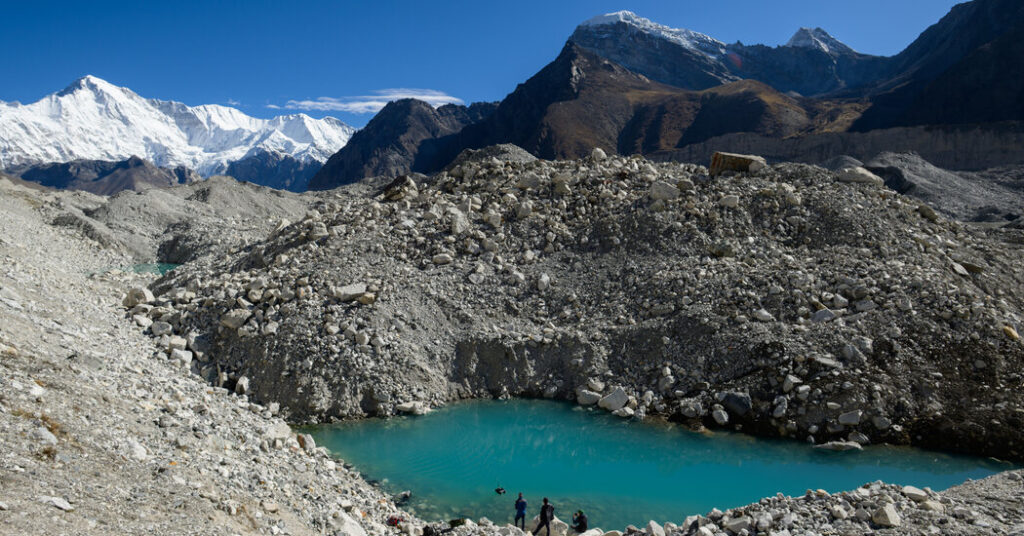
Himalayan glaciers, once blazingly white, are increasingly coated in pollution from car exhaust, coal plants and factories. As that black cover settles on glacier surfaces, it’s causing them to absorb more heat from the sun and melt faster, scientists warn.
It’s especially true in high-mountain regions like Langtang in Nepal, where a recent glacier collapse triggered devastating flash floods. Despite the region’s picturesque setting, it sits downwind from some of the most heavily polluted corridors in South Asia.
And while the exact trigger of the Nepal disaster is still unclear, scientists warn that air pollution is a growing threat to the world’s glaciers and one that, together with global warming, is ultimately increasing the risk of catastrophic glacier failures and floods. “It’s having a huge impact on these glaciers, especially as they become thinner and thinner,” said Marco Tedesco, a professor of geophysics at the Lamont-Doherty Earth Observatory at Columbia University.
These findings underscore how few places on earth remain untouched by pollution, whether microplastics in the depths of the Pacific Ocean or toxic PFAS “forever chemicals” in the Amazon.
Scientists are particularly concerned about soot on glaciers, and not just because of the heavy metals and other hazardous materials the pollution contains.
Just like wearing a black T-shirt when the sun feels hot, darkened ice is less reflective and absorbs more solar radiation directly onto the glacier surface. It weakens what scientists call the albedo effect, the ability of a surface to reflect solar energy back into space. (Albedo is the scientific term for the reflectivity of a surface, specifically measuring the fraction of solar energy reflected back into space compared with the total amount that strikes it.)
Clean, high-altitude snow reflects up to 90 percent of incoming sunlight. But when airborne pollutants like soot land on snow and ice, they can drastically lower the reflectivity, causing the surface to absorb more heat rather than bounce it back into space.
That can accelerate melting. A recent modeling study by researchers at the Chinese Academy of Sciences estimated that South Asian black carbon accounted for as much as a third of overall glacier-mass loss in the Himalayas from 2007 to 2016. And as the water that pools on the ice surface starts draining downward, carving tunnels deep into a glacier’s frozen body, the glacier can destabilize and even violently collapse.
Satellite data has begun to provide a clearer picture of the phenomenon. Research published this year analyzed six years of satellite data to study how black carbon and mineral dust from Pakistan’s industrial lowlands travel to high-altitude glaciers in the Himalayas, darkening ice surfaces and accelerating ice melt.
If pollution remains unchecked, “we may notice more and more loss in the future,” said Abira Sengupta, a researcher at the University of Otago in New Zealand who led the study. “And we risk more flooding, like we saw in Nepal.”
There are other compounding factors in play. For example, scientists have found that airborne soot traps heat in the air above the mountains, altering cloud formation and suppressing regional snowfall. That starves the glaciers of the new snow they need to grow. Pollution can also be captured by the snow and enter the ice pack itself, leading to more melting from within.
The sources of that pollution are many. Exhaust from gasoline vehicles is a major contributor. In South Asia, so are household cookstoves, traditional brick kilns and seasonal crop and forest fires.
But the findings also point to potential solutions. While carbon dioxide, the main driver of global warming, persists in the atmosphere for centuries, black carbon stays in the air for only days to weeks. That means reducing the amount being pumped into the air — for example through cleaner technologies like electric vehicles, renewable energy or cleaner stoves — can start to clear the air almost immediately, reducing the harm to vulnerable glaciers.
A 2023 study led by researchers at the Indian Institute of Tropical Meteorology used the spring 2020 Covid-19 lockdowns as a real-world experiment in protecting Himalayan glaciers. The team found that the temporary drop in pollution brightened snow cover and reduced Himalayan snowmelt by as much as 40 percent.
The point isn’t that the world needs to shut down economic activity, the authors noted. Rather, efforts to rein in air pollution could safeguard the region’s glaciers, which are otherwise under the threat of disappearing.
The post Dirty Ice Could Be Fueling Himalayan Disasters appeared first on New York Times.