August Wilson’s “Ma Rainey’s Black Bottom,” the first of his plays to reach Broadway, catapulted the author’s playwriting career.
It’s the only drama in Wilson’s 10-play American Century Cycle not set in Pittsburgh’s Hill District. But the series might never have come to fruition were it not for the way “Ma Rainey’s Black Bottom” heralded the emergence of a major new American dramatist.
Although it’s still one of his most produced works, “Ma Rainey’s Black Bottom” has the hallmarks of an early piece. Wilson discovers his playwriting voice in this play, but he’s still working out his approach to dramatic structure.
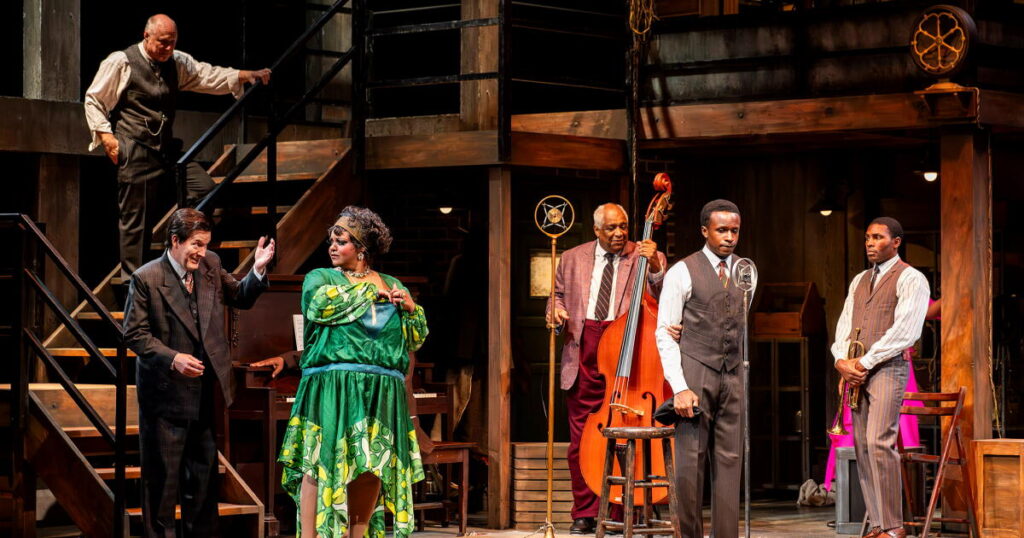
I wasn’t champing at the bit to see another production of “Ma Rainey’s,” but I’m glad I didn’t miss this latest Wilson revival at A Noise Within, directed by Gregg T. Daniel. Acted with breathtaking ensemble naturalness, the play seems lived in rather than performed.
The voices of the characters come through as though we’re eavesdropping from a discreet distance on their banter and squabbles. There’s nothing more riveting on stage than the truth, and here we have human beings in all their flagrant, unadorned and seemingly irreconcilable complications.
Set in a Chicago recording studio in 1927, the play splits its focus between the title character, a fictitious re-creation of the great blues singer Ma Rainey engaged in a power struggle with her white industry overlords, and the exchanges of her sidemen, a quartet of Black men with markedly different ambitions and sensibilities.
Levee, the role magnificently played by Chadwick Boseman in George C. Wolfe‘s 2020 film adaptation, may have more of a claim on the protagonist role than even Ma Rainey, who’s the play’s thematic center. As she throws her diva weight around in defense of a talent born out of Black suffering, she crystallizes the racial politics that Wilson powerfully illuminates.
But Levee’s role is the most dynamic in the play. A trumpeter who wants to move the band in a more musically sophisticated direction, he’s written his own arrangement of the song “Ma Rainey’s Black Bottom” that they’ve come to the studio to record. But Ma Rainey insists on doing it her way, even if Levee’s version is more interesting from a jazz perspective.
Overcome with anger from a traumatic childhood in which he witnessed his mother being raped by a mob of white men, he can’t tolerate slights, big or small. And his fiery temper, igniting at every possible moment with his older and more accommodating bandmates, turns this snapshot of history into genuine tragedy.
The bedraggled studio has been visually renovated with the wood-slatted elegance of Tesshi Nakagawa’s scenic design. Daniel’s production demands that we experience the play in a fresh light. The period is respected but never allowed to become stiff or artificial. This isn’t a waxwork staging.
Standing microphones, placed on different tiers of the set, never let us forget that Wilson was first and foremost a conductor of voices. He bestows on his characters arias, and Daniel’s cast delivers them as though the words were expressly made for these particular actors.
Jamar Gilbert’s Levee moves through the world as if it’s a battle zone, which of course for him it has been. Conflict has dogged him his entire life, and injustice is what he’s come to expect. His focus is on himself, his music, his sensual pleasures and his determination not to be anyone’s victim. He takes as much pride in the shine of his new shoes as he does in the flirtatious giggle of a pretty woman.
Toledo (Gerald C. Rivers), the philosopher and historian of the group, tries to broaden Levee’s perspective, but the two men have a knack for getting under each other’s skin. Their antagonism is fueled in part by Levee’s immaturity, but there’s also a divide in their worldview: Levee wants society to change in time for him to make good while Toledo is more concerned with the collective spirit of his people.
Meanwhile, Slow Drag (Alex Morris) mostly wants to get on with the session, collect his money and enjoy life as it was meant to be enjoyed, with whiskey, a little reefer and good-looking women. Cutler (Kai A. Ealy) tries to be a moderating influence, but he winds up as exasperated by Levee as Toledo.
The authenticity of the production encompasses the music. These actors don’t mime making music, as is often the case in revivals. They jam together, modestly but effectively enough to make their recording session real to us.
There’s nothing at all modest about Amber Liekhus’ musical talent. Indeed, Liekhus is the first actor who was able to convince me that the character of Ma Rainey really is a professional, jobbing singer. She doesn’t imitate being the mother of the blues, as her character is known. She earns the distinction through the wondrous depths of her soulful singing.
She refuses to be bulldozed by either Irvin (Bert Emmett), her manager, or Sturdyvant (Matt Foyer), the owner of the recording studio, knowing full well that they depend on her gift for their pile of money. Her insistence that Sylvester (Francis C. Edemobi), her nephew with a pronounced stutter, speaks the intro to her new record, is her way of asserting human control over corporate greed.
Liekhus’ Ma Rainey isn’t merely being temperamental, as Sturdyvant and Irvin assume. She’s using her limited leverage in whatever ways she can. There’s something touching about her imperiousness, a regal vulnerability that shines through even in her romantic interaction with Dussie Mae (CJ Obilom), whom Levee has his predatory eye on.
The honesty of the acting is so enlivening that I’m tempted to rank this production among the very best Wilson revivals I’ve seen. If there’s one slight misstep, it happens at the play’s violent climax. The moment makes perfect psychological and dramatic sense, but the confrontation needs a few more beats than Daniel allows.
But this encounter with “Ma Rainey” reveals that even early Wilsoncan, in the right hands, offer unadulterated playwriting greatness.
The post August Wilson’s ‘Ma Rainey’s Black Bottom’ at A Noise Within presents acting of the highest caliber appeared first on Los Angeles Times.