Early Saturday afternoon at the Daisy Chain Fields festival, in Irvine, California, the 25-year-old singer Eli twirled in a tank top emblazoned with a cartoon guitar while singing songs whose plasticky violins recalled the kind of music played on the Disney Channel in 2004. Dancers waved poles with dresses attached to them as if they were flags. She took out her phone, whose case was shaped like a cute bear, and read some thoughts she’d jotted down.
“This journal entry is to show you my fundamental belief that we must redistribute wealth,” she said. “We must love our neighbors no matter what they believe or don’t. We must unite with each other and radicalize. Eat the identity politics that deceive and divide us all, as well as”—here she broke into a ragged moan—“eating the rich!”
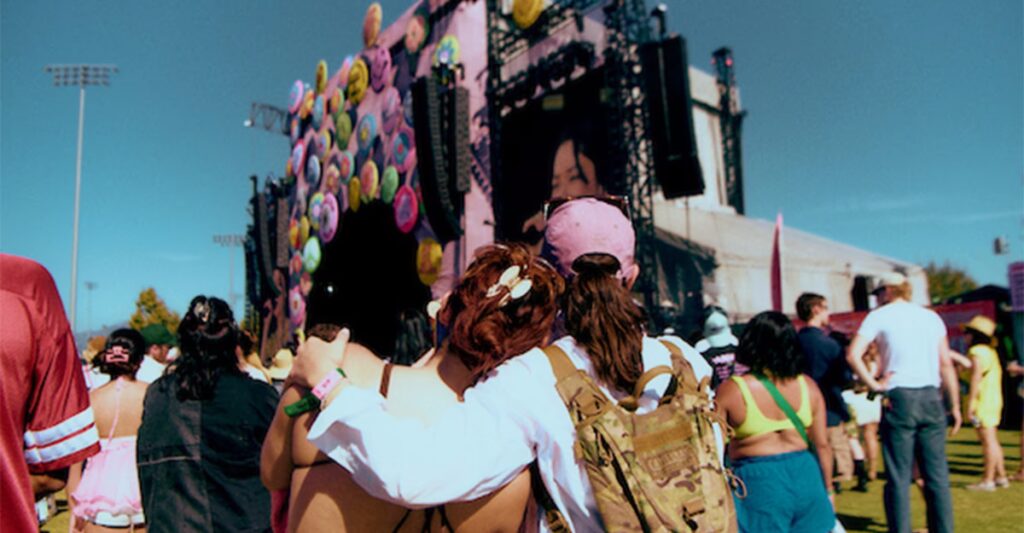
Eli is a campy artist of questionable earnestness, but her statement was in line with the mood of Daisy Chain—a place where girlish aesthetics that are so often seen as frivolous could accompany calls for revolution. Organized by the 23-year-old pop star Olivia Rodrigo, the inaugural edition of the festival featured an all-female lineup and raised $20 million—half of which was donated by Melinda French Gates—for an array of women’s-rights organizations, including Planned Parenthood and the National Domestic Workers Alliance. Even as a brutal heat wave threatened to smother the energy, the fest felt like a cheerful coming-out party—an announcement of the political commitments of a generation of mainstream artists more famous for singing about the self than about society.
Rodrigo patterned Daisy Chain off of Lilith Fair, the best-selling female-fronted touring festival that ran from 1997 to 1999, but the two events are a study in contrasts. Lilith’s co-founder Sarah McLachlan wanted to prove the viability of female musicians at a time when, she told the LA Times, radio programmers were reluctant to play two of them back-to-back. The lineup reflected a boom in singer-songwriters—Tracy Chapman, Jewel, Paula Cole, Indigo Girls—whose socially conscientious songs harkened back to the spirit of Woodstock (an obvious influence on the flower-powery Daisy Chain as well). Lilith’s aesthetics were earthen and earnest—a celebration of an ideal of strong, serious womanhood, much to the perturbation of late-night comics who cracked jokes about Cole’s armpit hair.
Today, women aren’t so marginal to the record industry; in fact, it can sometimes seem like Taylor Swift and her disciples are the record industry. But with power has come an inversion in content and style. The dominant female musical archetype of the 2020s isn’t the diva or the chanteuse—it’s the girlie, a term that conveys knowing immaturity and kitsch femininity. Girlies write songs about kinky sex while calling themselves princesses (as does the Daisy Chain singer Chappell Roan), or rap tough and fast while slathered in Barbie-pink body paint (as Doechii did on Saturday). The word is gendered, but it refers to a disposition, and thus can encompass gay guys and even those shy and sweet straight men known as babygirls.
Daisy Chain was for the girlies. Irvine’s Great Park was turned into a Lewis Carroll wonderland pocked with floral arrangements that seemed like crayon drawings come to life. Young kids ran around in tiaras while adults blended frilliness and adolescent-alternative stylings: blond locks with streaks of slime green, or the undying rebel-girl look of baby-doll dresses and Doc Martens. I wondered whether the commitment to daintiness explained even the dearth of shade at the fest; the tasseled umbrellas dotting the grounds were totally adorable and terribly unmatched to an El Niño August.
Girlie nation has arisen slowly, over decades. As my colleague Sophie Gilbert reported in her book Girl on Girl, Lilith Fair’s vision of female artistry was sidelined as record labels and radio stations began to favor smiling, pliable teenagers such as Britney Spears. Twenty-first-century youths grew up with former Mouseketeers serving as aspirational figures—and, eventually, as cautionary tales about giving up one’s agency for fame. Following in the example of Swift, who built on her teen-princess image with her own formidable songwriting, the new female guard arose. Some, like Rodrigo and Sabrina Carpenter, were trained by Disney; others, like Billie Eilish and Rachel Chinouriri (an ascendent U.K. singer and a Daisy Chain booking), got their start at home, posting music online. All of them project control with every slickly witty, emotionally frank, personally revealing hit they write.
What they haven’t projected much of, in their songs, at least, is the political edge of the Lilith crowd. Jewel broke out with an album whose title song made a shockingly frontal attack on bigotry (“You say he’s a faggot; does he make you sick to your stomach?”). But today’s young stars mostly just side-eye society’s problems in lyrical tales of hookups, breakups, and anxiety. When Roan calls for a “Femininomenon” (one song title), she’s implicitly calling for feminist change, but she’s explicitly calling just for more girls to ditch their dudes.
It’s not that Gen Z has nothing to say—many of these singers will readily riff about ICE and Gaza on their Instagram and in public comments. Rodrigo even delivered an onstage F.U. to the Supreme Court after the fall of national abortion rights, in 2022. But when it comes to their music, they prefer to focus mostly on the personal. Perhaps that’s because their milieu is the isolation and intimacy of the smartphone-enabled bedroom, not the social jungle of rock clubs and coffee shops. Maybe it’s because they watched progressive pop of the mid-2010s cheer Hillary Clinton’s failed presidential campaign and then spin itself into an even more didactic fervor during Donald Trump’s first term. On some level, girliehood may be a defensive posture amid conservative cultural backlash: a way to speak and shout and command lots of influence without being seen as threatening.
Indeed, Daisy Chain inevitably raised the question of how potent mere cultural visibility can be. Lines of people snaked through the grounds throughout the day—some for art installations by female artists, and many for immersive brand activations, including a pink, larger-than-life Taco Bell Baja Blast that had been scrawled on with diary-cursive font. The festival was a co-production of the convicted monopoly Live Nation and felt, in execution, like a re-skinned version of moneymaking glitz fests such as Coachella. Eli’s rallying cry with a side of giggles aside, the fest was not destabilizing power structures—it was part of them. Rodrigo is probably not the person to figure out what true counterculture might mean in this, the most consumerist decade of human history.
Still, she’s trying. Daisy Chain’s two stages were festooned with mock buttons, like on a backpack, that advertised the fest’s 10 nonprofit beneficiaries (representatives for which got to speak to the crowds before various sets). This great design decision served whimsical eye candy, evoked a lineage of hippies and women’s libbers, and dispensed useful information. The featured slogans—Bans off our bodies, Reproductive rights are human rights, WOMEN ROCK BETTER—hardly read like safe platitudes in post-Dobbs America, where some conservatives now openly yearn to roll back women’s right to vote.
Rodrigo is also at last tackling overt protest music. Shortly before the festival, she released a coolly seething post-punk single called “Serena Joy,” named for a character in The Handmaid’s Tale. Its exact concerns are a bit hazy: A lyric about gold-painted towers indirectly sneers at Trump, and a mention of bothered “neighbors” could be about ICE deportations or even tariffs on Canada. What’s clear is her overall call to wake up and fight back. I get shivers when she sings, “If you can’t throw a punch / You can learn how to spit.”
The fest’s lineup also made a statement by tracing an intergenerational feminist lineage instead of just spotlighting trendy new acts. One invitee was the ’90s rock band Garbage, whose singer, Shirley Manson, made painfully heartfelt speeches about resilience, growing older, and LGBTQ acceptance. Another was the indie band the Breeders, whose cooed harmonies and twisted guitars are the bay-leaf influence on Rodrigo’s tangiest songs. The reggae-inflected alternative singer Santigold—a representative of the 2000s indie landscape—invited members of the crowd onstage for a joyful, if less than impressively skilled, dance contest.
The most telling booking was Bikini Kill, the punk band whose riot-grrrl sound flipped clichés about demure young womanhood way back in the early ’90s. The lead singer, Kathleen Hanna, opened with some political scene setting: “This government hates us and wants us dead. They don’t give a shit about anybody’s health care. They don’t care if we’re dying in parking lots of curable illnesses.” Then she got to croaking and gyrating with a ferocity that offered a reminder to the Instagram-generation viewers that playing pretty isn’t the only way to command eyeballs. “This is the most engaged crowd I’ve ever seen in my life,” she said at one point, and a reason was clear: At Bikini Kill’s early shows, she would call for men to make room for girls to come to the front of the crowd, but here, she didn’t need to do that.
Read: How indie rock changed the world
Still, the festival’s greatest highlights came from gutsy and well-executed performances by young people. The first act of the day, the experimental electronic-pop artist Quiet Light, offered a calm and cooling welcome as she executed slow choreo in a billowing nightie. Later, the blue-haired songwriter Devon Again—a last-minute replacement after the girl group Katseye dropped out—knocked me back with country-tinged electro rock as crunchy as a kettle chip. In a stunt that recalled bros such as Blink-182 and Red Hot Chili Peppers, her band members dropped trou at the start of the set and rocked in their boxers.
As the sun fell, Roan took to the stage for a happy-go-lucky display of dominance. Her band, dressed in snazzy ’80s power suits, whipped up simmering disco tension punctuated by Van Halen–style guitar eruptions. Roan, who was styled like a flight attendant from the ’90s sci-fi movie The Fifth Element, also acted all-business: spare with her banter and springy on her feet as she flicked between chatty verses and lung-busting choruses.
After that stratospheric spectacle, Rodrigo’s headlining set felt a bit like a wobbly-legged return to Earth. Although she can dig deep and nail the big moments—“The Cure” sounded bottomlessly sad—she often leans too heavily on actorly tics that overplay the considerable personality already inherent in her lyrics. Listening to her sing her stellar recent song “Maggots for Brains,” I had the thought that her songwriting talent, bar for bar, matches almost any of her predecessors’. Just then, some predecessors joined her: first McLachlan, for a festival-shushing rendition of “Building a Mystery” and “Angel,” and then Alanis Morissette, to grin and yowl “Ironic.” The Gen X parents in the crowd, clearly worn down by a day of sticky-hot chaperoning, suddenly came alive.
The final song of the night was the most moving one: Rodrigo and Stevie Nicks, another special guest, singing “Landslide.” Their delivery was so careful and crystalline that no one could miss the relevance of the lyrics about generations bound together by time’s forward march. When Nicks sang, “Yes, I’m getting older too,” on her own, with a sad smile, my gut twisted at the thought of the trailblazers we’ve lost lately. But Nicks also conveyed hope—because today’s girls are only at the beginning of what they’ll accomplish.
The post Welcome to Girlie-Pop Woodstock appeared first on The Atlantic.