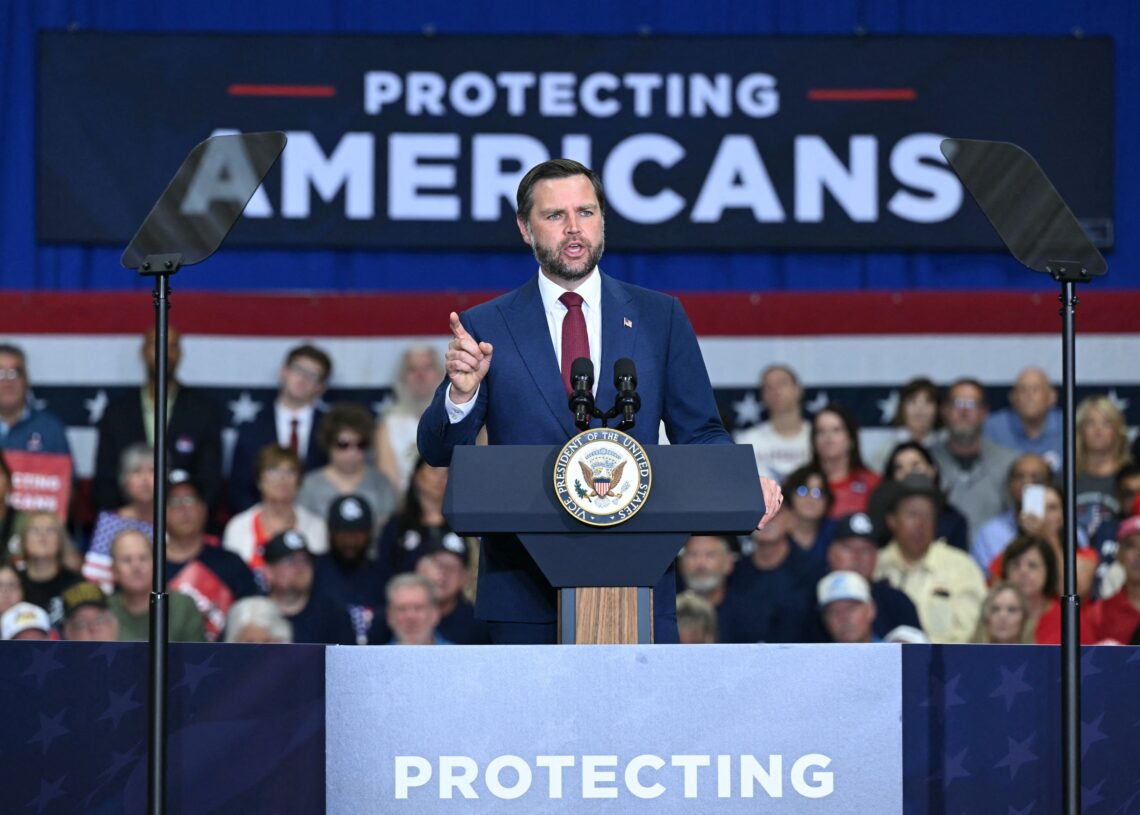
LAS VEGAS — There were few people at the Republican Jewish Coalition summit who would call Vice President JD Vance one of their favorite politicians.
But the vice president spoke here anyway Monday night, drawing a standing ovation after remarks that included lauding the U.S. relationship with Israel, according to two people in the room for the closed-door speech, and acknowledging that “not everybody in this room is going to agree with” him on his tolerance for some controversial podcasters.
His visit was designed to extend an olive branch as a chorus of anti-Vance voices in the GOP’s pro-Israel community have been raised against his potential presidential run, people with knowledge of his thinking said.
Vance treaded carefully. Up until late last week, organizers remained unsure whether the vice president would attend the event, which is taking place at the Venetian Resort on the Las Vegas Strip, a luxury casino and hotel complex developed and owned by the Adelsons, a family of billionaire GOP megadonors.
He ultimately decided to appear, though with the caveat that his remarks be closed to the media — a decision that puzzled many coalition members, but that organizers said allowed for a more genuine conversation. The Washington Post obtained a full recording of the remarks.
Vance was asked during the fireside chat about right-wing podcasters who have platformed antisemites, including former Fox News host Tucker Carlson, his longtime friend and ally who has found himself fiercely at odds with the U.S.-Israel lobby and facing allegations of antisemitism from prominent Republicans, including Sen. Ted Cruz (Texas). He declined to criticize Carlson specifically, instead training his fire on podcaster Nick Fuentes, who Vance said “really does hate Jews.”
“One area where I really do draw the line is on people who engage in what I call this blood guilt attitude, and I recognize a lot of people in this room may disagree with things that Tucker Carlson or Megyn Kelly or Joe Rogan have said,” Vance said.
The vice president said he likes Rogan, whose podcast he recently appeared on, despite some Jewish Republicans’ criticism of the conversation.
“I do not think that Joe Rogan and Nick Fuentes are the same, just substantively,” Vance said. “But as a political matter, I think that we have got to be willing to go everywhere and bring our message anywhere, to any person.”
Attendees said they were pleased Vance made an appearance at a meeting that is a frequent stop for Republican presidential hopefuls seeking to win over donors and Jewish leaders from the more hawkish wing of the GOP. But showing up was just one step, they said.
“Look, the vice president’s record on some of the things he said about Israel is not great, but this is an important step in trying to earn our trust, and I hope he does,” Eric Levine, a longtime Republican fundraiser and a coalition board member, said prior to Vance’s remarks. Vance was coming to speak to “some of the most pro-American-Israeli constituents that you can find,” he said.
A person close to the vice president, who spoke on the condition of anonymity to discuss Vance’s thinking ahead of the meeting, said Vance wanted to make an appeal to those in the crowd who might have questions about where he stands. Vance accepted the invitation because he wanted to attend, but did not have the expectation that everyone in the room would agree with him, the person said.
At one point in the remarks, Vance said he wanted to “address some of the obvious elephants in the room.”
“There is a growing suspicion among, I would call it under 40s, of the U.S.-Israel relationship,” Vance said. “I think my view is what we have to do is articulate why this is in the best interest of the United States of America, and actually get out there and talk about the ways in which it is in the best interest of the United States of America.”
The vice president said there is “a much deeper cultural symbiosis and harmony” to the U.S. relationship with countries like the United Kingdom and Israel than with other allies.
Another Vance ally, who spoke on the condition of anonymity to talk about strategy, said “there will clearly be criticism of him by some people” and always will be, “but it’s always better to have the conversation straight up.”
Vance has maintained that he views Israel as an ally. Some prominent conservative Jewish commentators and traditional Republican neoconservative thought leaders, however, have criticized the 42-year-old vice president for attacking Israeli officials and for his efforts to lead the U.S. peace negotiations with Iran, among other issues.
Allies of Vance have noted that his remarks on Israel and Iran — including criticism of officials in Israeli Prime Minister Benjamin Netanyahu’s government — are not out of step with those by President Donald Trump. The president has praised the memorandum of understanding Vance helped broker with Iran and has confirmed his own frustrations with Netanyahu, including calling him “crazy” and using expletives during a phone call with him earlier this summer.
One area in which Vance has diverged from Trump, however, is his refusal to disavow Carlson. Trump distanced himself from Carlson earlier this year, although that came after Carlson criticized his policies and was not in direct response to Carlson’s comments about Israel. Last week, Carlson called for Trump to be removed from office.
The Carlson question has emerged as a 2028 test for a number of well-known GOP Jewish leaders, even as Vance has maintained he is not interested in “canceling” conservatives who see things differently from him — and especially not doing so in response to pressure.
“There’s no question with the Jewish people whether or not [Secretary of State] Marco Rubio loves us. A lot of questions about JD,” said Sid Rosenberg, a New York City radio host and a vocal supporter of Trump. “The bottom line is, if you’re close to Tucker Carlson, the real Jews, they want no part of you.”
From the stage here, more than one speaker, including the head of the Republican Jewish Coalition, brought up the issue.
“We have taken Tucker Carlson on by name,” said former senator Norm Coleman (R-Minnesota), the coalition’s national chairman. Not in private, Coleman said, but “publicly, directly.”
“Because platforming Holocaust deniers, smearing Jews who stand with Israel and dressing up old hatred as ‘just asking questions’ is not MAGA, and it’s not conservatism. And we have said so, and we will keep saying so,” Coleman said during remarks earlier in the day, before speaking with Vance for the fireside chat.
“This is what a serious organization does. We do not demand purity from the other side, the other party and then excuse our own.”
The audience booed earlier in the day when Rosenberg mentioned Vance’s friendship with Carlson. But despite expressing his own preference for other candidates, Rosenberg urged the crowd to “give Vance a chance,” saying he expects Trump will ultimately anoint Vance as his successor.
Ari Fleischer, the White House press secretary for President George W. Bush and a coalition board member, said the issue mattered to those in attendance.
“Tucker has earned his place in a unique spot of ‘Do you stand with him or against him?’ And I think that’s going to be a delicate matter for JD.”
Afterward, Fleischer was among the RJC officials praising Vance’s appearance.
“The primary is a long way off,” Fleischer said. “It’s off to a good start tonight.”
Regarding his relationship with Carlson, Vance “will have to address it at some point, should he want the American Jewish vote and support,” said Shabbos Kestenbaum, a young activist and former Democrat who joined the Republican Party after Hamas’s Oct. 7, 2023, attack on Israel. “And so if he doesn’t address it now, he’s simply delaying the inevitable.”
The Vance ally who spoke on the condition of anonymity dismissed the notion that the vice president should be expected to disavow Carlson.
“He can disagree with Tucker, and there’s plenty he disagrees with with lots of his friends,” the ally said. “But we’re done with the canceling, period.”
Even if he isn’t the favorite here, Vance is still likely to eventually win the support of Jewish Republican activists if he becomes the nominee, coalition attendees said both openly and privately in conversations. The dynamic is similar to GOP donors who preferred Republican candidates other than Trump in both 2016 and 2024, but embraced him once Trump received the nomination.
“They’d rather have Marco Rubio, they’d rather have Ted Cruz. To be honest with you, he’s not our first choice,” Rosenberg said in an interview. “He may not be our third choice, but 99 percent of these people will vote for him over any Democrat anyway.”
Earlier in the day, Vance appeared at a rally in Michigan, where he criticized Abdul El-Sayed, the Democratic Senate nominee who issued an apology in recent days for comments he made in March that were criticized as appearing to minimize a March attack on a synagogue in the state.
Vance referred to El-Sayed, whom many Republicans and some Democrats have accused of antisemitism, as “evil.”
Vance also received kudos during the Las Vegas gathering. Ron Dermer, a former Israeli ambassador to the U.S. and most recently Israel’s minister of strategic affairs, recalled having a two-hour lunch with Vance in Jerusalem when Vance was running for Senate in Ohio several years ago.
“He asked me a lot of questions about why this serves U.S. interests,” Dermer said, referring to the U.S. alliance with Israel. While Dermer did not discuss Vance’s role in the current war with Iran, he praised him for playing “a critical role” in the 12-day war last year, when the U.S. and Israel bombed Iranian nuclear facilities.
“I will be forever grateful for the role that he played at that critical moment,” Dermer said.
Vance was endorsed by the Republican Jewish Coalition when he ran for Senate, attending the conference as a candidate in 2022 to mingle with members, but he did not speak from the stage. The coalition publicly praised his selection as Trump’s running mate in 2024, even as Rubio was widely considered the favorite for the job among pro-Israel activists.
correctionAn earlier version of this story incorrectly said that former senator Norm Coleman urged the crowd to “give Vance a chance.” The remark was made by Sid Rosenberg.
The post Vance woos Jewish Republicans, sidestepping question on Tucker Carlson appeared first on Washington Post.