When a storm is coming, there will always be signs. The wind might suddenly drop. The tide goes out farther than usual. Streamers of clouds sail across the sky.
It’s possible to misread or even ignore these signs — to insist that the drops of rain are just a passing shower — until it’s too late. That’s when the real trouble arrives.
What is true of weather is also true of human affairs. Regimes look strong until they don’t. Revolutions at home and upheavals in the international order — the two so often go together — are easy to see in retrospect, but are not always anticipated. Yet if we look closer, we’ll often find the signs were there.
Those of us who live in relatively stable and well-ordered societies would like to believe, like Voltaire’s absurd Dr. Pangloss, who stumbles from one disaster to another, that “all is for the best.” We might grumble about the economy or the prospect of another far-off war, or listen approvingly to radical voices from either end of the political spectrum, but we don’t expect our world to be turned upside down.
We would do better to heed the warning of another French writer. In Albert Camus’s postwar novel “The Plague,” when dead rats appear on the streets of the Algerian city of Oran, and people fall ill with a mysterious disease, the local government and most of the citizens ignore the signs until it is too late. “There have been as many plagues as wars in history,” Camus’s narrator says, “yet always plagues and wars take people equally by surprise.”
Today, there are dead rats all around. New temperature records have been set and reset this summer, the earth has baked in droughts, and wildfires have raged. Debt across advanced economies is approaching historic highs. Cuts in medical and food aid, most significantly by the United States, have caused unnecessary deaths and helped the spread of diseases, one of which, sooner or later, could become another pandemic. Artificial intelligence continues its rapid, unregulated rise, threatening jobs, security and, in darker projections, human existence.
Revisionist powers flout rules and norms with impunity. Electorates are angry and volatile. Slow, deliberate, necessarily discreet diplomacy, which builds trust and understanding, has given way to a performative, brash style more suited for TikTok-addled attention spans or the playground.
The Uppsala Conflict Data Program recorded 65 state-based conflicts last year — the highest number since 1946. Great powers find themselves bogged down in asymmetric wars with countries that are making the most of new technologies. President Vladimir Putin of Russia’s war in Ukraine, meant to be won in a matter of days, is creaking through its fifth year. Iran, using inexpensive, mass-produced drones to attack American forces and allies, has gained control, perhaps permanently, over a crucial corridor of world trade, drastically reduced U.S. missile stocks and mired President Trump in a war of his own choice.
A world war is not inevitable, but the threat of a catastrophic conflict between big and well-armed powers is closer than it has been for decades.
Like the people of Camus’s Oran, we are understandably reluctant to recognize just how much the world has changed. The problems are thorny, complex and tedious, and it’s easier to look away. So we holiday on beaches while wildfires rage; we ask A.I. how to train a new puppy, how to write that letter — to do our thinking for us. We hope that the wars will end, that the guardrails, institutions and alliances will be rebuilt, and that the world as we understand it will recover and endure.
But a new reality has arrived with startling speed. The world order that held together for most of our lives started to erode when those within it got too comfortable and complacent, and when there was too much acceptance — even approval — of bad behavior.
We have arrived in a new age of disorder. We must prepare ourselves, which begins with being honest about the seriousness of the moment we’re in, and accepting that our fragile system is faltering. That countries are already adjusting, for better and worse. And that any future of cooperation will have to look different.
What happens to those who refuse to adapt, and insist that a crumbling system can carry on? Consider three revolutions that were, and one that wasn’t.
On the eve of the French Revolution, France, Europe’s greatest land power, was probably bankrupt, in large part because of the enormous amounts it had borrowed to help defeat the British in the American Revolution. Extravagant and corrupt ruling elites had lost their way, and a growing middle class, excluded from political power, was demanding change. At the bottom of society, workers and peasants faced starvation and were increasingly desperate.
Powerful new Enlightenment ideas were circulating — some of which were imported from the American Revolution — about human rights and new forms of government that would give power to at least some of the people.
The French kings and their courtiers misunderstood the depth of the discontent and assumed that nothing could shake them from their privileged position. They were wrong: The monarchy was overthrown, and a chaotic, violent republic was born. Within a decade, Napoleon would be emperor.
There is no single pattern for revolutionary change, but those at the summit of a regime often fail to recognize how brittle it is. The Russian Revolution of 1917 was the consequence of defeat abroad, rather than a costly victory. But Czar Nicholas II also insisted, against all evidence, that no reforms were needed because Russians still adored him. In 1930s Germany, Hitler was invited into power by elites who thought, wrongly, that they would be able to use him, and that the existing system was strong enough to box him in.
Each of these revolutions had profound international ramifications. Napoleon led France to dominance over the continent, smashing old institutions and ideas like the divine right of kings to rule. The Bolsheviks, who seized power in Russia, preached and fostered revolutionary internationalism, waging war worldwide on capitalism and democratic nations. Hitler rearmed Germany, conquered most of Europe and murdered millions of Jews and many others in the name of Aryan dominance.
Sometimes, though, nations and their leaders read the tea leaves in time. In the 1820s, the British government was facing pressure from the middle classes, newly created by the Industrial Revolution, but shut out of political decision making. The British elite, attuned to the recent catastrophe in France, knew that it needed to adapt in order to survive. The 1832 Great Reform Act served as a pressure valve that widened the franchise sufficiently to avert a wider crisis.
It is easy to find the parallels in our own moment. Angry populations. Unelected elites with enormous wealth and the power to bend governments to their will. Leaders who refuse to build consensus or take advice. When Mr. Trump was asked in January what limits there were on his power, he answered, “my own morality”; King Louis XIV left France greatly weakened after the wars he fought, he said, for “la gloire,” his glory.
Those who choose to ignore the warning signs and dismiss history as irrelevant for the present might find themselves surprised and appalled when unwanted events happen to them anyway.
International order has always depended on the support of great powers and on the cooperation and buy-in of sufficient smaller powers. At the end of the Cold War, with the disappearance of the Soviet Union, the United States seemed ready to continue as the guarantor of the post-1945 system. Under President Trump, that’s no longer the case.
It could be that under a different president the United States will resume its role as hegemon, a willing supporter of international institutions and norms, a good and dependable ally and a firm opponent of tyrants. That world will once more go on as peacefully as it has — at least from some perspectives — since 1945. The big powers, including now China and India, will continue to rub along together, and something called an “international community” will recommit to its work to eliminate poverty, injustice, conflict and climate change.
But what if we are already in the early stages of what will be a protracted period of disorder? A world in which we cannot assume that what was true yesterday will be true tomorrow, or that seemingly solid institutions will endure. We might cease to be surprised at what the news brings each day. Natural disasters like the floods in Nepal and Tibet happen, and it’s not clear who is sending the cavalry. Do we shrug and carry on with our own lives? Conflicts — some with the potential to embroil great powers — occur with no obvious arbiter. Dependable alliances such as NATO are being tested and retested, and could fall apart. Russia’s hybrid war with Europe is expanding; China and the United States could clash over Taiwan; competition for resources in a warming, drier world is already stimulating violence.
This is a world of increasing unpredictability in which we are left, to a much greater extent than we expected, at the whims of our leaders, who are less bound by external frameworks and feel freer to make it up as they go along. We should be choosing those decision makers more carefully than ever — just when electorates seem less inclined to do so.
These are dark clouds. But the end of the old system does not have to mean the end of cooperation. We still have many of the components of an effective world order. We have a rich web of international institutions, many of them largely invisible, which manage the links among nations, from civil aviation to the internet. Treaties are still largely observed. International law and sovereignty can be hard to enforce and defend, but many of us still deplore the breaches. The very existence of an international public opinion can still put pressure on our leaders. Many of the organizations of the fading structures, among them the United Nations, the World Trade Organization and the World Bank, are increasingly drained of resources and meaning, but they still exist.
In a much-discussed speech in Davos in January, Prime Minister Mark Carney of Canada, months before trade talks with the United States broke down, described the end of Pax Americana as the end of a “pleasant fiction.” But other countries could push back, he said, particularly if they banded together in coalitions of shared values with shared goals. A number of middle powers, including Canada, Australia and Japan, are working together to fill the gap left by the withdrawal of the United States from its former role as the benevolent superpower.
Change is hard, but clinging to the old ways can be a dangerous delusion. In the summer of 1914, the British foreign secretary, Sir Edward Grey, and many others in positions of power in Britain and across Europe assumed that the latest crisis in the Balkans would be settled, as similar ones had been before, by a conference of the great powers. He failed to understand how rapidly Europe was moving to war and to use Britain’s great power to bring the different sides together. The First World War changed Europe and the world for good.
By 1945, Britain, the Soviet Union, the United States and their allies had fought two brutal world wars in the space of three decades. When they created the architecture of the existing order, they were very clear on what they wanted to prevent. The previous frameworks had failed, and they would create something new that would not.
The Panglossian road of unwarranted optimism is a dead end. But that doesn’t mean we cannot do what has so often been done before, and embark on the laborious process of building something afresh.
In a new series, “The New World Disorder,” Times Opinion will be exploring in the coming weeks the disintegration of the postwar international system and how countries are adjusting as America steps aside.
Margaret MacMillan is a historian and a former warden of St. Antony’s College, Oxford.
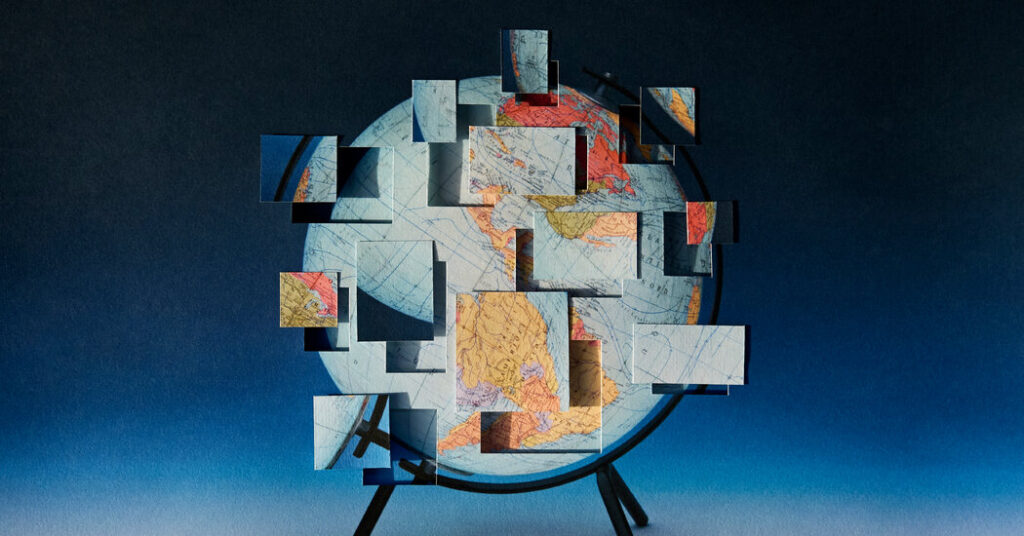
Source photograph by Plainview/ Getty Images.
The Times is committed to publishing a diversity of letters to the editor. We’d like to hear what you think about this or any of our articles. Here are some tips. And here’s our email: [email protected].
Follow the New York Times Opinion section on Facebook, Instagram, TikTok, Bluesky, WhatsApp and Threads.
The post This Is the New Disorder appeared first on New York Times.