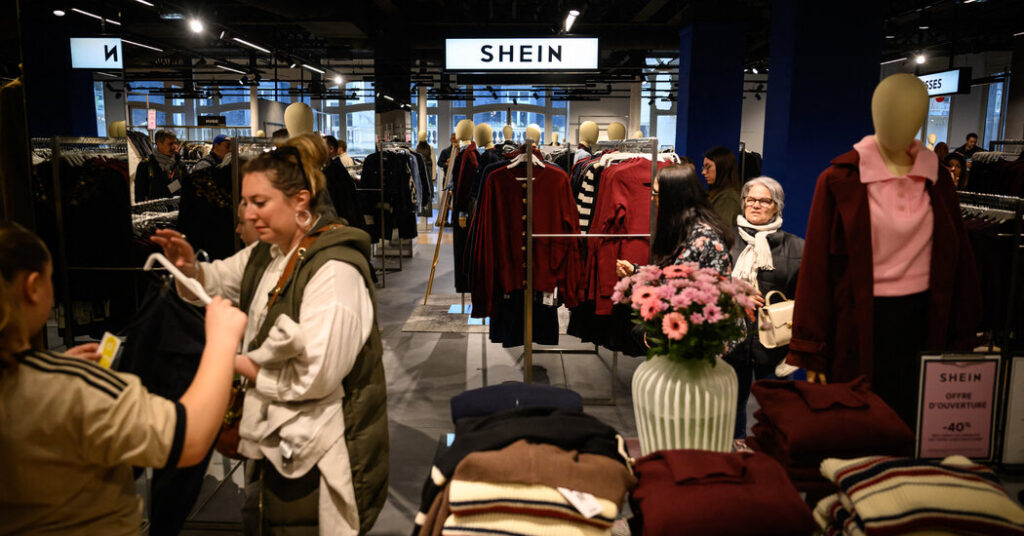
When Shein unveiled itself to the world at the height of its popularity several years ago, it touted a modern era for fashion — one built on speed, technology and an on-demand system capable of creating 4,700 new styles a day.
Today, that model is increasingly looking like a relic.
In the small factories that form the backbone of Shein’s operations in China’s southeastern manufacturing hub of Guangdong, there are no humanoid robots, quantum computers or state-of-the-art technology. Instead, there are dozens of workers toiling away in 10- to 14-hour shifts — in a way that, some say, feels almost like China of yesteryear.
“It represents the old tech, as opposed to the new tech,” said Nirgunan Tiruchelvam, who leads the consumer and internet division at Aletheia Capital, an investment advisory firm focused on Asia. “Shein would have had a lot more traction with investors in the 2021 vintage. But the world has moved on from blockbuster e-commerce listings.”
On Tuesday, investors largely agreed. Shares in Shein fell 6 percent in early trading, a humbling debut for a company once valued at $100 billion but now worth about a quarter of that. Its offering came after a wave of Chinese A.I. companies went public in Hong Kong and Shanghai, and years after Shein tried, and failed, twice in its efforts to list in New York and London amid opposition from officials and activists over working conditions at its facilities.
The drop in valuation reflects questions many investors have about the sustainability of Shein’s business — and whether it can find new ways to grow after the United States and Europe, two of the company’s biggest markets, ended tariff exemptions on cheap goods that had helped propel its low-cost model.
Shein’s offering comes weeks after shares of Unitree Robotics and CXMT — two companies that are driving the A.I. investment boom in China — skyrocketed in their public listings in Shanghai. Both firms are textbook examples of what the Chinese government calls “new, quality productive forces” — the slogan for the country’s plan to drive economic growth and innovation through high-value-added manufacturing.
Weiheng Chen, a senior partner at Wilson Sonsini, a law firm in Hong Kong, and head of its Greater China practice, noted that institutional buyers that were offered Shein shares before the stock went public took up just over 20 percent of the offering, compared with the roughly 50 percent typical of popular public listings.
“It’s a fashion company that is not that fashionable to today’s investors,” said Mr. Chen, who has been an adviser on many high-profile listings.
The challenge for Shein will be to regain interest among Generation Z, the group that powered the company’s rise during the pandemic. Michael Gunther, senior vice president of research and market intelligence at Consumer Edge, a firm that tracks spending data in the United States and Europe, said Shein had continued to cede market share in the United States, with the steepest losses among 18- to 34-year-olds.
“The fact that it’s continuing to lose share more with that group than other groups is notable,” Mr. Gunther said, adding that affordability and sustainability concerns could have prompted the shift. In May 2025, Shein raised prices in the United States to offset the surge in import costs.
In Britain, Shein’s market share gains have slowed despite no change in government policy, Mr. Gunther said. In Europe, where there is a fee of 3 euros on parcels entering the bloc, Shein’s market share has continued to slide, with declines most pronounced in France and Spain, he said.
Its current fortunes are a stunning reversal for a company that came out of nowhere to become the world’s largest online fashion retailer.
Shein got its start in 2012 when Sky Xu Yangtian, a Chinese search engine expert, founded the company with three former colleagues. The company compressed the fashion cycle from months to days, using algorithms to track emerging trends and placing initial orders of a few hundred units to test demand.
But behind its success are tens of thousands of garment workers subjected to a punishing pace. To complete orders on time, workers say, they put in 20 or more consecutive days without a single day off, according to a forthcoming report by China Labor Watch, a U.S.-based nonprofit that investigates labor conditions in China. The report, which has not yet been made public, was shared with The New York Times.
The organization interviewed 13 workers who made apparel at suppliers to the company as well as Shein employees who worked at its warehouses and corporate offices. The workers said they were given 10-minute breaks and reprimanded if they took too long to sew — for a pay of 7 to 28 cents per item.
Workers earn, on average, $850 to $1,130 per month, but only by working weekends and taking no days off, according to China Labor Watch.
Li Qiang, the director of China Labor Watch, said garment factories in China generally limited work hours to around 60 per week. “None are quite like Shein,” he said. “With Shein, working 100 hours a week is entirely possible.”
The findings from China Labor Watch appear to contravene Shein’s official supplier policy, which states that workers should not work more than 60 hours a week, including overtime.
In a written statement, Shein said it categorically rejected these characterizations of working conditions within Shein’s supplier ecosystem. It also said that the payment figures presented in the report “are not factual and misrepresent the wage structures used by suppliers.”
On Douyin, China’s version of TikTok, several Chinese workers say they are exhausted from working at Shein, with one calling it “Guangdong’s most tiring logistics factory.” Several factory owners say they no longer want to work with Shein because they face heavy fines for failing quality checks.
Shein has also come under fire for copying other people’s designs. Since 2021, it has been named as a defendant in 58 lawsuits in the United States alleging trademark infringement and racketeering, according to court records. The company said being named as a defendant in litigation “does not establish the validity of the allegations made” and that it continues to strengthen its intellectual property protection and enforcement.
Taken together, the challenges have complicated the story that Shein once sold investors — that it had reinvented fashion for the digital age. Now, the technology cycle has moved on.
Winston Ma, a former managing director at the China Investment Corporation, the country’s largest sovereign wealth fund, compared Shein to a stock like Zoom, which surged during the pandemic but has since fallen from its valuation highs.
“It was a superpromising concept during Covid,” Mr. Ma said of Shein. “But now it’s overshadowed by the new A.I. era.”
Li You contributed reporting.
The post Shein’s Lackluster Debut Shows a Fast-Fashion Model Left Behind appeared first on New York Times.