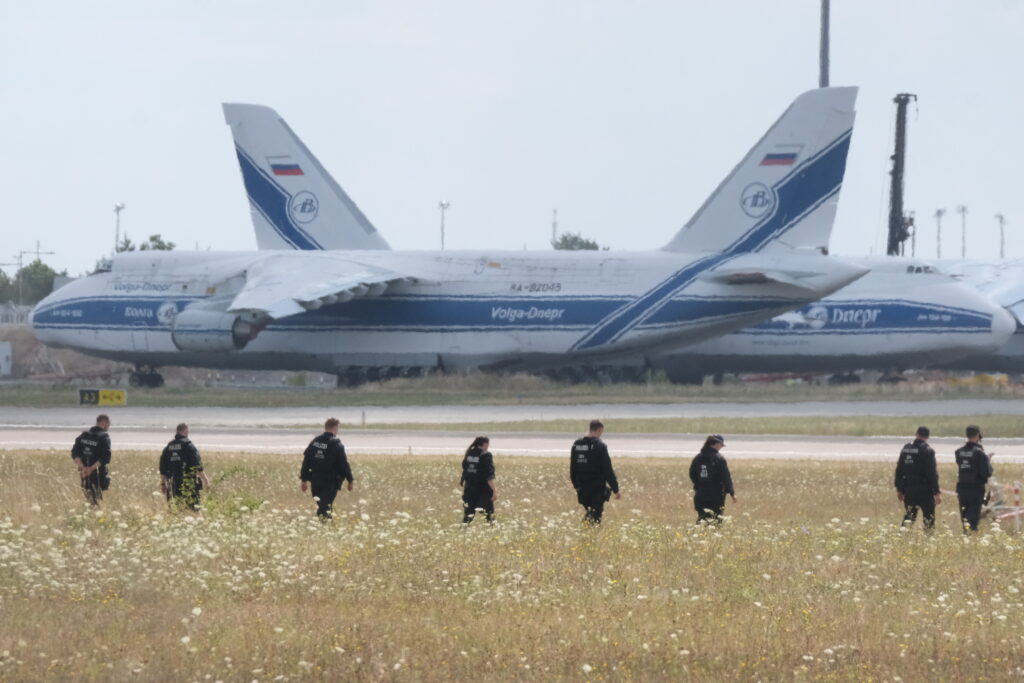
After weeks of reticence, German officials on Tuesday blamed Russia for an attempted drone attack last month at Leipzig/Halle Airport and announced they would summon Moscow’s ambassador to Berlin, close a Russian consulate and take other measures in response.
A drone stacked with military-grade explosives was found Aug. 4 next to a Ukrainian cargo plane at the airport, a hub that’s also used by European and NATO military aircraft. Security camera footage appeared to show the weapon striking the plane’s wing before falling to the ground without exploding.
Later that day, a second drone collided with a cargo plane in flight. Ten days later, German media has reported, a third drone was found with traces of military-grade explosives in a field near the airport.
Germany has concluded the attack was plotted by professionals working for the Russian state, Interior Minister Alexander Dobrindt told reporters in Berlin.
“The means used — such as the drone configuration, components, explosives and detonation systems — are known to us from other hybrid operations by Russia and its war against Ukraine,” Dobrindt said. The device indicated “a high degree of technical expertise,” he said, but its deployment appeared to have been left to “low-level agents.”
“Things didn’t go according to plan, thank God,” he said.
Russia denied the allegation.
“When such serious accusations are made, they must be backed by something,” Kremlin spokesman Dmitry Peskov told reporters. “Unless I am mistaken, no evidence has been presented. It is obvious that Germany is proceeding down a path of further escalation.”
German Foreign Minister Johann Wadephul described the attempted attack as one in “a long chain” of “aggressive actions in Europe” by Russia. Germany, which has helped lead European opposition to Russia’s war on Ukraine, “is no exception,” he said.
Wadephul said Germany would close Russia’s consulate in Bonn and terminate the contract for the Russia House in Berlin, a cultural center that German lawmakers have long alleged is a front for Russian espionage.
Officials also planned to summon Ambassador Sergei Nechayev, tighten controls on Russians entering Germany and increase pressure on Russia’s so-called ghost fleet of vessels that use flags of convenience, frequent name changes, GPS spoofing and other methods to transport Russian oil in evasion of Western sanctions.
A spokeswoman for the Russian Foreign said the Germans had “made up a pretext” to impose more sanctions on the country.
“Berlin itself is deeply implicated both in fueling the conflict in Ukraine and in taking part in terrorist attacks against civilians,” spokeswoman Maria Zakharova said. “They have long been bothered by the Russian House. So they were looking for something to latch onto. …
“Moscow will respond.”
German Chancellor Friedrich Merz had been under pressure from lawmakers, including some from his own Christian Democratic Union, to name Russia in the attack.
Concern is growing that Moscow is ramping up a campaign of sabotage against NATO allies aimed at undermining European support for Ukraine. In the past month, weapons facilities in Italy, Bulgaria, Estonia and Slovakia that supply Ukrainian forces have suffered mysterious explosions, fires and arson attempts.
“We assume that Germany will be the target of further hybrid attacks by Russia,” Dobrindt said. “There is a preparedness for hybrid attacks to cause ever greater damage.”
Some German lawmakers and former security officials said the countermeasures announced by Merz’s government fell short of the response needed to deter Moscow from further attempts.
“This is not enough,” said Arndt Freytag von Loringhoven, a former deputy director of Germany’s Federal Intelligence Service.
“At best this can be the first step,” said Nico Lange, a former Defense Ministry chief of staff. “But nobody will have a sleepless night in the Kremlin tonight.”
“It’s contradictory if they are saying its Russia, and not only Leipzig but there is a pattern of attacks and we attribute all of that to Russia, and then they are not sending a message of deterrence to Russia, saying if you do that again there will be dire consequences. So what’s the point of this?”
Other Western leaders reiterated their support for Germany on Tuesday.
“NATO stands in full solidarity with Germany after the Russian hybrid attack in Leipzig,” Secretary-General Mark Rutte wrote on social media. “I welcome the measures announced by Germany in response.”
Natalia Abbakumova contributed to this report.
The post Germany blames Russia for drone attack on airport, announces countermeasures appeared first on Washington Post.