John Boorman, the celebrated director of “Deliverance” and “Hope and Glory,” is one of David Kittredge’s favorite filmmakers. But when Kittredge, a Los Angeles director and writer, got the idea for a documentary about his hero, he didn’t want to focus on either of those Oscar-nominated movies or on the times Boorman won best director at Cannes.
No, Kittredge wanted to look at Boorman’s “Exorcist II: The Heretic.” When that big-budget sequel was released in 1977, it was lambasted as one of the worst movies in recent memory, if not all time. The thing was, Kittredge actually liked the movie. And he wanted Boorman, decades after the film drove fans to pelt theater screens with garbage, to talk with him about it, on camera.
“That was a bit of a courtship,” Kittredge admitted.
In the end, Boorman relented, baring his soul and still remarkable memory.
“It was the first time I’d really talked about a very hard period of my life,” Boorman said by email from his London home.
Filming on a single day in 2018, the British director recalled what it was like following up the first “Exorcist,” a 1973 blockbuster, and how the critical reception for his own film nearly drove him from the industry.
The result is “Boorman and the Devil,” which opened Friday. Filled with scenes from “Exorcist II” and animated recreations from that film’s seemingly cursed past, this documentary is remarkable not just because it reunites so many members of the original cast and crew, including a very introspective Boorman. It also invites viewers to reassess this controversial work — a critical re-examination that has been going on since the film’s infamous premiere five decades ago.
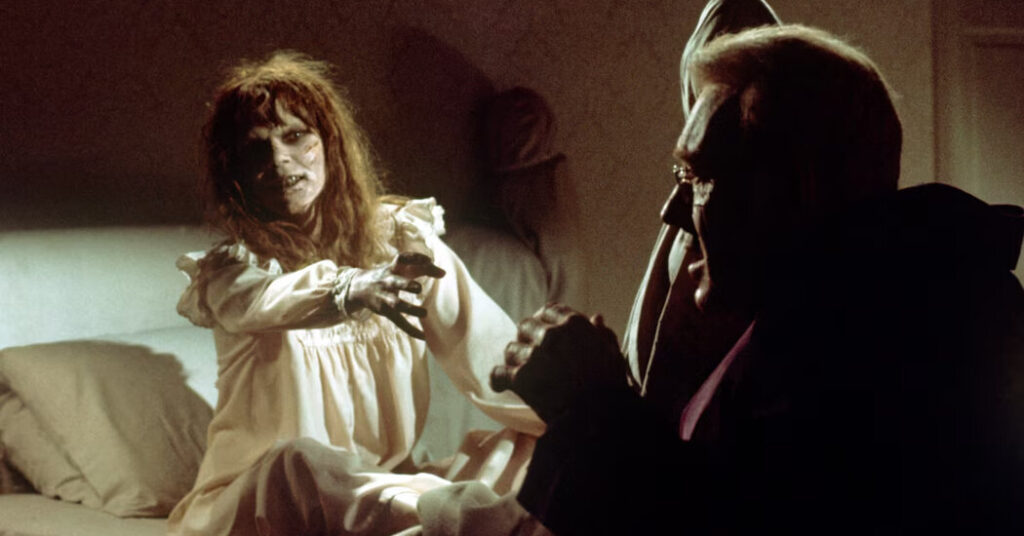
“Exorcist II,” opens with Regan, Linda Blair’s character, four years after her demonic possession and the other events of the first “Exorcist.” A psychiatrist (Louise Fletcher) and a priest (Richard Burton) try to uncover Regan’s hidden memories of the ordeal via a contraption called a “synchronizer.”
Despite its huge budget ($14 million, a record for Warner Bros. at the time) and star-filled cast, the production was troubled nearly from the start. Burton, a notorious alcoholic, came to set drunk; the production was shut down for five weeks after Boorman contracted Valley fever, a fungal infection, while shooting scenes filled with sand, dust and thousands of locusts on a Burbank sound stage transformed to look like an African village. “A lot of things went wrong in a lot of very strange ways,” Kittredge said.
Many stories come straight from the mouths of the folks who were there as the whole thing unraveled. Blair is here, talking about why she really didn’t want to do the film, but ultimately relented (because of the script and the understanding that the film was going to be done on “my terms”). Fletcher is here, too, blaming the multitude of problems on, yes, the Devil.
Kittredge also lured back many of the crew members, including the script supervisor Bonnie Prendergast and the second assistant director Victor Hsu. They “shot this movie 50 years ago and have hundreds of credits between them, and yet they remember this movie like it was last Thursday,” Kittredge said. “It was a hugely formative movie.”
Unlike the original, which was famously terrifying (stories of moviegoers becoming physically ill made the news), the sequel was weirdly, infuriatingly not. “I love the film,” the critic Jim Hemphill said. “But it’s not a horror movie.”
Viewers walked out of theaters and demanded their money back; the New York Times critic Vincent Canby panned the film, citing its “spectacular fatuousness.” At a sneak preview in Pasadena, Calif., angry viewers spotted studio heads in the back of the theater and chased them onto the street.
“Audiences who wanted to be scared, who expected to be scared, ended up laughing at the screen,” Kittredge said. “They were absolutely furious.”
Boorman admitted, “The release was obviously disappointing,” but added, “I worked with an amazing cast and crew, and they didn’t deserve the reaction the film received.”
For Mike Flanagan, who directed “The Exorcist: Martyrs” (due next year), the seventh film in the franchise, the problem was that Boorman never set out to make a horror movie in the first place.
He “wasn’t trying to scare people,” Flanagan said. “He was more interested in themes of technology and faith and superstition, and his lack of interest in the horror elements come across clearly.”
Like Kittredge, Flanagan is a big fan of the sequel — as much for its back story as for what appears onscreen. “It was this incredible mix of ambition and miscalculation, and it just didn’t work as a movie, but you couldn’t look away,” he said.
Over the years, the film has garnered second approving looks from a variety of Boorman fans, including the New Yorker critic Pauline Kael, who praised its “swirling, hallucinogenic, apocalyptic quality” and “visionary crazy grandeur”; Martin Scorsese declared that it surpassed the original.
There are certainly things to love. Shot by William Fraker, the Oscar-nominated cinematographer of “Looking for Mr. Goodbar” and “Heaven Can Wait,” the film includes trippy images of the good Regan meeting up with the demonically possessed one and pre-C.G.I. scenes of locust swarms in Africa created using thousands of the insects. “It is inarguably one of the best photographed movies ever made,” Hemphill said.
Even the odd moments — Blair tap dancing; James Earl Jones in a locust costume — have their unique charm. “There’s stuff in it that’s incredible,” Kittredge said. “And wouldn’t you rather have a movie that swings for the fences and fails, rather than one that doesn’t try much and is just fine?”
Perhaps not so surprisingly, Kittredge’s movie has gotten far better reviews than the one it dissects. Much of that, the director said, is thanks to his subject. “Boorman is one of our greatest filmmakers, and to have him talk as candidly as he did, not just about this film that changed the way he looked at films and nearly killed him, but also about his life and his approach to art, is so important to anyone who loves cinema.”
Flanagan agreed. “It’s amazing to look out at the minefield and see Boorman there, very generously showing off all of the body parts he’s left behind as he was blown to hell walking through that very same field,” he said.
“He speaks so eloquently about why he did the things he did and how he came out of that experience,” Flanagan continued. “I think it’s one of the most interesting windows into a filmmaker’s process that I can remember seeing.”
The post ‘Exorcist II’ Bombed in 1977. Its Director Still Feels the Sting. appeared first on New York Times.