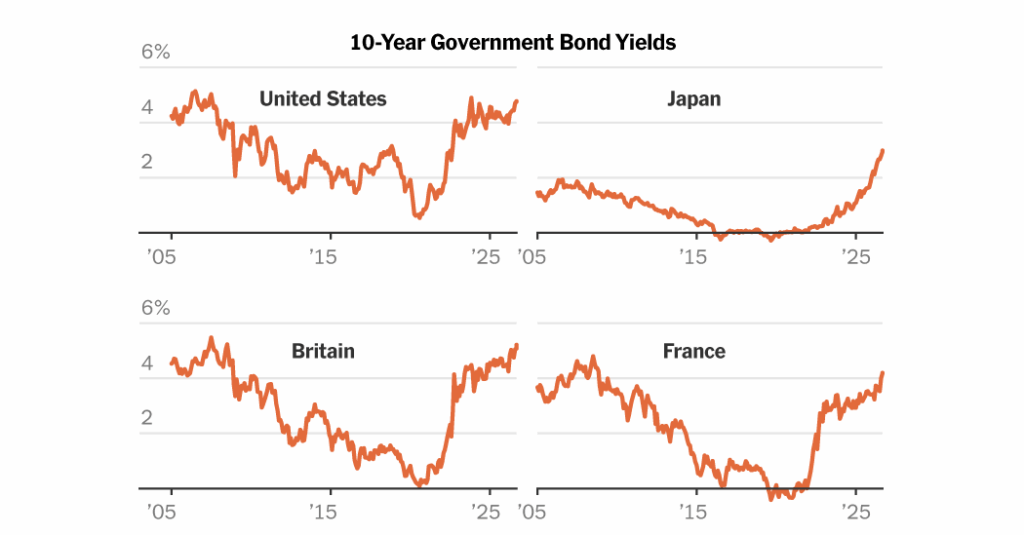
A global sell-off in government bonds intensified on Tuesday, pushing up borrowing costs in some of the world’s largest economies to their highest in decades.
The rise in bond yields squeezes government budgets and raises interest rates on a wide range of debt, including mortgages and business loans.
The yield on 10-year U.S. Treasury notes, perhaps the world’s most influential interest rate, reached its highest since January 2025, and the 30-year yield continued to hover around a two-decade high. Yields move inversely to prices, so the rise in yields reflects a drop in prices on weaker demand from bond buyers.
America’s rising borrowing costs have set off a battle between Treasury Secretary Scott Bessent and bond investors, but the factors pushing up yields in the United States are also issues in other big markets. In many advanced economies, widening budget deficits, high debt levels and stubborn inflation have unnerved investors who believe that governments are either unable or unwilling to take steps to improve their fiscal situations.
The rise in oil prices since the start of the war in Iran has compounded worries about stubbornly high inflation. Mr. Bessent is meeting with international finance ministers this week in Asheville, N.C., for a Group of 20 meeting, as U.S. foreign policy continues to upend the global economy.
This week, the yield on 10-year Japanese bonds climbed above 3 percent for the first time since 1996, the yield on 10-year British bonds reached their highest level since mid-2007 and 10-year German bonds hit levels last seen in 2011.
A borrowing binge by technology companies to build artificial intelligence systems is another factor in rising yields. Companies have issued billions of dollars in bonds, swamping markets and pulling investors away from government debt. These companies, known as hyperscalers, are also increasingly turning to euro-denominated bonds.
“It’s a global story,” said Peter Schaffrik, a strategist at RBC Capital Markets in London.
Stocks around the world also dropped on Tuesday. The S&P 500 fell in early trading in New York. Japan’s benchmark index, the Nikkei, closed lower and the Stoxx Europe 600 slipped half a percent.
One of the most pressing and unpredictable drivers of higher yields is the protracted war in Iran. As the United States and Iran renewed attacks recently, the price of oil and natural gas began to climb again. Brent crude, the international oil benchmark, rose on Tuesday to above $92 a barrel, nearly 30 percent higher than prewar levels.
The jump in energy costs — the prices of refined fuels like gasoline and diesel have risen even faster — has increased expectations of accelerating inflation that could prompt central banks to raise the short-term interest rates they control. Higher fuel prices also add enormous costs to governments in Asia and Europe, which are big energy importers.
Consumer prices in the eurozone rose 3.3 percent in August compared with a year earlier, the fastest pace of inflation in nearly three years, as energy prices stayed high. The European Central Bank is widely expected to raise interest rates at its policy meeting next week, which would be the second increase since the war in Iran started.
Traders have also increased their bets that the Federal Reserve may raise interest rates at its next meeting, later this month. The Fed chairman, Kevin M. Warsh, said last week that the central bank would have “work to do” if price pressures did not ease in a timely fashion. In his most hawkish comments yet, he said that responsibility for the long stretch of “sustained, elevated inflation” sat squarely with the central bank. Some of his fellow Fed policymakers have already been pushing to raise rates.
These expectations for higher interest rates are colliding with government debt levels, which in some cases have already reached eye-watering levels. America’s gross national debt topped $40 trillion for the first time last month, or more than 120 percent of the size of its economy. In France, public debt exceeded 3.5 trillion euros (about $4 trillion), which is 117 percent of the size of its economy. In Japan, the government is spending heavily despite a public debt pile that is more than twice the size of its economy.
In the eyes of investors, many politicians don’t appear worried enough about these debt levels. Instead, investors see government plans that are not likely to shrink budget deficits.
And so, with expectations of more borrowing to come, investors are demanding higher returns to hold government bonds.
“The confrontation between bond markets and policymakers is becoming a battle of attrition,” Geoffrey Yu, a strategist at BNY Mellon, wrote in a note on Tuesday. “Persistent inflation, fiscal concerns and energy risk continue to push investors to demand greater compensation.”
In Europe, France is at the forefront of investors’ skepticism in the run-up to a presidential election next year, in which none of the front-runners appear to have what investors consider credible plans to reduce ballooning debt levels. France’s reputation as one of Europe’s safer financial havens has been eroded, and it is quickly becoming the region’s most worrisome debt market, more than the southern European economies like Italy and Greece that were at the center of past debt crises. This summer, the yield on French government bonds climbed above Italy’s.
Some investors argue that rising bond yields are also, in part, a reflection of resilient economic growth, despite all the obstacles, a more encouraging explanation for recent moves in markets. “That may keep upward pressure on yields in the near term, but it is also creating a more attractive backdrop for long-term fixed-income investors” in Europe, Jenny Zeng, a fixed-income investor at Allianz Global Investors, wrote in a note.
The recent jumps in yields across global bond markets may have also been exacerbated by lower trading volumes in summer. Still, it is not clear whether the pressures pushing up bond yields will resolve anytime soon, analysts say.
Pressure from the bond market may force political leaders to take stronger action on debt and deficits, Mr. Schaffrik of RBC said. “You need some kind of a disciplinary factor, and that’s probably the bond market,” he noted.
The post Bond Sell-Off Threatens to Squeeze Borrowers Around the World appeared first on New York Times.