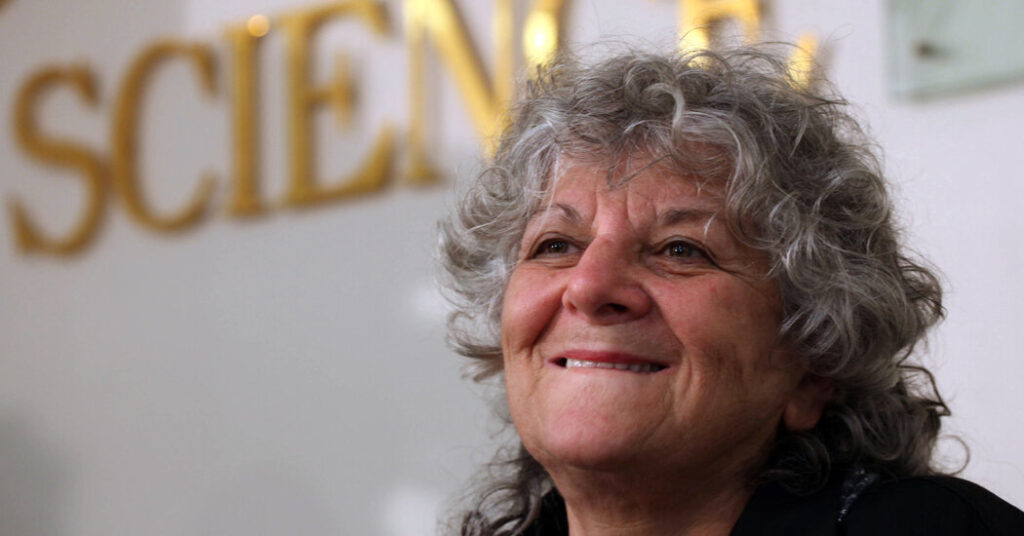
Ada Yonath, the boundary pushing Israeli chemist whose ingenuity and tenacity helped unlock the inner workings of the ribosome — the microscopic factory inside every living cell that builds the proteins necessary for life — died on Monday. She was 87.
The Weizmann Institute of Science, near Tel Aviv, where Dr. Yonath worked for decades, announced the death but did not provide further details.
Dr. Yonath’s career was defined by a question that had long bedeviled scientists: What does the ribosome actually look like? Determining its three-dimensional structure at the molecular level was considered one of biology’s most elusive challenges.
Her work, once dismissed as impractical, ultimately earned her a share of the 2009 Nobel Prize in Chemistry and opened new pathways for designing antibiotics at a time when drug resistance has become a global threat.
In her Nobel acceptance speech, Dr. Yonath, the first Israeli woman to receive a Nobel, recalled the years of skepticism and ridicule that greeted her research. Distinguished colleagues, she said, insisted that all that could be learned about ribosomes was already known, and warned that her project was a “dead end.” She said some even added: “You will be dead before you get there.”
For decades, scientists knew in broad terms that if DNA is the blueprint of life, ribosomes act as the construction crew. They understood that ribosomes translate genetic information encoded in DNA and assemble proteins accordingly.
But they could not see how the process worked at the molecular level, because ribosomes are extraordinarily complex and are constantly in motion as they perform their task. Capturing their structure — especially in action — seemed nearly impossible.
Working at the Weizmann Institute, Dr. Yonath set out in the 1970s to use X-ray crystallography to map the ribosome’s structure. The method requires coaxing molecules into forming crystals, which can then be bombarded with X-rays to reveal their atomic arrangement. It had worked for simpler molecules, but most experts believed ribosomes were too large, too fragile and too dynamic to crystallize.
Dr. Yonath disagreed. Her approach combined ingenuity with stubbornness. She turned to extremophile bacteria — organisms that live in harsh environments like hot springs and salt flats — reasoning that their ribosomes might be more stable and therefore easier to crystallize. She also developed techniques to freeze ribosomal crystals at very low temperatures, preserving their structure long enough for analysis.
Progress was slow and often discouraging. Yet she persisted, refining her methods step by step.
By the 1980s and 1990s, her laboratory began producing increasingly detailed images of the ribosome. Around the same time, other researchers — notably Venkatraman Ramakrishnan, an India-born, British American structural biologist, and Thomas Steitz, an American biochemist — entered the field. All three of their efforts culminated in the first high-resolution images of the ribosome’s structure at the turn of the 21st century.
For this achievement, they shared the Nobel Prize. In announcing the award, the Nobel committee highlighted their roles in clarifying “fundamental and medically important aspects of ribosome function” that led to “the development of novel antibiotic drugs in the ongoing medical struggle against the ever emerging drug resistance among bacterial pathogens.”
Dr. Yonath, chosen among the three to deliver the Nobel acceptance speech because of her resolve and her pioneering methodology for ribosome crystallography, said that the earliest inspiration for her research came from the polar bear.
“Polar bears pack their ribosomes in an orderly way in their cells just before hibernation,” she said, “and these stay intact and functional for months. I said: ‘If polar bears know how to do it, we can do it too.’”
Ada Esther Lifshitz, the older of two sisters, was born on June 22, 1939, in Jerusalem, then under British Mandate rule. Her parents, Hillel and Esther Lifshitz, were Polish immigrants who had arrived six years earlier.
Her father barely made a living as a rabbi and neighborhood grocer, and the family was forced to share a cramped apartment with her mother’s sisters and their families.
After the death of Ada’s father when she was 11 years old, the family moved to Tel Aviv, where her mother became a low-paid clerk in Israel’s finance ministry. To the publication The Conversation, she recalled being “shocked” when her mother, newly widowed and filling out forms, seemed helpless being able to perform basic calculations.
“This really stuck with me,” she said. “Knowledge and understanding and skills of this nature became important for me.” Because of her excellent test scores, Ada was accepted at Tichon Hadash, an elite high school. With her mother unable to cover the fees, Ada helped cover tuition by tutoring fellow students in math.
Following two years of mandatory military service, Ada returned to Jerusalem to earn a bachelor’s degree in chemistry in 1962 and a master’s degree in biophysics in 1964, both at the Hebrew University. In 1968, she received a doctorate at the Weizmann Institute in X-ray crystallography. She spent the next two years in postdoctoral positions at the Massachusetts Institute of Technology and Carnegie Mellon University in Pittsburgh.
Her marriage to Moshe Yonath ended in divorce. They had a daughter, Hagith Yonath, who is a physician and medical director at Sheba Medical Center in Israel; and a granddaughter.
Ada Yonath’s lengthy ribosome quest began in 1970 when she established Israel’s only protein crystallography laboratory at the Weizmann Institute. With funding low and skepticism from colleagues rising, she looked for support abroad.
In 1986, she began a 17-year collaboration with the famed Max-Planck Research Unit in Hamburg, Germany, where she ran a research unit for ribosomal structure in parallel to the ribosome research unit she headed at the Weizmann Institute.
This arrangement was facilitated by a long-term ribosome research collaboration with Prof. Heinz-Günter Wittmann of the Max Planck Institute for Molecular Genetics in Berlin. Professor Wittmann helped Dr. Yonath secure funding in Germany. He also provided her access to a synchrotron — a large, circular particle accelerator that produces high-intensity X-ray beams required to determine the precise, complex, three-dimensional atomic structure of the ribosome.
From 1986 to 2004, Dr. Yonath commuted frequently between Germany and Israel to oversee both her research teams and manage the intensive efforts involved in ribosome crystallization, a process of over 25,000 painstaking experiments.
In the end, scientists were able to see exactly how the ribosome reads genetic code and links amino acids together to form proteins. The process, once abstract, became vividly concrete.
The significance of Dr. Yonath’s work extended far beyond basic science. It had immediate and practical consequences for medicine — especially in the fight against infectious disease.
Many antibiotics work by binding to specific sites on a bacteria’s ribosome and disrupting protein production, effectively killing the bacteria or stopping it from multiplying. The challenge, however, is that human cells also have ribosomes. A successful antibiotic must attack bacterial ribosomes without harming human ones.
Before Dr. Yonath’s work, drug designers were operating partly in the dark. They knew that certain antibiotics were effective, but not precisely how they interacted with their targets. With detailed ribosome structures in hand, scientists could now see where antibiotics bind and how they interfere with protein synthesis.
This insight made it possible to design drugs more effectively. Researchers could modify existing antibiotics to make them more potent against resistant bacteria. They could also identify entirely new binding sites — new vulnerabilities in the bacterial machinery — and develop drugs to exploit them. In an era when antibiotic resistance threatens to outpace drug development, such advances have been crucial.
“Ribosomes are alive and kicking, and so am I,” Dr. Yonath said in her Nobel acceptance speech. She added with delight that her research stimulated “the imagination of many youngsters, including my granddaughter, Noa, who is showing continuous interest, and invited me at the ages of 5 and 13 to explain to her classes what the ribosome is.”
The post Ada Yonath, Chemist and First Israeli Woman to Receive a Nobel, Dies at 87 appeared first on New York Times.