To the Editor:
Re “Supreme Court Puts Ballroom Back on Track” (front page, Sept. 1):
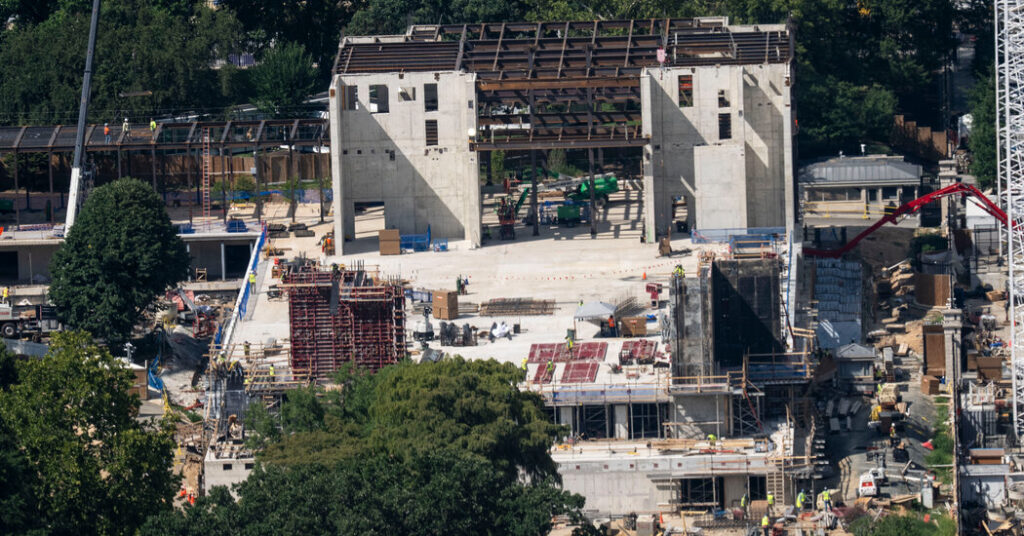
The Supreme Court decision to allow the Trump administration to continue building the White House ballroom is a manifestation of textual legal philosophy. Rather than ruling on the likely illegal construction of the ballroom, the court cited a technical issue of standing over the question of whether this project was legally approved.
It wasn’t.
Textual philosophy, a cornerstone of the late Justice Antonin Scalia’s legal approach, teaches that laws must be interpreted based strictly on their text without consideration of what the intent may have been. While it prohibits legislating from the bench, it also excuses the court from interpreting the spirit and intent of laws.
By citing the potential lack of standing in this case, the court has permitted the ongoing construction of an expensive building on government property. And not just any government property, but the presidential residence, which has huge implications for national security, symbolism and function.
Congress has been accused of avoiding its duty. We now have a Supreme Court that avoids tough decisions, leaving the executive branch to run wild.
David Weden Medfield, Mass.
To the Editor:
I was reading the reporting on President Trump’s executive order regarding mail-in balloting and made a connection between it and his construction projects.
It seems the courts are favoring the president by handing down decisions that, in effect, say, “We’re not sure this is legal, but we’re allowing construction — or changes to mail-in voting — to continue until we’ve had more time to consider the case.”
In the case of his construction projects, by the time the court rules, the ballroom will be too far along and will have to be finished. In the case of mail-in voting, states will not have time to make the changes, giving Mr. Trump an opportunity to declare them null and void.
It’s hard not to draw conclusions about the fairness of the courts and the corruption in our system.
Peter Hornbein Lafayette, Colo.
To the Editor:
I applaud the Supreme Court’s decision to allow work on the new East Wing to continue.
State dinners will finally have a suitable venue. The White House infrastructure is being updated, the architecture is elegant, and the Executive Mansion is being preserved.
The left reflexively opposes President Trump, but the country has grown tremendously in 250 years, and this expansion was needed long ago. Perhaps Congress can authorize the building of a larger West Wing at the scale of the ballroom, while preserving the historic Oval Office.
Mark Godburn Norfolk, Conn.
To the Editor:
President Trump is putting his name on sites all over Washington, while he is altering a symbol of America, the White House, by destroying the East Wing and adding a giant ballroom.
I can’t help but wonder if the Trump name looming over our nation’s capital will serve as a constant reminder of his failed presidency.
Doris Fenig Floral Park, N.Y.
To the Editor:
Whenever one of President Trump’s ill-conceived building projects are proposed or approved, I remind myself that it won’t take long to knock them all down.
Michael Filippini Pella, Iowa
Regulating Marijuana to Protect Children
To the Editor:
Re “The Weed Got Too Strong,” by Sivabalaji Kaliamurthy (Opinion guest essay, Aug. 26):
I commend Dr. Kaliamurthy for his thoughtful and important essay about the need to better regulate marijuana and protect children.
As the director of “Weeding the Truth,” a short documentary about marijuana’s impact on young people, I have spoken with teens, parents and educators who have seen firsthand the consequences of today’s increasingly potent products.
This is not the marijuana of decades ago. High-THC vapes, edibles and other products can pose serious risks to the developing adolescent brain, including addiction and mental health problems.
As marijuana becomes increasingly normalized and accessible, we must not lose sight of its potential cost to our children. Protecting young people — not tax revenue or industry growth — must take priority.
Lori Tobin Hull, Mass.
The post A Disputed Supreme Court Ruling on Trump’s Ballroom appeared first on New York Times.