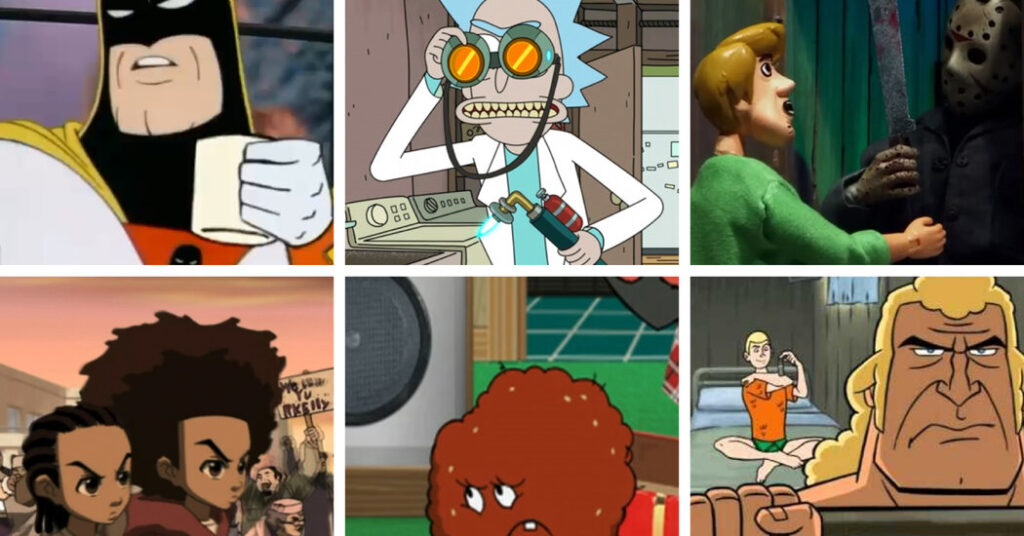
Twenty-five years ago something changed in the world of TV: Cartoon Network premiered a late-night programming block of animated shows geared toward adults. Early promos featured black-and-white video of grown-ups at a public swimming pool, with a voice-over saying, “It’s all kids out of the pool for adult swim.”
Adult Swim quickly became the space for experimental adult animation, featuring wild parodies, satires, mockumentaries and more, often presented in a lo-fi style heavy on improvised dialogue and offhand gags. The absurdist, surreal brand of comedy and D.I.Y. approach to the animation — think crude line drawings, reused footage, rough edits, paper-cutout-style graphics — pushed the boundaries of animated television. The Adult Swim sensibility became one of unhinged imagination and driftless humor that refused traditional storytelling in favor of utterly unpredictable and stratospherically weird entertainment.
In celebration of the Adult Swim anniversary, here’s a guide to understanding the programming block’s innovative and expansive style through some of its signature series.
Space Ghost Coast to Coast (1993-2012)
Nostalgic Characters, Surreal New Settings
“Space Ghost Coast to Coast,” a late-night talk show parody starring the 1960s Hanna-Barbera superhero, recycled pre-existing clips from the old show to create a surreal, non sequitur-driven series that incorporated real celebrity interviews. Space Ghost was the dopey host of a show directed and produced by a helmet-wearing lava man named Moltar and also starring a sassy evil mantis named Zorak as bandleader.
First aired as an original series on Cartoon Network and produced by Williams Street, the production studio which would later start Adult Swim, “Space Ghost Coast to Coast” set the eccentric standards for the programming block. Unabashedly weird and cringey, as halting in its dialogue as in its animation, “Space Ghost Coast to Coast” was unique for its mash-up of animation and real footage, improvised humor and scripted randomness. The show also spawned its own broader universe of repurposed heroes and villains who suddenly have to deal with the mundane parts of everyday modern life, with popular series like “Harvey Birdman, Attorney at Law” and “The Brak Show.”
Aqua Teen Hunger Force (2000-2023)
Absurdist Shock Comedy
So many Adult Swim shows are based on premises that have the chaos of an ad-lib. Take, for example, “Aqua Teen Hunger Force,” an absurdist chronicle of the daily lives of three anthropomorphized foodstuffs — Master Shake, Frylock and Meatwad — living together in a house in South Jersey. Their adventures are often plotless and surreal, featuring monsters and aliens alongside the (much more rare) regular humans. Narrative continuity? Not here.
With its 2-D digital graphics and stiff cutout animation, there’s an anything-goes sense to the show’s illustration and comedy. There are murderous toys, cursed sandwiches, mad scientists and juvenile aliens from the moon. The series was one of the earliest to strike that perfect balance of deliberately scripted jokes and improvisational comedy.
The Venture Bros. (2003-2018)
Parodies of Classics
One of Adult Swim’s longest-running series, “The Venture Bros.,” spoofed popular boy-adventurer stories like “Jonny Quest” and the Hardy Boys. But whereas those stories featured brave heroes using their brawn, wits and futuristic technology to get out of scrapes, “The Venture Bros.” told tales of the many failures of an inane group of men led by the crooked, narcissistic Dr. Venture, his naïve twin sons and their beefy, testosterone-fueled bodyguard.
Masculinity is a main target of the show, which mocks the faux innocence of the young boy heroes and the over-the-top macho swagger of the older male ones. The cast of quirky characters includes several parodic superheroes, supervillains and spies. There’s an invisible-limbed villain who appears as just a floating torso, and an oversexed chain-smoking Black Widow type in a skimpy unitard. “The Venture Bros.” is also an example of the storytelling range of Adult Swim; whereas a lot of the network’s more experimental offerings were stand-alone narratives, this series followed several characters and story lines over the course of its seven seasons, specials and a film.
The Boondocks (2005-2014)
Biting Racial and Social Satire
One of Adult Swim’s smartest shows, “The Boondocks” was about an upper-middle-class Black family living in the predominantly white suburbs of the fictional town Woodcrest. Created by Aaron McGruder, “The Boondocks” first gained popularity as a syndicated comic, but in its animated format was a much more daring, incisive critique of African American stereotypes and issues like gentrification, Black fetishization and racism both internalized and institutional.
“The Boondocks” was an amazing comedic showcase for its voice actors, especially Regina King, who voiced the two brothers at the center of the show. There was Huey Freeman, a young Black revolutionary who sported an Afro, called out regressive ideals and fought kung fu. His brother Riley was a gangsta-rap-loving boy with a fondness for Timbs, rims and stacks.
As the resident skeptic and provocateur, Huey set the tone for the show in the very first episode with one of its most famous lines: “Jesus was Black, Ronald Reagan was the devil and the government is lying about 9/11.” Heavy on expletives and its criticism of elements of white American culture and African American culture alike, the show was unafraid to take on even the most sacred and taboo topics, celebrities and institutions.
Robot Chicken (2005-present)
Predicting the Algorithm
This irreverent series of bite-size skits predicted the speedy, stylized, irony-dense content that would come to define the TikTok generation. As in most Adult Swim shows, nostalgia is a primary target for mockery. TV shows, commercials and movies from past and present are beautifully Frankenstein-ed together into parodies of modern media using a combination of stop-motion animation and Claymation with action figures and toys, emphasizing the show as a cynical experiment in play.
One of the longest-running Adult Swim series, “Robot Chicken” represents an unpredictable hodgepodge of fandoms and genre influences. Its delightfully varied cast of recurring voice actors and cameos has included Scarlett Johansson, Elijah Wood, Ludacris, George Lucas and Don Knotts.
Rick and Morty (2013-present)
Modern Adult Animation
The modern jewel of Adult Swim is this celebrated series, about the intergalactic adventures of an alcoholic super genius and his idiotic 14-year-old grandson. In “Rick and Morty” you can clearly see the influence of renowned adult animated shows like “Family Guy,” “The Simpsons” and “South Park,” and the inspiration from sci-fi adventure franchises like “Doctor Who” and “Back to the Future.” But it’s the particular cocktail of self-aware, high-concept storytelling with lowbrow scatological humor and graphic visuals that give it an Adult Swim identity.
“Rick and Morty” continues to exhibit some of the most sophisticated humor contemporary animated television has to offer, and it does so while tackling mind-bending ideas like the moral implications of living in a multiverse and cloning human life. The show also excels at character development regarding the evolving codependent relationship between a lonely, grieving, big-brained alcoholic and his family, who are usually at the mercy of his cosmic whims and inventions. “Rick and Morty” takes a cheeky approach to the clichés of franchised entertainment — callbacks, flashbacks, manipulation of the canon, spinoffs, side quests, referential humor — and simultaneously mocks these common tools of longform storytelling while using them to their best effect.
Videos: Adult Swim
The post 6 Series That Made Adult Swim a New Frontier of Animated Weirdness appeared first on New York Times.