Maj. Gen. Eyal Ben-Reuven spent his life fighting for Israel. He survived the Arab-Israeli war of 1973, when his platoon was nearly wiped out, then went on to command a division in the West Bank and lead Israel’s ground forces in the 2006 war against Hezbollah.
But in recent months, he has returned to the Israeli-occupied West Bank, touring the territory with retired generals and former Israeli officials like himself. He has walked through the remains of a Palestinian school looted by Israeli settlers, and listened to Palestinian shepherds and farmers describe being tortured by settlers who seize their livestock and land.
Now, General Ben-Reuven says he has an entirely different understanding of the risks facing Israel today.
“This, what the settlers are doing here, is the real threat to Israel,” he said, his eyes welling with emotion. “This is more concerning to me than Iran, Gaza or Lebanon.”
Other former high-ranking Israeli officials touring the West Bank with him shared the same indignation.
“This is ethnic cleansing, to put it simply,” Ephraim Sneh, a retired brigadier general and former minister of health, said of Israeli settlers’ attacks on Palestinians in the West Bank.
Asaf Agmon, a retired Air Force general, went even further, comparing it to what some Israelis’ forebears endured in the Holocaust — not in the scale of the violence, he explained, but in the effort to erase the Palestinian presence from much of the West Bank.
“Once a society behaves this way,” he said, “that society is doomed.”
Since the Hamas-led terrorist attacks of Oct. 7, 2023, when as many as 1,200 Israelis were killed, war has consumed Israel: first with Hamas, leaving Gaza in ruins and tens of thousands dead. Two rounds of fighting with Hezbollah in Lebanon. Two campaigns against Iran.
But in the shadows of those conflicts, a quieter front has emerged in the West Bank. Armed Israeli settlers, emboldened by the most right-wing government in the nation’s history, raid and torch Palestinian homes, mosques and villages with seeming impunity, openly trying to drive them out of the territory.
Israel’s top military commander in the West Bank has warned that the violence risked setting the territory ablaze. Settlers have waged thousands of attacks in the West Bank since Oct. 7, 2023, injuring thousands of Palestinians, according to the United Nations. More than 3,200 Palestinians have been displaced by settler attacks this year alone — double the rate of last year.
As the pace of violence climbs, the U.N. says, the number of Palestinians injured in settler attacks has risen from an average of one every three days in 2020 to more than three per day in 2026.
The retired generals condemning this violence are part of a small but rapidly expanding array of influential Israelis, including many from the upper echelons of the military and intelligence apparatus, who are publicly declaring the lawlessness in the West Bank a threat to Israel’s existence as a democracy.
More than 200 prominent Israelis signed a letter in June demanding that the government stop the attacks against Palestinian civilians in the West Bank. The signatories included two former prime ministers, more than three dozen retired Army and Air Force generals, the former heads of the nation’s foreign and domestic intelligence services, as well as rabbis, a Nobel laureate and one of Israel’s most revered novelists.
The retired officials come from across the political landscape, including from Prime Minister Benjamin Netanyahu’s own party, and many were considered security hawks.
In their letter, they called for an end to “Jewish terrorism” and the “ethnic cleansing” underway in the West Bank. And they accused Mr. Netanyahu’s government not just of being negligent in failing to stop it, but of pursuing “a deliberate government policy in which the entire security establishment — including the military, Shin Bet and the police — is knowingly complicit.”
The signatories cited tens of millions of dollars in government spending on illegal Israeli outposts and farms, and demanded a full accounting of all public money spent on roads, water, electricity, vehicles and weapons to support them.
They also accused the military of being complicit in the violence, saying soldiers stand by and watch as Palestinians are attacked, or sometimes even join settlers to assault Palestinian villages together.
The public denunciation, given whom it is coming from, is staggering. Activists have often asserted that Israel commits atrocities in the West Bank. But accusations of ethnic cleansing from such a large group of former prime ministers, generals and other top Israeli officials — the same people who once led their nation’s security forces — are virtually unheard of.
Many of the Israeli critics took part in extreme violence during their own military careers, ordering targeted killings, deadly airstrikes, raids and other attacks on Palestinians, including in the West Bank. But they say they were acting in the interest of Israeli security, under a chain of command and legal oversight.
The difference now, they say, is that the violence is unchecked, indiscriminate and targets innocent civilians, with the intent of clearing large stretches of the West Bank so that Israelis can take it for themselves and stamp out any prospect of a Palestinian state.
The injustice today, they contend, has crossed a moral red line in which the state is allowing, and sometimes helping, Israeli civilians beat, stab and shoot others with almost no consequences.
Azriel Nevo, who served as military secretary to four prime ministers, argued that other prime ministers he worked for “would have never allowed this to occur.”
“Shocking,” is how he described what he saw on the tour.
Some of the retired officials contend that the campaign against Palestinians in the West Bank is reminiscent of Nazism — an extraordinarily contentious assertion, especially in Israel, where many Jews found sanctuary after their families were eradicated in Europe.
Moshe Ya’alon, the former army chief of staff who served as defense minister under Mr. Netanyahu until 2016, recently likened the ideology of extremist Israeli settlers in the West Bank to that of World War II Germany.
“What is Jewish supremacy?” Mr. Ya’alon, long considered a security hawk, recently said on Ynet, an Israeli news site. “Eighty years after the Holocaust, ‘Mein Kampf’ in reverse. The master race is us.”
The prime minister’s office declined to answer questions about the growing accusations from former generals and other officials, and the government did not respond to multiple requests for data on settler attacks in the West Bank.
In the past, Mr. Netanyahu has dismissed settler violence as the unlawful acts of “a handful of kids,” while some ministers in his government have said there is no such thing as Jewish terrorism.
But as the condemnation of settler violence grows, including from the United States, pressure is building on Mr. Netanyahu to respond more forcefully. Settlers recently besieged several Palestinian homes, one of which belonged to an American citizen. In a rare statement over the weekend, Mr. Netanyahu said such “criminal acts” cause “immense harm” to the law-abiding settlers and “damage Israel’s standing in the world.”
The Israel military rejects any suggestion that it supports “the actions of violent groups” in the West Bank. It says its mission is to “protect all residents,” and that any soldier who takes part in settler attacks or stands by while they occur is “acting in complete disregard” of their orders.
Religious leaders who support Israeli settlements in the West Bank have applauded the military and government for backing a record number of new outposts and farms, which the retired generals say fuel settler violence in the West Bank.
But Rabbi Elyakim Levanon, who oversees a religious council in the West Bank, recently cautioned supporters to avoid violence, saying critics were using it as justification to harm the settler movement’s “reputation both in Israel, the U.S. and worldwide.”
The settler attacks are unfolding at the same time the Israeli military is acting much more aggressively in the West Bank.
Since the Oct. 7 attacks almost three years ago, more than 1,100 Palestinians, some of them combatants, have been killed in the territory, the vast majority of them at the hands of Israeli forces. That is roughly the same number of Palestinians killed in the West Bank from 2005 through 2022, according to the United Nations. Since 2023, 67 Israelis have been killed by Palestinians in the West Bank.
As the violence mounts — and killings, burnings and lootings go unpunished — even some who once defended the occupation are sounding the alarm.
“If I had to, I could make a legal defense of what the Israel Defense Forces have done in Gaza,” said Gal Levertov, the former head of the international division at the Ministry of Justice, who represented Israel before the International Criminal Court in The Hague.
“But what is happening today in the West Bank?” he added. “It’s indefensible.”
The Tour
The retired Israeli generals came to the West Bank on a trip organized by Yaakov Or, himself a retired general who spent much of his career in the West Bank.
Outraged by the escalating settler violence and what he views as the state’s involvement in it, Mr. Or has made it his mission to bring as many Israeli notables as he can to the West Bank to see for themselves.
He often begins with a warning.
“When I take you to see what is happening in the West Bank, you will have two choices,” he said to a group in June. “You can stay silent, and be complicit,” he told them, “or you can speak out, and tell everyone you know about what is happening.”
He then invited anyone who preferred not to be put in that position to leave.
Mr. Or, 79, began his military career fighting for Israel in the Arab-Israeli war of 1967, which ended with the Israeli occupation of the West Bank. He went on to oversee civilian and security affairs in the territory, before retiring from the state comptroller’s office, where he was responsible for investigating the Israeli defense establishment.
Since he began organizing the tours a little over a year ago, more than 250 participants — former military brass, high-ranking intelligence officials, prominent lawyers, economists and diplomats — have joined.
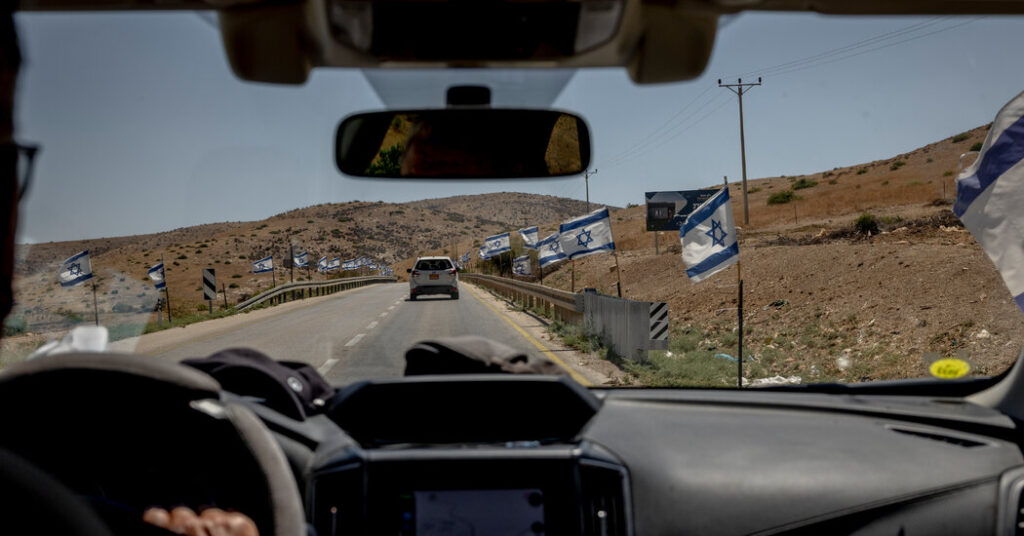
The New York Times accompanied him in June as he led several former officials including generals, a cabinet minister, a military aide to four prime ministers, an intelligence official, a state prosecutor and an ambassador on an arc through multiple villages in the middle of the West Bank. Along the way, highways were lined with Israeli flags, equally spaced, kilometer after kilometer.
Mr. Or asked the visitors to note the miles of new fences erected by settlers to hem in Palestinian villagers and keep them from accessing their own land.
And he urged participants to look for the prevalence of settler outposts, the makeshift frontier encampments placed on hilltops throughout the territory.
“It is showing us the overall concept — how to widen areas of control and narrow the places where Palestinian communities can live,” he told them.
‘They Want to Take My House’
In the village of Burin, Bashar Eid, a Palestinian farmer, took the visitors to his roof, limping behind them with a cane, the result of a settler attack that left him permanently impaired, he said.
He told them about the constant attacks from settler outposts, which were visible from the roof, positioned along the hillsides surrounding him. The settlers enter the village every day, he said, even during the Sabbath.
One recent morning, he said, he spotted a young settler boy walking on his land. When he asked him what he was doing, the boy told him to shut up or they would break his other leg.
“A kid told me that,” he said, shaking his head.
He could no longer farm his land, he said, because settlers attack him when he tries. His days have been reduced to sitting on his roof, watching for settler incursions.
“I don’t know what to do,” he said. “They want to take my house.”
The participants took notes as the heat bore down from above. The scent of sunscreen filled the air.
A former chief state attorney raised his hand. “It is absurd that Israeli forces are not doing their duty to protect them — it is embarrassing to even ask, but why don’t the Palestinians defend themselves?” he asked.
“I’m afraid if I defend myself, it will be even worse for us,” Mr. Eid said.
Mr. Or agreed: Any violent response from the Palestinians would invite retribution, which would be much more severe and likely include the Israeli military, he said. Retaliation against the settlers would be deemed terrorism, prompting more crackdowns, he said.
Raphael Schutz, a former Israeli ambassador to Spain, Norway and the Holy See, mopped sweat from his brow as he processed what he had heard.
He thought of his mother, who had fled Nazi Germany as a 9-year-old with her parents and siblings, he said.
Today, he said, when she watches videos of settlers setting cars ablaze and shooting innocent farmers, she feels shame.
“To her,” said Mr. Schutz, 68, “it is inconceivable that Jews can behave this way.”
“I’m glad I left the foreign service,” he added. “It would be impossible for me to explain this.”
A Community Erased
The Jordan Valley runs north to south along the banks of the Jordan River, a fertile plain that marks the eastern border of the occupied West Bank.
In the last few years, settler violence has displaced several Palestinian communities from the area, largely Bedouin encampments like Hamamat al-Maleh.
Just a few months ago, during a separate visit to the community by The Times, a few families were still holding on. Violent incursions in the middle of the night had already forced most to flee. But when we visited in February, we came across a couple of Palestinian families holed up in a stone edifice from Ottoman times, clustered together on mattresses on the bare floor.
“We don’t even sleep an hour,” said Mohammad Khalil, 37, who was born in the community, as his father had been. “If they come and you’re asleep, you won’t survive it.”
At the time, a school constructed with donor funds sat empty. The last of the students had fled a few days earlier. By March, after a series of settler raids, thefts and attacks, Mr. Khalil and the other holdouts gave up and left, too.
Not long after, residents and activists said, settlers came with a bulldozer and leveled the school. Settlers shared a video of themselves celebrating Passover amid the ruins.
By the time the retired Israeli generals and other dignitaries arrived in late June, the Palestinian residents were long gone. Mr. Or wanted to show them what an erased community looked like.
The group walked past the broken school structure, where loose strands of rebar poked through the rubble like unkempt hair. A roll of artificial grass lay in dirty folds. A broken concrete wall betrayed traces of a destroyed mural.
Within the old Ottoman structure, an office was upended. Desks in disarray, a door torn from its hinges lying on the floor.
Elie Avidor, an activist who helps organize Israeli volunteers to protect Palestinians from settler attacks, said he was in the village not long after the school was destroyed and took video, which he later shared, of settler women and children looting notebooks and markers from the office.
Left behind were piles of academic detritus, smashed cabinets, shards of glass and scattered papers.
“When you are burning books, when you are destroying knowledge and attacking children, you’re like the Germans,” said Nehemia Dagan, 86, a retired Air Force general who helped build Israel’s helicopter capabilities and also served as the chief education officer of the Israel military.
“We have lost ourselves, and we have lost this fight,” he said, shaking with rage.
“We must separate,” he added, referring to the two-state solution, which would establish an independent Palestinian state alongside Israel. “Not for their sake, but for our own.”
‘It’s Like a Jail’
On the last stop, in a barren valley in the northern Jordan Valley, a young Palestinian farmer stood before the ranks of Israeli visitors and pointed.
Behind him, a settler outpost had been scraped into the side of a hill, the Israeli flag flying over it. In front of him, a few hundred feet away, stood a long line of Israeli flags, planted one after the next, as if lining a parade route.
Nearby, settlers had erected a fence, turning his farm into something of a holding pen.
“Six months ago, this was our land,” he said. “Now, it’s like a jail.”
As recently as January, life in his village had been relatively normal, he said. They farmed, grazed their sheep, and came and went as they pleased.
That ended abruptly with the arrival of the first settlers, who stationed themselves on the hillside, he said. Now, the farmer and his family could no longer use his farmland or harvest his crops.
He was forbidden from accessing it, he told the assembled visitors, and every time he tried, settlers called the police. He had already been arrested four times, he said, though he was always released.
But whenever he called the police to report harassment, or vandalism of his water tanks, “they never answer,” he said. The Israeli national police said they “investigate every complaint or incident involving suspected criminal activity, impartially.”
The Palestinian farmer said he decided to sell his sheep, rather than lose them to settlers or starvation because he could no longer go out and graze them.
“They should see this reality, and not accept it,” the farmer said, referring to the Israeli generals.
Many of the men assembled had played their own roles in violence against Palestinians — authorizing killings and striking locations, knowing that children might die in some cases — because they believed it helped ensure Israel’s security.
But the settler attacks in the West Bank were not making Israel safer, several of the retired generals said. Instead, the violence and intimidation were having the opposite effect, they argued.
“When you ruin the image of Israel, the diplomatic value of Israel and the core values that hold the military together, you achieve nothing,” said Mr. Agmon, the retired Air Force general.
“I’ve earned the right to speak,” added Mr. Agmon, 78, whose grandson, an Israeli soldier, was killed in Lebanon last year. “My family and I paid the highest price for this country.”
“I am ashamed of what our people are doing here,” he said.
The post These Generals Fought for Israel. Now They See ‘Jewish Terrorism’ as the Threat. appeared first on New York Times.