The Smithsonian Institution on Monday approved converting one of its current buildings into the National Museum of the American Latino, bypassing the need for congressional approval of a new site at a time when the Smithsonian has been criticized by the Trump administration.
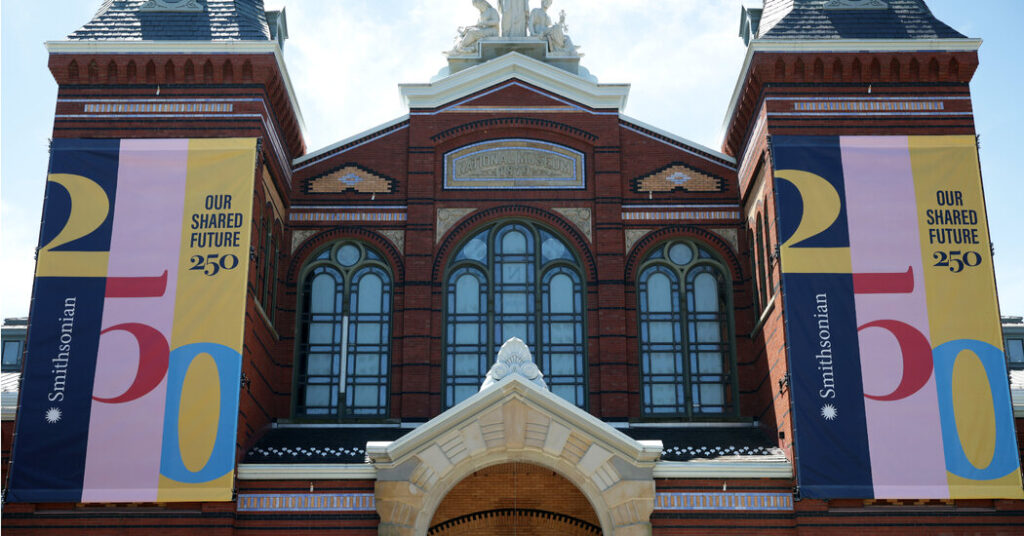
The decision by the institution’s governing Board of Regents will place the museum in the Arts and Industries Building, a 19th-century structure that is owned by the Smithsonian and sits on the National Mall in Washington.
“Today marks a major milestone in a dream and effort of decades in the making,” Jorge Zamanillo, the museum’s director, said in a statement, adding that the location places “the U.S. Latino story at the heart of the National Mall and the American story.
“We could not be more excited to build on the rich legacy of this historic building,” he continued, “and transform it into a next-generation museum that celebrates the history, culture and contributions of Latinos in the United States.”
In a statement, the board said its vote set the building as the “permanent site” of the museum and “concludes the site-selection process.”
Other sites that had been considered were controlled by the National Park Service and would have required approval by the Republican-controlled Congress. This year, President Trump’s executive budget stripped out funding for a Latino museum in favor of creating a decentralized Smithsonian Latino Center that would present exhibitions across some of its 21 museums.
Raising the money to retrofit the Arts and Industries Building for the Latino Museum remains a hurdle for the project, which is expected to cost about $1 billion, with half to come from federal sources. The museum has so far raised $72 million in private funding.
Though it has lacked a permanent home, the Latino Museum was authorized by Congress in 2020 and opened a temporary space at the National Museum of American History in 2022. There it has presented two exhibitions: “¡Presente!,” a survey of Latino history, and a show about salsa.
Some conservatives have accused the Latino Museum of presenting a negative version of Latino history that emphasizes grievances and struggle rather than accomplishments and triumph.
Mike Gonzalez, a senior fellow at the conservative Heritage Foundation, called Monday’s vote an effort by the Smithsonian board “to duck a congressional vote they would lose.”
Trump Administration: Live Updates
Updated
- Bessent claims that Canada is too small to fight a trade war.
- The Supreme Court allows Trump’s White House ballroom construction to continue.
- More than 100 trucking schools are closed for English-language lapses.
A recent report by the Heritage Foundation criticized the content of “¡Presente!” for, in part, its “strange fascination with drag queens, transgender activists, lesbians and gender nonconformists.”
In 2023, a group of Latino Republican congressmen led a vote to eliminate the museum’s funding. Some commentators characterized the “¡Presente!” exhibition as a Marxist portrayal that painted Latinos as victims of an oppressive United States.
Latino Museum officials initially felt strongly about building an architecturally distinct home on the National Mall, in part because it can be easier to solicit private donors for new construction projects. But they ultimately settled on the idea of using the Arts and Industries Building as the political climate became more challenging.
Eduardo Díaz, the former interim director of the Latino Museum, commended the decision as a compromise. “There were people saying, ‘We don’t want a hand-me-down,’” he said. “I get that, but I don’t think it’s a bad choice to go there.”
Opened in 1881 as the country’s first U.S. national museum, and located near the Smithsonian’s administration building, known as the Castle, the Arts and Industries Building is currently used for exhibitions and programs. It reopened to the public this summer after having been closed for renovations since 2004.
Diaz, who also served as the director of the Smithsonian Latino Center — a precursor to the museum — said he had long argued for locating the institution in the Arts and Industries Building as a hub for other museums and cultural centers that could serve Latino communities around the country. “The chances of a working-class family from El Paso, Texas, to go to the mall? Not likely,” he said. “It makes sense to look at another model for a national museum, not do the build-it-they-will-come model.”
Diaz defended the “Presente!” exhibition that drew fire from conservatives. He said in an email that it “presented a well-researched, diverse and balanced view of U.S. Latino history and culture” and that it “was well-attended and received very positive reviews from visitors.”
President Trump’s second term has been marked by recurring battles with the Smithsonian, which he has derided as a politically biased institution that presents an overly negative view of American history. On July 4, the White House released a report about the Smithsonian’s American History Museum, which accused its director of “radical activist ideology” and the museum of undermining “faith in American institutions.”
At the meeting on Monday, Secretary Lonnie G. Bunch III said he was preparing a response to the report and would share it with the board’s executive committee next week.
Mr. Bunch has typically taken a measured stance in responding to the White House efforts to influence programming and personnel at the Smithsonian, which relies on federal funding but has long been viewed as operating independent of the executive branch.
The post Smithsonian to Put Latino Museum in Existing Building It Controls appeared first on New York Times.