President Trump arrived in Pittsburgh last summer on a mission to bring the country’s artificial intelligence boom to the Rust Belt.
Flanked by senators and cabinet members, the president celebrated pledges from Google, Amazon and Anthropic to invest more than $90 billion in data centers and other technology in the region.
“Today’s commitments are ensuring that the future is going to be designed, built and made right here in Pennsylvania and right here in Pittsburgh,” Mr. Trump said. It was part of his administration’s efforts to support a sector it sees as critical to the country’s economic growth and national security.
At the time, Gov. Josh Shapiro, a Democrat, was all-in, fast-tracking approvals for the enormous Amazon data center and offering incentives to bring data centers to old industrial hubs like Pittsburgh, which never fully recovered from the collapse of the steel industry. More than 120 data centers have been planned in the state.
But now, things have shifted.
A national backlash against the rapid build-out of data centers has made them a top issue in this fall’s midterm elections. The governor, a potential 2028 presidential candidate, two weeks ago labeled data center developers “predatory” and signed an executive order for what he described as “the nation’s strictest guardrails” for the facilities. He said the state would no longer speed approvals and that data centers must meet new requirements and be approved first by local communities before advancing.
Governor Shapiro’s office did not reply to requests for comment. In announcing the executive order, he said he was responding to residents who are alarmed by the speed and scale of these projects.
“Data centers cause real challenges in terms of energy use, emissions, water usage, community issues, and nobody is managing it,” said Costa Samaras, director of the Scott Institute for Energy Innovation at Carnegie Mellon University in Pittsburgh. “It’s a free for all.”
But in struggling western Pennsylvania, unions and business groups welcome the projects, many of which are already moving forward.
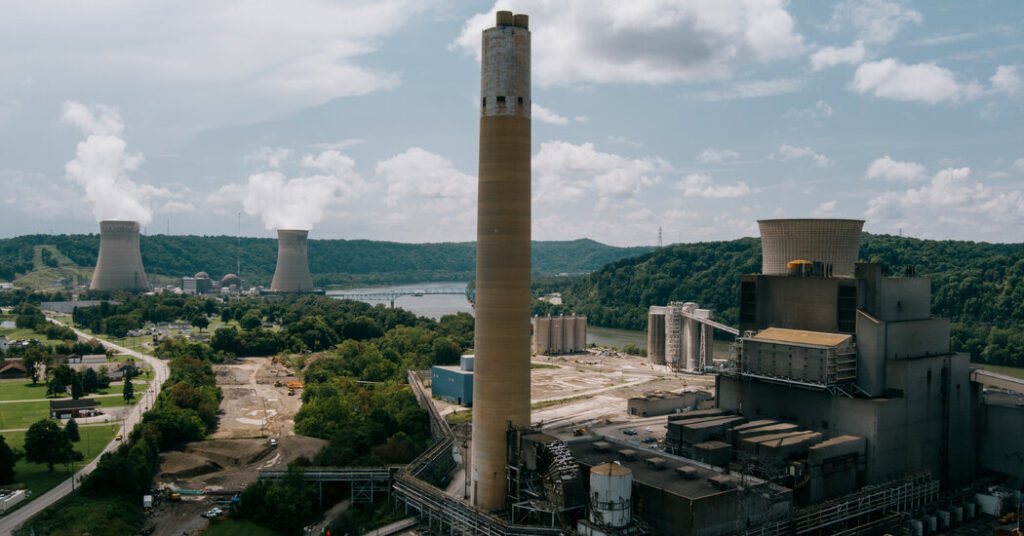
An hour’s drive east of Pittsburgh, the giant Homer City coal-fired power plant is being converted into what would be one of the nation’s largest gas plants to power a hyperscale data center complex.
Northwest of the city, a $10 billion data center project is planned that involves another coal-burning plant being retrofitted to burn gas. Just down the river from that, a former steel mill in Aliquippa is being targeted for another data center project with a new gas plant.
Amazon has pledged to spend $20 billion on multiple data centers in the state, including two enormous facilities, one next to a nuclear plant, and another on an old U.S. Steel site.
One major consequence could be a spike in the pollution that is warming the planet. The Environmental Integrity Project, an advocacy group, found that just seven of the proposed plants in Pennsylvania could emit roughly 68 million tons of carbon dioxide or equivalent greenhouse gases each year. That is equivalent to the annual emissions from about 15 million gasoline-burning cars.
And yet, the idea of billions of dollars flooding into a region that has grappled with economic decline remains tantalizing to many.
“The data center build-out could be one of the largest construction booms in the history of the Commonwealth of Pennsylvania,” said Rob Bair, president of the Pennsylvania Building and Construction Trades Council, an umbrella group for several labor unions. “And done properly, it could give a whole new generation of workers a lifelong career.”
A study from March sponsored by a coalition of Pennsylvania business groups estimated that data centers in the state could result in $12 billion in annual economic output and more than 19,000 additional jobs by 2036.
Already, an influx of new technology manufacturing associated with the data center boom is bringing jobs back to western Pennsylvania.
That includes an $86 million Mitsubishi factory that makes electronics, a $70 million investment by Hitachi to make transformers and a $166 million outlay by GE Vernova to manufacture gas turbines.
It’s a reversal from the 1980s, when “the population shrunk, people fled, manufacturing went overseas, steel was no longer being produced at the same rate,” said Brian Kennedy, senior vice president at Pittsburgh Technology Council, one of the groups behind the study. “That all crumbled. There’s been a gray cloud hanging over it for a long time.”
Western Pennsylvania’s industrial roots date to the colonial times, when the first coal mine opened in 1760. A little more than a century later, Andrew Carnegie began mass producing steel at the Edgar Thomson Works, just outside Pittsburgh. A decade after that, the Westinghouse Electric Company was founded in the city and began making the equipment that would wire the nation.
Heavy industry made western Pennsylvania prosperous for much of the 20th century. But as the steel mills went quiet in the 1980s and manufacturing moved overseas, Pittsburgh’s fortunes declined. Then, in the early 2000s, the fracking boom arrived, bringing a new wave of investment, and an uptick in natural gas emissions.
Throughout these boom-and-bust cycles, coal, steel and gas took an environmental toll. Pollution from smokestacks hung over the region, trapped in the air by the river valleys. Air quality has improved in recent years as some coal-burning power plants have closed, but pollution persists. Last year, the American Lung Association reported that Pittsburgh had some of the worst air quality in the nation.
The prospect of a data center boom is raising concerns about new sources of pollution.
Matt Mehalik has tracked the city’s fortunes his whole life. His family worked in the steel mills, and he now monitors pollution in the region as executive director of the Breathe Project, a nonprofit group.
“Fossil fuel extraction and combustion have been interwoven with the region’s DNA for its entire existence,” he said.
With funding from the Environmental Protection Agency, Mr. Mehalik has been testing air samples for particulate matter, the microscopic solid bits that come from smokestacks and cause lung disease, heart attacks and other serious health effects.
Early this summer, Mr. Mehalik parked across the Ohio River from an enormous petrochemical facility in Beaver County. The plant, operated by Shell, heats natural gas and turns it into polyethylene pellets that are used to make plastic.
Mr. Mehalik said he has recorded elevated levels of benzene, a carcinogen, and toluene, which can harm liver and kidneys, in the air around the Shell plant.
Shell declined to comment on Mr. Mehalik’s findings. But since 2022, the plant has regularly exceeded limits on benzene, nitrogen oxide and other pollutants, according to the Pennsylvania Department of Environmental Protection. In 2023, Shell agreed to pay a civil penalty of $5 million and spend another $5 million to benefit the community. But the violations have continued, according to state records.
With an influx of new gas-fired power plants expected to power data centers, Mr. Mehalik is now trying to establish a base line that will let him observe whether air pollution in the region increases in the years ahead.
As Mr. Mehalik sees it, data centers are just the latest customer for the natural gas industry. The fracking boom unlocked vast stores of natural gas, leading to the construction of industrial facilities like the Shell plant.
“This area has suffered from poor air quality for a long time,” he said. “Data centers are the next chapter.”
The largest data center project in the state is taking shape an hour east of Pittsburgh, in Homer City. Once the site of Pennsylvania’s largest coal-burning power plant, the 3,200-acre complex is being redeveloped into a $10 billion, 4.4-gigawatt natural gas-powered data center campus.
When installed, the turbines made by GE Vernova will form one of the largest natural gas-fired power plants in the nation, generating enough electricity to power the city of Pittsburgh more than twice over. But instead of flowing to the grid, all of that power will be used by the new data center.
Environmental groups have appealed the state’s approval of the project, saying the gas plant would release excessive pollution.
“We will not stand by idly while our government green lights a devastating and illegal toxic data center power plant,” Alex Bomstein, executive director of the Clean Air Council, said in a statement when his group joined the Sierra Club in filing the appeal.
But in Homer City, some see the next chapter for the state’s aging industrial base.
“Everything we’re doing in western Pennsylvania is a story of reuse,” Mr. Kennedy said. “Instead of having Homer City be a monument to our coal economy, it is going to be a monument to the most advanced A.I. industry in the world.”
Mr. Bair of the Pennsylvania Building and Construction Trades Council said that data centers could provide a lifeline to rural communities that are starved for tax revenues and lacking in basic services.
“Millions of dollars in a rural community could buy a whole lot of parks, a whole lot of ambulances, a lot of fire equipment, fire trucks, rescue trucks, ambulances, prop up your police, help buy your town water and sewers, and have a recurring revenue stream every night,” he said.
Those arguments are not persuasive to Katie Muth, a state senator who represents southeast Pennsylvania and has become the face of the data center resistance in her state.
For the past year, Ms. Muth, a Democrat, has waged a campaign to stop what she calls the uncontrolled build-out of data centers. She is calling for a three-year moratorium on the development of hyperscale data centers.
Her bill has not gained traction in the legislature but if passed, it would be the second such statewide moratorium, following Gov. Kathy Hochul’s executive order in July pausing data center development in New York.
This summer, Ms. Muth was the featured speaker at an anti-data center rally that took place just steps from her office, in the rotunda of the Pennsylvania State Capitol.
As more than 100 protesters waved signs reading “No A.I. Data Center,” “You Can’t Drink Data” and “PA Residents Over Big Tech,” Ms. Muth stepped to the lectern and pushed back against the idea that data centers should be central to Pennsylvania’s economic future.
“We are being told that hyperscale A.I. data centers and their associated infrastructure build-out here in our commonwealth is a sign of progress, a sign of economic growth,” she said. “We are told that they’re necessary for economic development and national security. What I’m asking today is very simple. Who is this progress for? And at whose expense?”
The crowd roared its approval.
The post Pennsylvania’s A.I. Gold Rush Meets Second Thoughts appeared first on New York Times.