Francis Fukuyama has published a shelf of books about politics and political theory, including lofty treatises on liberalism and a sober two-volume study tracing the development of the modern state. Yet it sometimes seems he will be forever dogged by four little words.
“Every week on Instagram or social media, I’ll post something and somebody will say, ‘Oh, well, I thought history ended,’” he said one recent afternoon in his Palo Alto home. What this “somebody” was referring to, of course, was “the end of history” — the four-word title and animating idea of Fukuyama’s cover essay for the summer 1989 issue of The National Interest. In the waning days of the Cold War, with the Soviet empire in retreat and American consumerism ascendant, Fukuyama anticipated “an unabashed victory of economic and political liberalism.” History was ending with “the triumph of the West.”
The article became a sensation, catapulting Fukuyama, then a policy wonk at the State Department, into a career as a scholar and public intellectual. He expanded the piece into his first book, “The End of History and the Last Man” (1992), and had the good luck — as well as misfortune — to come out of the gate with a work of earnest political theory that was also a runaway best seller.
As a phrase, “the end of history” sounded both highly potent and highly problematic, and Fukuyama was endlessly pilloried for it. People would gleefully point out that historical events kept happening. But he wasn’t talking about history; he was talking about History, in a grander, more conceptual sense. (The troublesome phrase wasn’t even his: He had borrowed it from Alexandre Kojève, the renowned Russian-French interpreter of Hegel.) Liberal democracy was an end point, Fukuyama argued, because as an ideal it could not fundamentally be improved upon: “All of the really big questions had been settled.”
It was an undeniably optimistic thesis, an emblem (as well as a punchline) for the post-Cold War era. But Fukuyama’s book also contained a dark antithesis. “The end of history” was haunted by the possibility that the spread of liberal democracy would give rise to “the last man” — Nietzsche’s term for a complacent, decadent figure who forgoes risk and ambition in favor of comfort and safety. In the last five chapters of his book, which hardly anyone seemed to read or remember, Fukuyama predicted that boredom and restlessness could fuel a rage against the establishment machine.
More than three decades later, restlessness and rage are everywhere, and Fukuyama, at 73, is still trying to make himself understood. On Sept. 8, Farrar, Straus & Giroux will publish “In the Realm of the Last Man,” a memoir. As the title suggests, Fukuyama is doubling down, pushing back against what he derides as “these stupid, superficial interpretations of the end of history” that caricatured him as a naïve Pollyanna. He sees the current plight of liberal democracy not as a rebuke to his earlier work but as a vindication. The “last men” of our age grew so restive that they fell for populist demagogues who convinced them everything was rotten — “an outcome,” he says, “that was perfectly predictable more than 30 years ago.”
But the memoir shows him changing his mind, too. Even though he disdains the “many casual critics” of his first book who didn’t bother to read past the first half of his title, Fukuyama also confessed that he never expected the realm of the last man to look quite like this.
The closing pages of that first book included a passing reference to Donald Trump, then a New York City real estate mogul. Trump, he wrote, was among those whose ambitions could be satisfied in a liberal democracy, with its market economy.
“Instead of wanting to be tyrants, they can just become really rich,” Fukuyama recalled of his thinking at the time. “Little did I know that just getting rich wouldn’t be enough for him.”
Fathers and sons
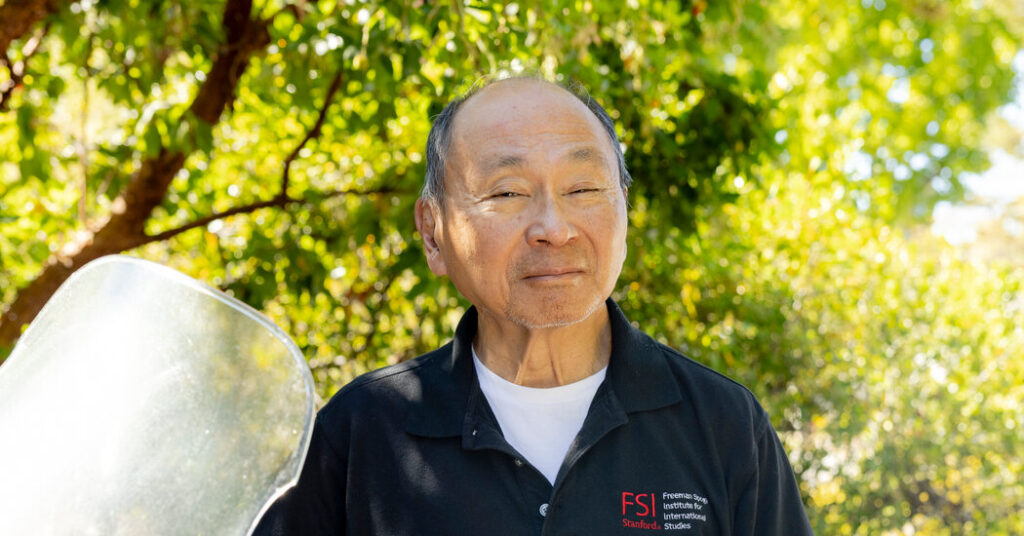
On a sunny morning in May, I met Fukuyama on the immaculately manicured campus of Stanford University, where he is currently a senior fellow at the Freeman Spogli Institute for International Studies. In person, he speaks quietly and projects a serene unflappability, though his intellectual and political journey has been remarkably circuitous.
Fukuyama’s father was born in Los Angeles to Japanese immigrants; his mother was from Japan. After the bombing of Pearl Harbor, his father’s family was sent to internment camps — a fate his father managed to escape by getting a scholarship to a liberal arts college in Nebraska.
His grandfather lost his hardware store in Little Tokyo. “Got his citizenship, finally, in the early ’60s,” Fukuyama said. “The first thing he does, he votes for Barry Goldwater,” the archconservative presidential candidate. Fukuyama’s father, by contrast, was a “die-hard liberal.” A sociologist and a Congregational minister, he was active in the civil rights movement and opposed the Vietnam War.
Fukuyama, an only child, was born in Chicago and raised in New York City. He studied classics at Cornell and lived at Telluride House — an insular, student-governed residence that was then heavily influenced by the conservative political theorist and classicist Allan Bloom. Bloom, in turn, had been a student of the German American philosopher Leo Strauss. “There was a fraternity next door,” recalled Ruth Epstein, a friend of Fukuyama’s from Telluride House. “They had keg parties. We had faculty receptions with sherry.” For an intellectually curious kid like Fukuyama, the atmosphere was thrilling.
It was also where he fell in with a “Straussian crowd” and became politically conservative, attracted to philosophical ideas about absolute truth and human nature. The development rankled his father, who insisted that his son had been “brainwashed.” Fukuyama resented this accusation. Even now, his father’s suggestion that he was the unwitting victim of a sinister influence campaign still pains him: “He never gave me credit for being able to think for myself.”
Fukuyama would end up having a number of conversion experiences. He briefly flirted with French post-structuralism, moving to Paris for six months, where he took a seminar with Roland Barthes. Realizing that he no longer wanted to pursue “nihilistic projects built on assertions of the impossibility of reasoned discourse,” Fukuyama abandoned a graduate program in comparative literature at Yale to study international relations at Harvard. There he wrote his Ph.D. dissertation on Soviet foreign policy in the Middle East.
“I thought of myself as not just a conservative, but I was part of this neoconservative cabal,” he told me. All of that changed in the first decade of the 2000s. First, he broke with the neocons over the U.S. invasion of Iraq; then, in 2008, Wall Street recklessness brought the financial system to the brink. Fukuyama started to revise his priors. “This belief in the use of military hard power in order to promote democracy led to the Iraq War, and the financial crisis was a result of this conservative belief in free markets and the self-regulating ability of markets to maintain stable economic growth,” he said. “Both of those turned out to be total bullshit.” Liberal democracy couldn’t be sustained through extreme deregulation, or imposed at gunpoint.
In a twist, he now finds himself more politically aligned with his father, who died shortly after “The End of History and the Last Man” was published. Still, Fukuyama is dismissive of what he calls the left’s “social justice agenda,” and likens the pro-Palestinian encampments on college campuses to “struggle for the sake of struggle.” He retains a Straussian emphasis on human nature, speaking like a traditional conservative on innate differences between men and women.
Asked how he would identify his politics today, he chuckled. “Well, it’s complicated.”
Stuck in the dialectic
Despite experiencing firsthand the downsides of intellectual celebrity — the glib critiques, the warped interpretations — Fukuyama has always wanted a broader audience beyond his fellow academics. He has two small offices on Stanford’s campus: one dominated by a big Ukrainian flag on the wall and the other by studio lights and camera equipment, which he uses to film content for his YouTube channel, “Frankly Fukuyama.” (It’s an endearingly corny double entendre — his friends call him Frank.)
“About a year ago I acquired a Gen Z social media manager,” he said, describing his efforts to reach a generation of young people who don’t read newspapers or watch TV. In the time of the last man, attention becomes the coin of the realm: “The moment you say something really edgy, you can see your numbers go up.”
Inside the classroom, his approach is decidedly different. He’s the director of the master’s program in public policy and teaches a class on “problem-solving in the real world.” The day I was there, I watched him teach a case study on the failed effort in the last decade to create a smart city in Toronto.
Fukuyama, standing at the front of a room encircled with white boards, skillfully guided two dozen students through the small-bore, technocratic details of this Canadian initiative in urban planning. The point of the class was to examine issues at a granular level, he told me: “We’re probably not going to do a case on how Israel should deal with Hamas.”
There’s something curious about seeing Fukuyama — one of the few American political theorists with public name recognition — instruct students in the finer points of municipal projects instead of enchanting them with big ideas. But the absence of philosophy flows directly from his philosophy. After all, if you believe that history has ended and “the really big questions” have been settled, you might well decide that the remaining questions are principally ones of policy and implementation.
This attraction to the nuts and bolts of problem-solving has a corollary in his private life, too. Fukuyama is a lifelong tinkerer; he dedicates multiple chapters in his memoir to his multiple hobbies. He used to build drones and fly them on campus. At his home, where he lives with his wife and their dog (the couple’s three children are grown), he keeps racks of computer servers that he built to store music and movies. He showed me some gorgeous bow-back chairs and a handsome card table that he crafted by hand. He derives evident satisfaction from making stuff that works. His original title for the memoir was “Building Things.”
Yet I caught an occasional glimpse of someone who seemed a little wilder and less prudent. There was a motorcycle parked in his driveway. (It’s a Yamaha; he used to ride a Harley.) A longtime friend, Mark Cordover, told me that when the family was living in McLean, Va., a couple of decades ago, Fukuyama took up cross-country biking and immediately ventured onto one of Virginia’s most treacherous trails. Biking with him, Cordover was “scared out of my mind.”
Fukuyama also put a ramp in front of his home to try out bike jumping and proceeded to break his elbow. While we were walking together on Stanford’s sprawling campus, with cyclists zooming by in every direction, he would stride into intersections without so much as a pause. Inevitably, he’s been hit by speeding e-bikes a couple of times; one collision was bad enough that he had to be taken away in an ambulance.
It’s striking that the methodical builder of practical objects can also be a rash risk-taker who jeopardizes his physical safety with confounding regularity. “I get into a lot of accidents,” he sheepishly told me. But then it makes sense that the author of “The End of History and the Last Man” would embody his own dialectic.
“I think that we may be fated to be in this kind of now cyclical system where we go through a period of peace and prosperity brought on by successful liberal democracy,” Fukuyama told me once we were safely seated in Stanford’s faculty club. “We get bored with it and then we try to destroy it. And we launch ourselves back into authoritarianism, conflict, war. And then we get tired of that, and we say, ‘Oh, maybe we should go back to liberal democracy again.’”
He seemed suspended in a place that might seem familiar to a lot of people these days, between hope and resignation: “I just don’t see that there are a whole lot of new ideas out there.”
The post He Warned That the End of History Could Be Rough. Maybe Now People Will Listen. appeared first on New York Times.