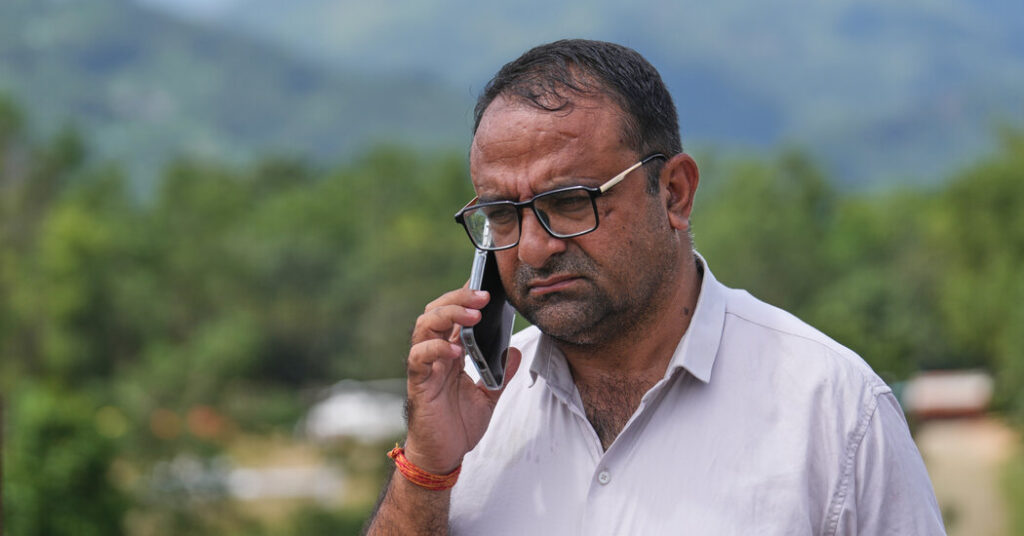
Wednesday seemed like any other morning for Rajendra Dawadi, the principal of a school in Nepal.
“Everything was going normally,” he said.
That changed around 9:10 a.m., when Mr. Dawadi was teaching a class at the Tribhuvan Trishuli School in Nuwakot, a district just north of Kathmandu, the country’s capital. A staff member burst into the classroom, shouting that a major flood was headed their way.
The news began to spread as relatives living upstream sent warnings to anyone in the path of the fast-approaching flood waters.
Mr. Dawadi had to make some quick decisions.
He told all the children who were present — about 900 of the school’s total 1,643 students — to run to higher ground. Only older pupils, ages 11 to 18, were at school when the floods hit, which aided the quick evacuation, Mr. Dawadi said. (The younger students did not start class until 10 a.m.)
“They were old enough to run immediately,” he said in a phone interview on Monday. “It would not have been possible to save everyone, had kindergarten and primary school students also been there.”
Pupils who had arrived at the school earlier by bus were told to get back on them, and Mr. Dawadi instructed the drivers to leave the area as quickly as possible.
“A couple of students became traumatized and fainted,” Mr. Dawadi said, adding that those children were transported to safety on teachers’ motorbikes.
“I thought that even if the warning turned out to be wrong, the worst it would cost us was one day of study,” Mr. Dawadi said. “But taking it lightly could mean the loss of hundreds of lives.”
His swift evacuation plan saved those lives.
Around 9:23 a.m., about 13 minutes after Mr. Dawadi heard the first warning, a deluge of water, mud and debris swept through the area. The school was destroyed in seconds, and at least one teacher remained missing as of Monday, Mr. Dawadi said.
At least 4,200 people were missing in Nepal as of Monday, less than a week after a torrent of water tore through the Himalayan river valleys, sweeping away buildings, homes, roads and other infrastructure.
Only a fraction of the thousands of missing had been identified among the dead, and officials said they expected the death toll to increase. So far, the authorities said, the disaster had killed nearly 1,000 people in Nepal.
The students’ rescue was a rarity among the reports of missing and dead and amid the destruction from the floods. In Bharatpur, a city southwest of the school, hundreds of bodies had washed up downstream. The local morgues had received far more bodies than they could accommodate.
Over the weekend, rescue workers struggled to extricate workers trapped in hydropower tunnels. The Nepal Army said its thermal drones were not detecting any signs of life.
The floods also destroyed miles of roads and disrupted communications. Video footage and images showed a debris-choked river wiping out bridges and partly burying towns in mud.
“I am extremely emotional to see the school completely swept away,” said Mr. Dawadi, who was a student there before becoming the principal years later. “The school holds so many memories for me.”
The building had been built over many years, he said. Now, all that remained were two school buses.
“We saved lives, but now there is no place to teach the students,” Mr. Dawadi said. “I am already worried about how we can start teaching and learning again.”
The post A Principal Saved 900 Students Before His School Was Washed Away in Nepal appeared first on New York Times.