Ben Kesling is the head of government relations for Chariot Defense, a start-up building battlefield power distribution systems. He served as a Marine Corps infantry officer and a Wall Street Journal staff reporter.
American soldiers use equipment vetted through established processes. From artillery cannon and complex computer systems down to troops’ underwear, officials check it all to ensure reliability and to support a domestic supply chain.
One crucial category of gear, though, doesn’t get the same attention: power banks manufactured in China. These large batteries, equipped with advanced microchips, can stand in for a small generator and have not been thoroughly tested by military labs or fully validated for security or safety. Yet troops depend on these Chinese-made systems for battlefield electricity.
Chinese technology threats recently gained attention after an investigation by the Telegraph revealed that British Royal Navy drone ships equipped with Chinese components unwittingly sent signals back to China.
The Trump administration has addressed these sorts of threats, announcing tariffs on drone imports this month in response to national and economic security concerns. And the Federal Communications Commission has wrestled with how to vet drones before the military is allowed to use them.
But the administration has not taken action on power banks.
Does the world’s preeminent military really depend on devices made by one of America’s biggest strategic competitors? Go into the field with ground units and you will likely find a Chinese power bank in use. Commanders even add them to crucial gear lists alongside Humvees, M4 rifles and field radios.
For years, manufacturers in the United States outsourced production of microchips, power electronics and advanced battery systems. China gave American consumers phones and electric vehicles through industries subsidized by its government. Chinese companies used that imbalance to develop their own advanced technologies.
One of those technologies was the power bank.
China created a near-monopoly on these battery packs as the U.S. couldn’t keep up with the need to manufacture them at scale. Go to any home store or outdoor retailer, and Chinese power banks are plentiful.
Just like those consumers, service members face a proliferation of electricity-hungry gear. But the gear they use includes sensitive equipment such as drones, radios and counter-drone systems.
When I served as a Marine Corps infantry officer more than a decade ago in Iraq and Afghanistan, we didn’t use battery banks because drones and small networked computers mounted on body armor weren’t ubiquitous. Today, I see firsthand the proliferation of Chinese systems filling a demand created by the insatiable need for electricity at even the small-unit level.
Multiple domestic companies, including the firm I work for, make replacements for these Chinese devices, so we stand to benefit if these systems are purged from the battlefield, but so do our competitors. The most important thing is to get Chinese systems out of U.S. formations for national security reasons and domestic supply-chain resilience. The Pentagon has options.
As demand for battlefield power has spiked, supply has dropped. Supply lines today are easily targeted by the enemy, and troops want to shut off noisy generators that can be quickly identified and destroyed. One of the major lessons from the Russia-Ukraine war is that if you use a generator, you can be detected and killed.
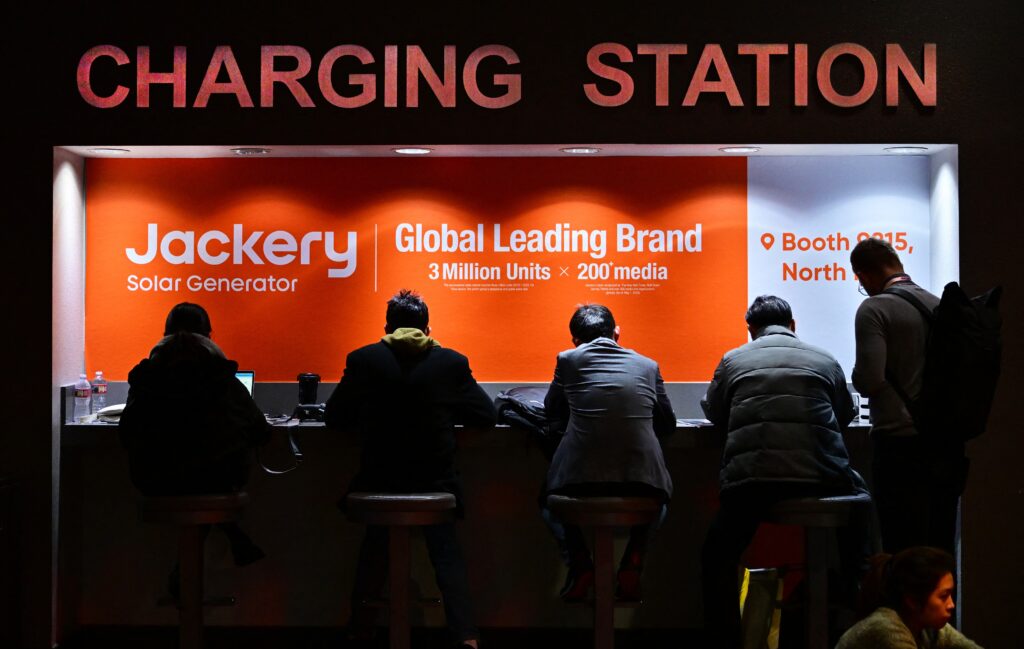
The Pentagon is thinking through this problem, but military personnel face a power gap now. For troops, the best available answer is to buy Chinese power banks from companies such as Jackery, EcoFlow and Bluetti. They’re affordable and can provide power as if from a wall outlet. They’re even available at the Exchange on base.
In classified and unclassified operations, power banks can become spying devices because many connect to the internet or use Bluetooth — an easily hackable feature. When connected devices are used in a combat zone, they can give away positions of bases or even warships by broadcasting coordinates over the internet.
A power bank also can become a small bomb. Israel turned pagers into bombs used against Hezbollah officials. Power banks don’t need explosives to become weapons. Instead, the energy-dense batteries at the heart of the system can be hacked and explode.
Service members were once allowed to fly foreign-made drones, including popular ones built by China-based DJI, until a ban took effect in 2018 over cybersecurity concerns.
However, other Chinese companies continue to manufacture battery banks in use by uniformed personnel today. Just this spring, an Army lab at White Sands Missile Range issued a notice of intent to purchase power banks, saying, “The United States Government intends to solicit and negotiate exclusively with authorized sellers or resellers of EcoFlow Logistics LLC.”
In March, at an officially sanctioned, premier Army conference that I attended in Huntsville, Alabama, a colonel gave a presentation in which he said EcoFlow power banks are “parts required” for his unit’s success in the field. EcoFlow is based in Shenzhen, China.
Last year an Army Airborne field artillery unit released a video on DVIDS, the Defense Department’s official media channel, touting its testing of EcoFlow battery units in the field.
The demand from troops and military officials for power is overwhelming, but there are solutions available.
Compliant systems don’t have to rely on 100 percent domestically produced parts. Components can come from allied and trusted nations, including reliable European sources. The Pentagon’s “Blue List” for drones follows this approach. The list serves to ban potentially compromised Chinese components, approve well-vetted foreign parts and encourage use of domestic products.
The post A looming threat: U.S. military’s reliance on Chinese batteries appeared first on Washington Post.