At the beginning of advance copies of his new novel, “The Disappearers,” Marlon James issues a warning: “This time, it’s personal,” he writes. “Not because these events happened (though many of them did), or that they happened to me (though some of them did), but because they’re all true.”
Only after reading this 600-page epic does it become apparent how radical that confession is. This is a book filled with horrific gay bashings, people dying in ditches, destructive sex and murder. It’s a distressing book, and James knows it. In fact, that’s the point.
“I don’t go to novels to be safe,” he said in a recent interview. “I go to novels to be titillated, to be scared, to be educated, to be frightened — honestly, to be appalled.”
It’s a characteristic Marlon James statement, thoughtful yet intense, so it’s perhaps surprising that in person, the author radiates nonchalance.
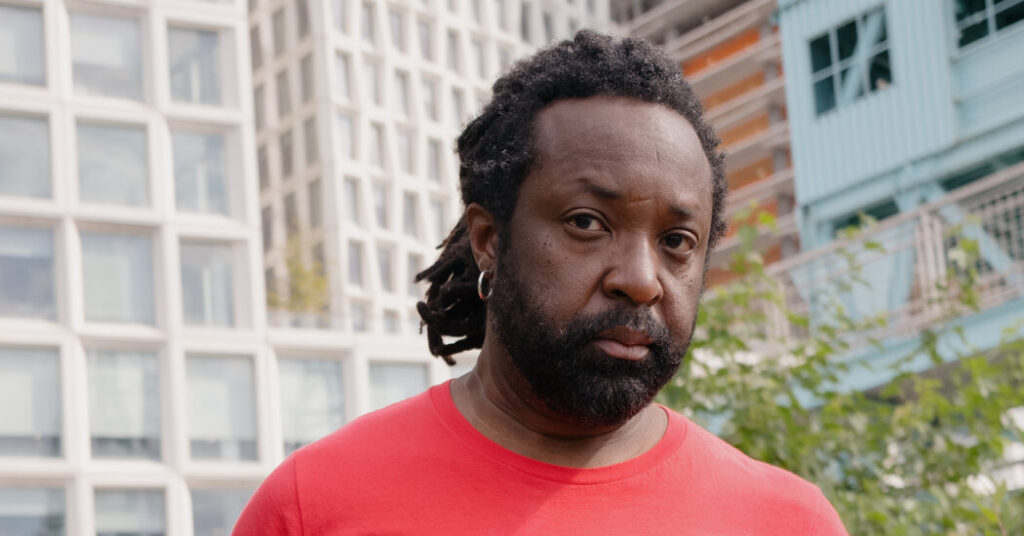
We met at a restaurant in Williamsburg, Brooklyn, where the author lives with his partner, the biographer Nicholas Boggs. Wearing a light T-shirt with a colorful illustration of a Hawaiian sumo wrestler, James sipped a chai oat latte; ate bacon, eggs and hash browns; and reflected on his life and career in ways both philosophical and dishy.
James would be the first to tell you he’s nerdy, obsessed with grammar and language, but also with music, literature, comics. Several times he had to pause, swept up in a story. “I forgot the original question,” he’d admit. And despite how painful his books are, he has an unmistakable sense of humor.
“He is someone who is not easily rattled,” said the producer and filmmaker Lena Waithe. The two met years ago and now describe each other as chosen family. “There’s a knowing that everything is going to work out the way it’s supposed to. And that is very much in his DNA.”
But if there’s one thing James is deadly serious about, it’s literature: “I think we should bleed on the page a little bit,” he said.
“The Disappearers,” out on Tuesday from Riverhead, spans two decades and is told in five sections, each in a different format. At the core of the story is a grisly attack in Kingston, Jamaica, in the 1980s. A group of gay men are rehearsing a play when a mob crashes in. Every person in the room is brutalized. Afterward, the survivors begin to vanish.
Why are the victims disappearing, and where are they going? What does life hold for those who are left? And what might justice look like in the face of savagery?
As James put it: “The novel is about the price you pay, eventually and day to day, for the simple act of being yourself,” he said.
That’s a dilemma he has been thinking about for a long time.
James, 55, grew up gay and closeted in Kingston in the ’70s, ’80s and ’90s. During that period, Jamaica, like many places in the world, rejected homosexuality, leading James to live in fear.
He had always enjoyed writing, and realized it could minimize some of the bullying he faced in school. “Writing stories was one of the few ways I could reach the impasse of students who would pick on me,” he said. “You know, being ‘the class homo,’ being ‘the sissy.’ But I can write a story that they’ll like.”
James attended the University of the West Indies, where he studied literature, but didn’t think a literary life was achievable after graduation. Instead he got a job as a copywriter at an advertising firm, then gigs as a graphic designer, an illustrator, an art director. It was stable work, but James found it boring.
“I needed an outlet where I could be myself,” he said. So he returned to fiction writing, where he could quietly explore his queerness. He toiled while working a day job, trying to draft a novel, scrapping it, trying again. Eventually, a work in progress stuck, and in 2005, he published his first book, “John Crow’s Devil.” It wasn’t a financial windfall, but it was a spiritual crux.
All the while, James made extended visits to New York, subletting from friends of friends for months at a time. He knew the trips were temporary, but they were something, anything, to get him out of Jamaica.
Then, in 2007, he got a teaching job at Macalester College in St. Paul, Minn. Finally, he could move to the United States.
James followed “John Crow’s Devil” with “The Book of Night Women” in 2009. A few years later, he published the book that would be his breakout: “A Brief History of Seven Killings,” which won the Booker Prize in 2015.
“It brought a sort of instant fame,” he said. “On purely commercial terms, it made me a writer who could just write.”
In the late 2010s, James began a fantasy series, the Dark Star trilogy, made up of “Black Leopard, Red Wolf” (2019), “Moon Witch, Spider King” (2022) and one more novel on the way.
“He is somebody who literally gets inspiration from absolutely everywhere,” said Jake Morrissey, the executive editor of Riverhead. (The two started a playful podcast about classic literature, “Marlon and Jake Read Dead People,” in 2019.)
While on tour for “Moon Witch,” something clicked for James. He had come out publicly; he was living openly in the United States; and he no longer cared what others might think when they found out he was gay.
That peace led to curiosity. “What I wanted to do with this freedom is visit the world I gave up because I was terrified,” he said. “So to me, it was, ‘I’m going to confront the story I was not allowed to live.’”
And he realized that even after all those years, he was, and is, angry. “I am angry that I had to live a different life. I am angry that there was hatred just because of who I was. I do resent the idea people always have when you’re a victim, or a potential victim, that you must always show civility.”
What do you do with that anger? The answer, for James, was a novel.
“The Disappearers” was inspired by a rumor he heard in his youth that “a bunch of random men broke into either an AIDS support group or a queer safe space, which wouldn’t have been called that back then, and beat everybody within an inch of their lives.”
The attack was never officially confirmed for the same reasons violence against marginalized people often isn’t — because afterward nobody speaks, fearing more brutality. Still, the story stuck with James. “I don’t think I forget atrocities. I don’t forget wrongs being done to people,” he said. “And I always remember that because of who I am, it could have been me.”
The novel required research. Though he grew up in Kingston in the ’80s like the young men at the center of the story, he wasn’t an authority on the time period. Just the opposite; he felt his perspective was stunted by his repression.
To fill in the gaps, he interviewed nearly 20 people across Kingston to get a sense of gay Jamaican life, past and present. He spoke to men and women, to people as young as 21 and as old as 80, to the rich and the poor.
What he learned from them surprised him. “I was expecting horror stories, and instead I found comedy, and I found defiance,” he said.
He did archival research at institutions like New York Public Library’s Schomburg Center for Research in Black Culture, and tracked down some of the porn and erotica published at the time. “It was in a gay adult magazine that I saw the headline, ‘Rare Gay Cancer Found,’” he said.
James immersed himself in the music and pop culture of the era: “Who was on the cover of Rolling Stone? And was it available in Jamaica? What was the No. 1 song?”
One chapter in the novel includes flashbacks to 1940s London, so he traveled there and toured where the city’s secret gay bars and molly houses used to be.
The writing itself was emotionally taxing. The first section of the novel follows a younger, more innocent character, so James had to keep “my cynicism or old gay bitterness” at bay. The second section is told from the point of view of the attackers, forcing James to ask: “What am I doing giving voice to the people who are trying to kill us?” He let his rage pour out on the page, but felt spent afterward. One section took James nine months to write.
The people in James’s life could see how much the novel meant to him. In an interview, the author Saeed Jones, one of James’s close friends, recalled his describing the book over lunch.
“Oh, this is the most vulnerable Marlon’s ever been,” Jones thought at the time. “I’ve never heard him open up about so much of this.”
In December 2025, James finished a draft, and sent it to Morrissey. The two worked on it for months, until finally, in July 2026, the book was done.
Time will tell how readers approach a novel this brutal, this furious, this gay. But James has his own goal. “I want people to know that people suffered,” he said. “I want people to know they can’t kill us even when they kill us.”
He has already received an encouraging signal. At the end of our first interview, James gasped. He had checked his email and saw news waiting in his inbox: “The Disappearers” had been nominated for the 2026 Booker Prize.
“You know I’m going to go back to my office and scream,” he said.
For James, the nomination is deeper than personal validation. It’s a sign that his vulnerable characters “mean something to other people,” he said. “I feel like I’m still protecting these boys.”
The post How Marlon James Confronted ‘the Story I Was Not Allowed to Live’ appeared first on New York Times.