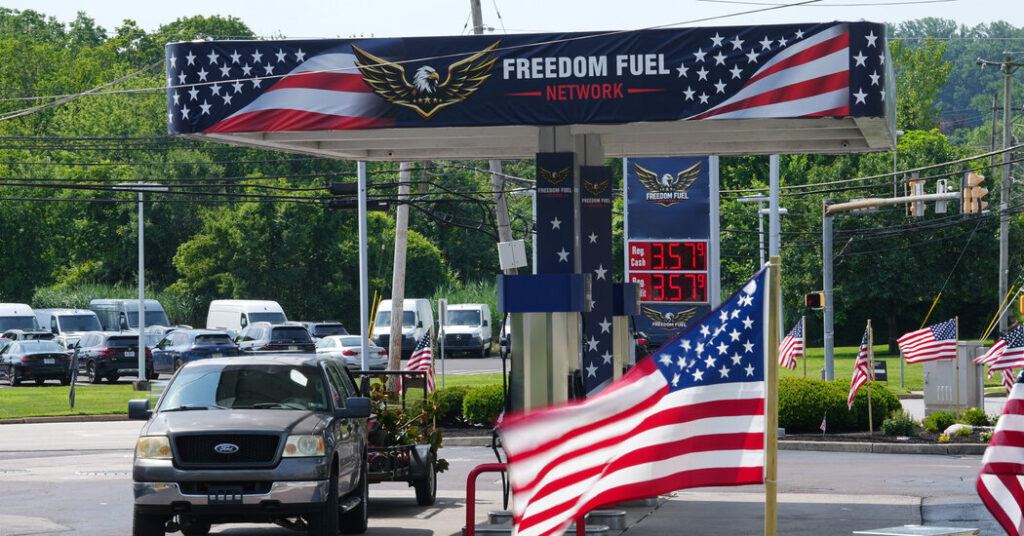
Last month the Trump administration promoted a chain of gas stations that were lowering prices in the Northeast because “they love the U.S.A.” Now, a new lawsuit claims that some of the fuel sold by the gas stations came from a dealer that never paid for it.
The chain of gas stations, called the Freedom Fuel Network, had lowered gas prices at 25 stations in the Philadelphia area, President Trump said in July. But a lawsuit filed this month in federal court claims that the Freedom Fuel Network was able to sell its gas at lower prices because some of the fuel derived from a dealer that had not paid for the gas.
The lawsuit was filed by the Georgia-based Mansfield Energy against KRSM, a company based in New Jersey, and its president, Syed Kazmi. From May 21 to July 7, KRSM picked up 1.1 million gallons of fuel worth nearly $4 million from a fuel supply terminal in Pennsylvania, the suit claims.
Then, KRSM sold that fuel to gas stations that were part of the Freedom Fuel Network, which was able to sell gas at lower prices than its competitors did, the lawsuit claims.
“KRSM was able to sell such fuel for such low prices and garner such publicity because it never paid plaintiff for such fuel,” the lawsuit says.
Urs Broderick Furrer, a lawyer representing Mansfield, said in a statement that Mr. Kazmi had picked up the fuel from Mansfield’s account.
“Despite the fact that the last delivery was more than five weeks ago, KRSM has not paid one dollar towards the $4,000,000 that KRSM owes Mansfield,” Mr. Furrer said. Some of that gas, Mr. Furrer said, was delivered to at least 10 locations that are listed on Freedom Fuel Network’s website. The lawsuit does not name the Freedom Fuel Network as a defendant, and does not detail how much of the unpaid fuel was received from KRSM.
Mauro Tucci, a lawyer representing Mr. Kazmi, said in an email, “KRSM disputes the allegations in this case, which is an accounting dispute over fuel invoices mis-priced by Mansfield Oil.”
According to the lawsuit, because of a data error, Mansfield did not receive information it needed to send invoices to KRSM until early July. After some discrepancies with invoices, the lawsuit says, Mansfield submitted draft requests to KRSM’s account in late July and was later told by its bank that KRSM had refused the drafts.
During phone calls with Mansfield between late July and early August, Mr. Kazmi said that KRSM would pay for the fuel, but payment had yet to be received, the lawsuit claims.
The lawsuit does not detail how Mr. Kazmi was connected to the Freedom Fuel Network or who owns it. A trademark application filed with the U.S. Patent and Trademark Office in July does not name owners for the Freedom Fuel Network.
“The Administration has had zero contact or dealings with the defendant: KRSM Inc or Sayed Kazmi,” a White House spokesperson said.
President Trump said in a post on Truth Social on July 1 that gas prices were falling, but “not as fast as they should be.” Ahead of the July 4 holiday, the Freedom Fuel Network planned to lower gas prices at 25 stations across the Greater Philadelphia area, Mr. Trump said.
“This Retailer is taking the lead, and others should follow,” Mr. Trump said. “They are doing this because they love the U.S.A.”
The Trump administration did not provide additional explanation for why gas stations in the Freedom Fuel Network were able to sell gas at a lower cost. On July 7, the White House posted a video on social media at a Freedom Fuel Network gas station that sold gas for $3.47 per gallon in Philadelphia, where the cost of a gallon of gas reached $3.99 that week.
Less than two weeks later, the national average for a gallon of gas reached $4, as the war with Iran rekindled. Yesterday, the national average for a gallon of gas was $4.08, according to the AAA motor club.
The post ‘Freedom Fuel’ Touts Cheap Gas. A Suit Says the Dealer Didn’t Pay for It. appeared first on New York Times.