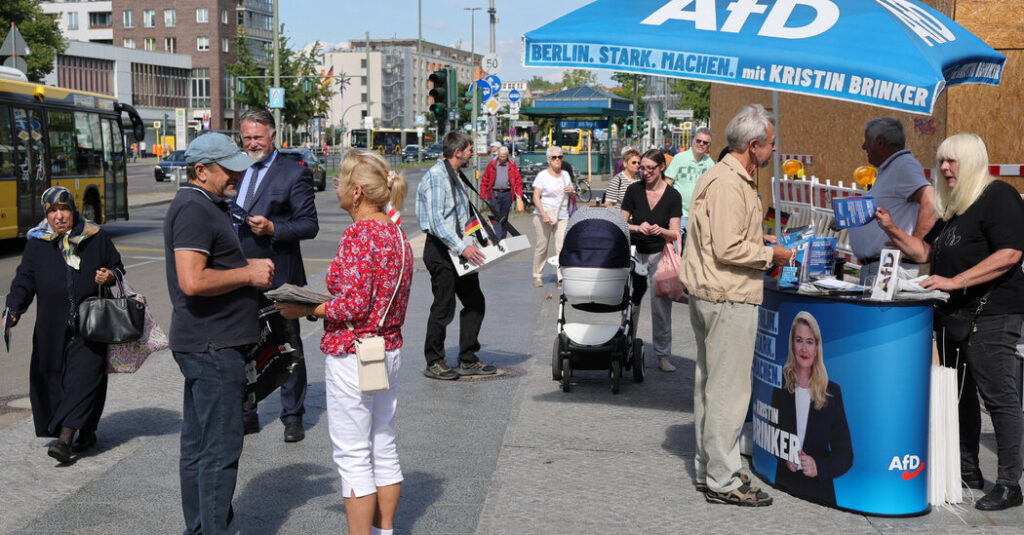
Government leaders across Germany are publicly and privately exploring ways to curb the power of the far-right Alternative for Germany party, or AfD, if it wins control of a state government in elections on Sept. 6.
The officials’ efforts, detailed in interviews and in statements by top officials, include attempts to throttle the routine sharing of certain classified information with state-level intelligence services should the AfD win control of them. They also involve less onerous measures aimed at policy matters. The planning is driven partly out of fear that AfD officials could pass national secrets to Russia, to which the party maintains close ties.
The AfD is poised to win the most votes in Sept. 6 elections in the state of Saxony-Anhalt in Germany’s east. If it secures enough seats to form a governing coalition by itself, it will become the first far-right party since World War II to hold power in Germany.
Governing a state would typically grant a party access to national secrets, including about intelligence and security.
Many officials seeking to curb the AfD’s power see it as a threat to German democracy and national security, and say their plans are necessary to safeguard the country. Protection of democracy is a particularly sensitive issue in Germany, which after World War II designed its institutions to prevent extreme parties like the Nazis from ever returning to power.
The AfD’s rival parties consider it extreme. No other major party in Germany will work with it to form a government at the state or national level, a collusion that is known in Germany as “the firewall” and that the AfD has long assailed.
Boris Pistorius, Germany’s defense minister, told the tabloid news outlet Bild this summer that he would not pass classified information to an AfD government. He cited the AfD’s closeness to President Vladimir V. Putin of Russia, whom party leaders have praised.
“Their affinity for Putin is impossible to overlook,” Mr. Pistorius said. “To seriously believe that we should carelessly let this information fall into the wrong hands, I think it’s obvious that must not happen.”
In the eyes of the AfD and its supporters, those efforts are an attempt to trample the will of voters and thwart its policy agenda, which includes deporting migrants and banning gay Pride flags in schools.
“It’s not democratic, not political and not proper — it’s just kind of dirty,” Ulrich Siegmund, the AfD’s candidate for governor in Saxony-Anhalt, said in an interview on the Austrian populist channel ServusTV.
AfD officials in Saxony-Anhalt did not respond to repeated emailed requests for comment on the efforts to curb the party’s power should it win.
In many cases, the planning to try to curb the AfD is happening secretly, in fear that discussions will be leaked to the press and feed the party’s narrative that the German federal government is obstructing voters’ will.
Interior ministers in other states have circulated ideas for restricting the power of an AfD government should it take shape, including by denying its officials access to certain information with security implications, according to Georg Maier, the interior minister of the state of Thuringia in central Germany.
“I believe it’s a real problem, and that it’s a threat to national security if it happens,” he said in an interview.
Mr. Maier, a sharp critic of the AfD, declined to publicly detail the steps interior ministers were contemplating.
Federal intelligence services have labeled the AfD as suspected of being right-wing extremist. It also maintains connections to Russia, an increasingly hostile adversary. Elected officials from the AfD have set off a political furor by seeking to reveal national security secrets, some of which relate to Germany’s support for Ukraine, that could benefit Russian military planning. German officials have accused Russia of sabotage, cyberattacks and other efforts to undermine German social cohesion.
The AfD is leading the polls in two states, Saxony-Anhalt and Mecklenburg-Western Pomerania, that will vote next month. Both lie in the former East Germany, an AfD stronghold, where party leaders have harnessed social media and local organizing to appeal to voters frustrated by economic stagnation, immigration and cultural change.
The AfD appears close to an outright majority of seats in Saxony-Anhalt. That would allow it to form a government without the help of any other party, bypassing the firewall. Federal intelligence classifies the AfD in Saxony-Anhalt as confirmed extremist. Its potential ascent has some officials contemplating extreme steps under German law.
The country’s Constitution was written by survivors of the Nazi era after the war. To prevent extremist forces from taking power again, it allows the federal government to take over state police forces if the country’s “free democratic order” is in danger.
Sven Hüber, a high-ranking police union official with no public party affiliation, compared a possible AfD takeover in Saxony-Anhalt to the ascent of the Nazi party in the 1930s. In a letter in a police union newsletter, he reassured officers that the union would help members who refused to carry out illegal orders from “undemocratic” ministers.
AfD allies struck back. Mr. Hüber was forced to resign from the union this week after a far-right news platform published a report accusing him of acts of violence during his time as an East German border guard in the 1980s. In a statement, Mr. Hüber called the accusations “defamatory and slanderous” and said he had taken legal action in response.
Government officials elsewhere are publicly contemplating less drastic measures to respond to an AfD win.
A group of ministers from other German states is considering a change that would stop a potential AfD state government from blocking some educational funding. The money requires unanimous approval by representatives from each state.
Saxony-Anhalt’s governing coalition also passed a law this spring meant to stop any one party from vetoing judicial appointments or blocking the appointment of a governor it does not like.
The law allows parties that do not finish first in an election to band together to nominate a head of the legislature. Previously, only the first-place party could nominate a candidate for the state legislature to approve. The change could allow mainstream parties this fall to elect their own choice to run the state if the AfD wins but fails to secure a majority.
State leaders in Saxony-Anhalt, including the center-right governor, Sven Schulze, took pains to say it was not targeting a single party. In an interview, Mr. Schulze said the democratic way to stop the AfD was at the ballot box.
Changing a range of rules to single out the AfD and block it from power “would be a capitulation, and I won’t go along with that,” he said.
Recently, Mr. Schulze adopted another tactic in a bid to win elections: He embraced parts of the AfD’s message.
Mr. Schulze echoed a longtime AfD call to remove terrorism suspects from Germany even if they are citizens, after a German-born man killed a woman and injured 29 people near a Berlin Pride event last month. The attacker had unsuccessfully tried to join the Islamic State terrorist group. “We simply can’t allow people to live here who don’t accept our culture,” Mr. Schulze said.
The post Far Right Is Poised to Win in a German State, but Fight Over Power Won’t End There appeared first on New York Times.