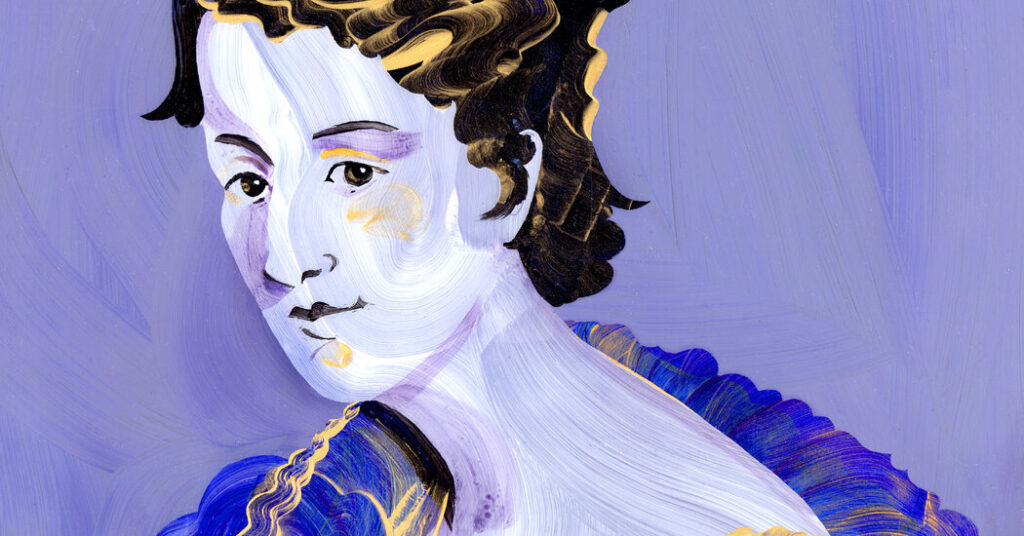
About a decade ago, I found that I couldn’t stop thinking about an aside from “The Worldly Philosophers,” Robert Heilbroner’s seminal history of modern economics. The book noted that one of the pioneers of the field had been friends with a woman named Maria Edgeworth.
“The daughter of an economist, she was perhaps the first woman to express opinions about the workings of the economy,” Heilbroner wrote.
I don’t know why such a minor point captured me. Maybe it was because the received history of economics was so devoid of women that it defied all reason: The standard account was all Adam Smith, Thomas Malthus, David Ricardo, and then a long line of Jameses and Johns and Roberts. Maybe it was because I myself was a 25-year-old woman covering macroeconomics, a field that remained male-dominated and rife with sexism.
I looked up Edgeworth. She had been a famous Irish novelist at the turn of the 19th century, one so well-regarded that she drastically out-earned her contemporary Jane Austen. Sir Walter Scott was her pen pal and protégé. Lord Byron envied her. Ricardo and Malthus called her a close friend. This was all surprising. I was both a sucker for Regency novels and an economics correspondent, and yet I had never even come across Edgeworth’s name. Why, I wondered, had I never heard of this lady?
I tried to purchase Edgeworth’s most famous book, “Castle Rackrent,” from 1800, but it was so hard to find in print that I ended up buying a shabbily produced copy off Amazon with weird margins and blank sections. What I read in its discombobulated pages shocked me.
In the novel, a comedy about the downfall of a family of Irish landowners, Edgeworth doesn’t just lightly reference economics. Large chunks were clearly built around Smith’s foundational 1776 text “The Wealth of Nations.” Edgeworth was writing about price setting, monopolies, productive land management — ideas that preoccupied the early economists. Economics was in the very title: Smith had called irrationally high land charges “racked rent.”
I wondered if anyone else had noticed. A search through academic journals showed that a specialized few had clocked Edgeworth’s contribution. The economic historian William Henderson once called “Castle Rackrent” a “literary extension” of Smith’s work, arguing that it had “extended the influence” of early economics by inspiring other writers to apply its theories to the social sphere. Other academics, including Susan Manly at the University of St. Andrews, had also written about Edgeworth’s heavy use of economics.
I ordered and read other Edgeworth books, many of which featured barely concealed lessons in early political economy. “Letters for Literary Ladies,” Edgeworth’s first full-length work, published in 1795, makes a case for including women in the intellectual sphere. In it, she applies Smith’s criticisms of monopoly to the gendered labor market. Edgeworth draws parallels to examples from “The Wealth of Nations” to argue that men were holding back the economy of ideas by locking women out of literature and academics — a kind of protectionism.
“The Dutch merchants, who burn whole cargoes of spice lest they should lower the price of the commodity in which they deal, show a mean spirit of monopoly which can plead no plausible excuse,” one character writes to another, in a reference straight out of Smith. “I hope you feel nothing like” that “Dutch jealousy,” she continues, “when you would exclude female talents from the literary market.”
“Ennui,” Edgeworth’s 1809 book about a hapless English-Irish landlord, further built on Smith’s and Malthus’s ideas to argue for broad education and free trade, and to riff on the conditions needed for lasting economic development. Edgeworth’s writing for children were full of tales about gains from trade and the division of labor.
By this point, I was fully obsessed. I pitched a book about Edgeworth and began to research it in earnest, hoping to find out if other women had gone missing from the story of the founding of economics. There were, I thought, two mysteries to solve. Why had Edgeworth hidden so much economics in her fiction — and why had the world so totally forgotten her?
The answer to the first question became clear on a drizzly winter day in Oxford. I was there to read through part of Edgeworth’s archives — the sprawling array of her family’s letters that was spread across literary collections in Ireland, the United Kingdom, Switzerland and the United States. The Bodleian Libraries host a large portion, so I was spending my days huddled over wooden desks, carefully shuffling through fragile 250-year-old documents, trying my best to decipher Edgeworth’s slanting scrawl.
I had dedicated that day to an unpublished essay on education, one that Edgeworth and her father seemed to have written together around 1800. As I worked my way through the hand-sewn notebook, I had a realization. This wasn’t just a piece of persuasive writing. It was a manifesto. It explained exactly what Edgeworth was trying to do, and why she was doing it.
The essay pushes for educating the poor and middle classes as a way to promote upward mobility and to make their members better voting citizens. These were big concerns at the time, when modern representative democracy was young and factories were just beginning to spring up. Edgeworth wrote, “The most certain and safe method of relieving the wretchedness of the poor & of increasing their share of the pleasures of life is to educate them.”
In particular, the essay makes the case for teaching the lower classes the basic principles of political economy, which have broad application to daily life and which might guide people toward pursuing their own interests while serving the greater good. Roughly a quarter century after the publication of Smith’s “Wealth of Nations,” economics was the rage in the Enlightenment circles in which Edgeworth and her father, an inventor, traveled.
There was, however, an obvious barrier to bringing avant-garde philosophical and scientific ideas to the masses. They could be complicated and difficult to understand. The Edgeworth pair noted that it could be useful “to mix some political & commercial knowledge with fictions that amuse the fancy.” In fact, this was something Edgeworth had already begun to do.
Edgeworth was embarking on a project that was larger than her own oeuvre. She began to coach other literary women on how to include economics in their work. She struck up a close friendship with Jane Marcet, a London socialite who had already written a primer on chemistry, and the two women corresponded about economic topics. When Marcet wrote what could be considered the first textbook on economics, Edgeworth gave her extensive notes on the rough draft.
Edgeworth was as skilled an editor as she was a writer. She told Marcet that Adam Smith ought to be abridged, because he “needs it much,” whereas the utilitarian philosopher Jeremy Bentham was “absolutely impossible” to put in fewer words, because what he needed was “to be diluted.”
“The more amusing anecdote & illustration you can mix with your solid information the better,” Edgeworth wrote to Marcet. “It should be your object rather to sow seeds than to exhibit full grown plants — Your work should excite curiosity to go further.”
Marcet’s textbook, released in 1816 and titled “Conversations on Political Economy,” was styled as a conversation between a student and her teacher. One of Marcet’s characters expresses skepticism that women should — or that children could — learn about something as complex and dry as economics. The story’s heroine insists that they already have. She points to Edgeworth’s short story “The Cherry Orchard,” which was by then standard reading in English nurseries.
“The author has judiciously avoided naming the science,” the character says. “But that little tale contains a simple and beautiful exposition of the division of labour.”
Edgeworth’s project — to spread economics beyond elite circles in Edinburgh and London — worked.
Her books and stories were read by the literate classes around the world, in English and in French. King George III reportedly said “I know something now of my Irish subjects” after reading “Castle Rackrent.” Generations of children, including Queen Victoria, would be reared on the educational texts that Edgeworth wrote with her father. (At age 10, Victoria even wrote a story mimicking Edgeworth, titled “Sophia and Adolphus: In the Style of Miss Edgeworth’s Harry and Lucy.”) As an empire’s worth of readers imbibed her stories, they also drank of the lessons they contained.
“Owing to the great popularity” of her work, Edgeworth had exerted “considerable influence on the attitude of thought in England regarding economic questions,” wrote Clara Elizabeth Collet in one of the earliest histories of economics, published in the 1890s. (Collet was a friend of Karl Marx’s family who was among the first women to graduate with a bachelor’s degree in England.)
Edgeworth also set off a chain reaction. Marcet went on to inspire another writer, Harriet Martineau, who continued the work of writing economics into fiction.
Political economics was seen as an extremely male pursuit, and cloaking it in stories made it both more digestible and more socially acceptable. Yet even the disguise of fiction was not enough to save those early female economic writers from eventual censure.
Contemporaries whispered about whether it was appropriate for ladies to be writing about such a crass, openly greedy topic. Readers speculated that it was Edgeworth’s father putting the economic content into her books. John Ward, the future Earl of Dudley, criticized Edgeworth for including political economics in her books, calling it “vile, cold-hearted trash.”
Marcet’s husband fretted that she would bring shame on their household. “People sometimes say that they don’t like political economy. They say it’s a harmful matter. Is the search for truth harmful?” he asked his diary, according to a biographer. Of his wife’s growing literary fame, he added: “Such a powerful deviation from the usual pursuits of a wife and mother may have consequences incalculable.”
As the 19th century wore on, and as the reaction to the French Revolution and the industrial age forced wealthy women further into domestic roles, those attitudes hardened. At the same time, economics had by the 1850s firmly established itself on the intellectual stage. It was no longer a fledgling set of philosophies. Its followers wanted to cement it as an academic science.
As the field professionalized, the second- and third-generation economists distanced themselves from the women and the fiction that had once helped to popularize and explain their ideas. Serious science, after all, could not possibly be for everyone. The economist Alfred Marshall referred to the women who tried to simplify economic doctrine as “parasites” in a footnote to his hugely influential textbook, “Principles of Economics,” first published in 1890 and popular throughout the 1900s.
By 1951, the great economist and economic historian Joseph Schumpeter noted in an aside (published posthumously) that Marcet had beaten Ricardo to publishing several ideas. But he sniffed at the way Marcet had presented the information. He mocked the idea that “truth was so delightfully simple as to be capable of being taught to every schoolgirl.” It was far more complicated, he implied, to understand the “infinitely complex organism of capitalist society.”
In that derision lies the answer, at least in part, to my second mystery. Edgeworth did not go missing from our histories by accident. Her literature was lost partly because of its clunkiness — its economics lessons made it harder to digest as lighter and more naturalistic stories became the style.
Her economics was lost for a different reason. Subsequent influential academics disparaged the ways that the early women of economics had presented the field. They bristled at being simplified, and they dismissed the idea that the women could have contributed something meaningful.
Yet there is value in remembering the female co-founders of modern economics. As an economics writer myself, I think it’s worth resurrecting Edgeworth in particular — because what she was trying to do applies to our modern era.
Today, economics is still often painted — sometimes by journalists, and sometimes by economists themselves — as a nearly incomprehensible topic that only experts wielding master’s degrees and doctorates can hope to grasp.
But as in Edgeworth’s day, basic economic literacy remains key to the well-being of our societies. Voters need to understand the basic mechanics of tariffs and economic growth to be able to make thoughtful choices at the ballot box. A grasp of price- and wage-setting helps us make informed day-to-day choices.
Many economists realize this, and make an effort to translate their work into lay language. After all, I learned about Edgeworth in a beautifully written and accessible book on the field.
When the field of economics forgets to explain itself, though — when it cloaks itself in jargon and math to sound authoritative — it risks excluding people from ideas that could benefit them. In the process, it can create an elite echo chamber, one that amplifies only its own misconceptions.
Maria Edgeworth believed that economics should be for everyone. Perhaps remembering her story can help us recall why.
This article is an adapted excerpt from “The Invisible Hand of Maria Edgeworth” by Jeanna Smialek, forthcoming from Alfred A. Knopf, a division of Penguin Random House, and August Books, an imprint of DK Canelo.
The post She Popularized Economics. Then She Was Erased From History. Why? appeared first on New York Times.