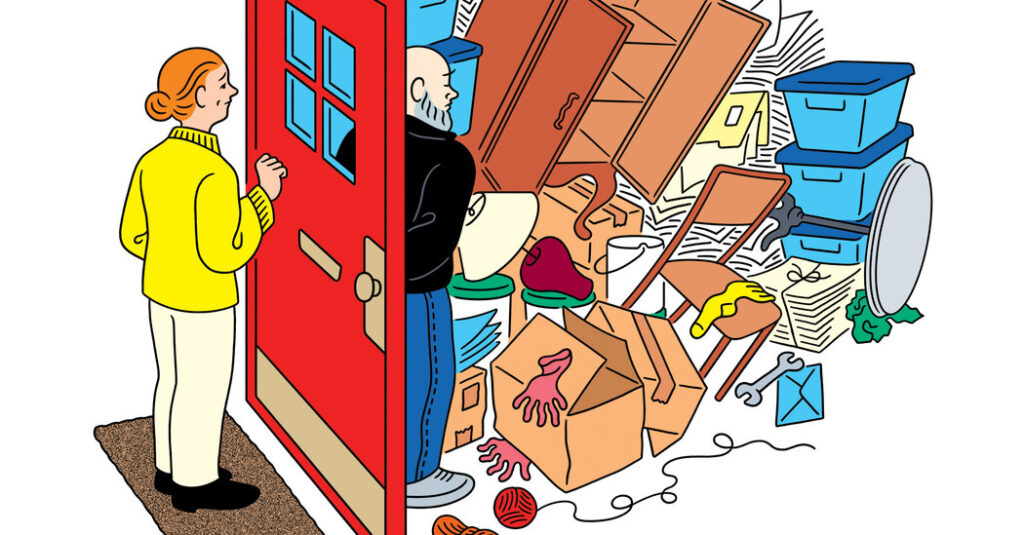
I have been married for 55 years to a man who is highly intelligent and educated. He is funny, generous and a wonderful provider. Together we have raised two amazing children we are very proud of. The problem is that he is a full-blown hoarder — the kind you see on TV.
More than a decade ago, he agreed to go to counseling with me to work on how to better communicate with each other. When I brought up working on the clutter together, he stood up, said he was done and walked out. We separated soon after that. Neither of us wanted a divorce, though, and we genuinely care about each other.
In the 10 years I have been gone, the hoarding has gotten much, much worse. His furnace has been broken for two years because he won’t let anybody into the house to fix it, so he has gone through two Northeastern winters with no central heat. Instead, he has used space heaters, which our family feels are very unsafe. He also does not have a working hot water heater or clothes dryer, because all the clutter in the basement makes it impossible to get the old ones out and replace them. We think that the house would most likely be condemned if county inspectors ever got inside. I am the only person who has been in the house in the 10 years I’ve been gone. And it was only one time.
He does not have dementia, so I can’t invoke power of attorney. It is entirely his choice to live like this. Our children and I have tried to encourage him to see what we see and have said we will help. His sister has said the same. But he refuses to change. He has excuses as to why things have gotten so bad, but they make sense only to him. He has the money to hire someone to work with him to clear things out, but it has been a hard no.
We are sick about this and see no way to help him, because he doesn’t want help. He seems content with the way things are. If we call Elder Services, he will know it was one of us, and he would never forgive us. Thoughts? — Name Withheld
From the Ethicist:
What makes your story especially sad is that the effects of your husband’s hoarding have spilled far beyond his living quarters; it clearly has contributed significantly to your separation and caused distress to other members of his family. It’s an instance of the dismal truth that hoarding can damage relationships. Unfortunately, it is notoriously difficult to get hoarders to accept that they need help. And most solutions depend on their doing so.
Given all those failed efforts to make your husband grasp his condition, I understand why you feel there is no good way to help him. One recourse that families in this situation sometimes contemplate is entering the hoarder’s home and removing things without consent. But this is generally not a good idea. It would be disrespectful of him and his autonomy, of course; as you say, it’s his choice to live like this. And he would probably just refill the space over time.
You might consider narrowing the scope of the intervention. You could still try to get him to see that the clutter in his basement makes it impossible to restore the heat in the house and that, at the very least, clearing a path to allow someone through would solve that problem. Clearing clutter in order to meet a specific need of his, rather than simply because it is clutter, won’t require him to admit (or you to insist) that he has a psychiatric problem.
You might also find a clinician who specializes in this disorder and, at intervals, gently remind your husband that you have that person’s contact information. Conceivably, your husband might eventually become curious about talking to someone outside the family about the situation. A specialist might also have ideas for strategies to get him to engage.
Failing this, though, there comes a point at which respect for his autonomy may have to yield to concern for his safety. The official fire-safety guidance in many states says combustible material should be kept at least three feet from space heaters and cautions against overloading electrical outlets. So there’s a strong case for contacting your state’s Adult Protective Services. He may be furious, but you could reasonably decide that trying to head off a serious danger trumps preserving his good will. Even outside authorities may be limited in what they can do. Still, you’ll at least have given an appropriate agency a chance to intervene.
In the end, though, you may have to accept that there’s only so much that can be done for someone who doesn’t recognize that anything is wrong. One of the painful parts of loving another adult is understanding that some problems are not ours to solve.
Readers Respond
The previous question was from a reader whose social group felt held back by a member. They wrote:
There is a woman in our mahjong group of 15 who is now nearly blind and a very slow player. She uses accommodations, such as a card with large print, oversize tiles and a magnifying glass with a light. We’ve all been together for years, but the situation is worsening. Despite these accommodations, she remains agonizingly slow. … Many members refuse to play with her or complain privately afterward. How do we gently tell her she is no longer welcome? We’re kind people; no one wants to hurt her, but we play to relax and challenge ourselves, and this situation no longer allows that. — Name Withheld
In his response, the Ethicist noted:
The respectful way to address it isn’t to complain behind her back or conspire to eject her; it’s to talk with her. Treat her, in short, as you would want to be treated should you find yourself in her position. … She is presumably coming along, like all of you, for the company as well as the game. You could agree on a time limit for turns, with the understanding that she may sometimes have to sit out the rest of a hand. Other compromises may suggest themselves: Some evenings could allow for slower play; one table could agree to play fewer games; she may have ideas for further accommodations herself. Any workable arrangement, though, begins with being honest with her about the situation. …
(Reread the full question and answer here.)
⬥
Games are played for fun. We have a Shakespeare reading group, and one of our members, at 97, has now begun to forget who her character is between her speeches. So someone sits next to her and nudges her, and smiles. I would suggest that, at every game, one different person sit with your friend to help her. Tell her why, and tell her that her company is worth the trouble. — John
⬥
Especially if the group is a big one, the compassionate thing is to discuss the situation with everyone but her and suggest a rotation where teams take turns including her. This can be almost literally a matter of life and death for the elderly. And, yes, it might be you someday. — Carol
⬥
It always comes as a surprise to me when people refer to themselves as kind except when they are inconvenienced. Playing fewer games seems more than fair, if it allows this woman to participate in something she enjoys. Shame on anyone who suggested she should leave the group. — Regina
⬥
I think the slow mahjong player should be kindly asked to find some other social event. She’s making what should be a pleasant game for others unpleasant, and there’s no getting around that. She herself should be aware of this, and should respectfully step away, so I see this as her being inconsiderate of the others. I play bridge, and when a player is consistently too slow, it makes the game downright painful for the others. — Paul
⬥
It’s not the M.L.B. or the N.B.A.; not everyone has to be M.V.P.! Let her play! — Dheeraj
The post My Estranged Husband Is a Hoarder. Can I Force Him to Get Help? appeared first on New York Times.