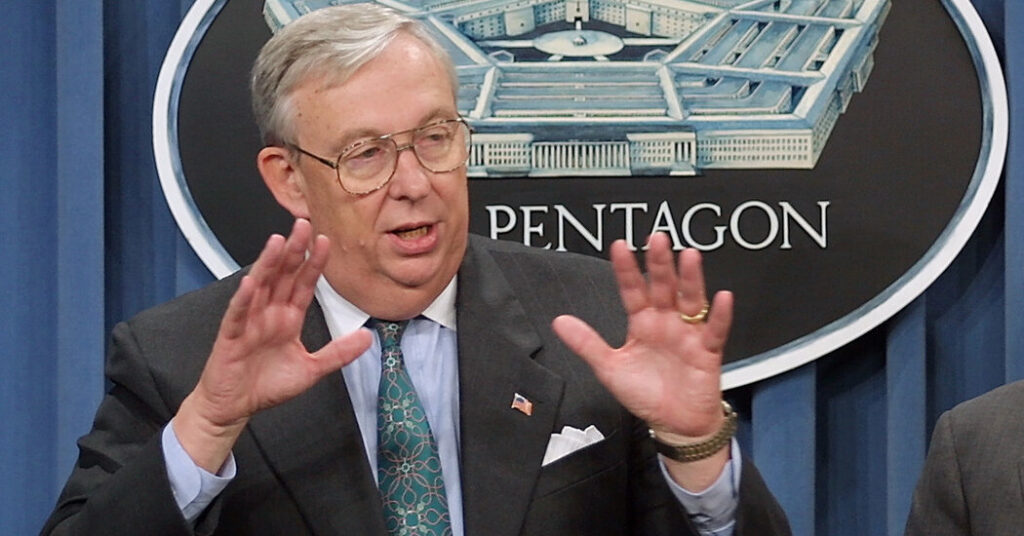
James G. Roche, who was secretary of the Air Force during an uproar over sexual assault at the Air Force Academy and a multibillion-dollar procurement scandal — twin controversies that prematurely ended his career as a rising star at the Pentagon in the early 2000s — died on Aug. 4 at his home in Annapolis, Md. He was 86.
The cause was vascular disease, Bill Bodie, a former Pentagon aide to Mr. Roche, said.
Mr. Roche served in the Navy for 23 years before retiring with the rank of captain in 1983. Later, as a senior executive at Northrop Corporation, which designed the B-2 Stealth bomber, he helped guide the company’s 1994 purchase of Grumman Aerospace, creating the defense contracting giant Northrop Grumman.
In the private sector, Mr. Roche was known for his innovative leadership. At Northrop Grumman, he brought in consultants to oversee a daylong Shakespeare workshop, during which he donned a cardboard crown and blue robe to declaim Henry V’s famous rallying cry at the siege of Harfleur: “The game’s afoot.”
He became a favorite of Defense Secretary Donald H. Rumsfeld and President George W. Bush, who nominated him as Air Force secretary in April 2001 in the hope of bringing corporate discipline to the Pentagon bureaucracy.
As Air Force secretary, Mr. Roche sought to contain the Air Force Academy scandal, which erupted in early 2003. Several current and former female cadets disclosed that they had been ignored or punished for reporting that they had been raped or sexually abused.
A report in The New York Times suggested that as many as half of the female cadets at the academy had experienced rape or sexual assault, but most chose not to report it for fear of reprisals in the toxic male culture of the academy, which did not begin admitting women until 1976.
In a speech in late February 2003 at the academy in Colorado Springs, Mr. Roche castigated students for tolerating sexual assault, while acknowledging that decade-old protocols to prevent rape had failed. He also replaced the top four officers at the academy and assembled an Air Force panel to review the allegations.
The panel largely defended the academy in a June 2003 report, asserting that its leaders had not mishandled complaints. It went on make some recommendations that were considered tone-deaf: offering first-year female cadets assertiveness training and removing a motto above a stone arch that read, “Bring Me Men.”
A congressional panel reviewing the assaults was much harsher, placing blame on the top Air Force leadership. “Since at least 1993,” the independent investigation found in a report released that September, “the highest levels of Air Force leadership have known of serious sexual misconduct problems at the academy,” but failed to respond effectively.
The commission praised some steps that Mr. Roche laid out, but said that they did “not go far enough.”
The scandal did not immediately tarnish Mr. Roche in the eyes of the Bush administration. The president nominated him to be secretary of the Army in May 2003, another high-level appointment. But his candidacy was soon overshadowed by his role in supporting a major deal with the Boeing Company.
The Air Force proposed to lease 100 of Boeing’s 767 aircraft and retrofit them as midair refueling tankers. But it soon emerged that the No. 2 weapons buyer for the Air Force, a civilian official who promoted the deal, was steering contracts to Boeing while seeking a $250,000 job at the company. She and a Boeing executive eventually went to prison.
Mr. Roche, who was not linked to a criminal scheme, was also an avid supporter of the $23 billion tanker deal. The deal fell apart under congressional opposition, in particular from Senator John S. McCain, Republican of Arizona. From his perch on the Committee on Armed Services, Mr. McCain accused the Air Force of wasting taxpayer money.
Mr. McCain was so incensed that he put a hold on Mr. Roche’s nomination for Army secretary. The White House, recognizing political reality, withdrew the nomination in March 2024. Mr. Roche announced his resignation as Air Force secretary that November, a few days before Mr. McCain released emails that showed Mr. Roche had been a cheerleader for Boeing, writing, “Go Boeing!” and criticizing opponents of the tanker deal as “fools.”
James Gerard Roche was born on Dec. 16, 1939, in Brooklyn, to Gerald Roche, a machinist, and Elizabeth (Counihan) Roche.
He received a humanities degree from the Illinois Institute of Technology in Chicago in 1960, the same year that he was commissioned as an ensign in the Navy and married Diane Mikula.
During the Vietnam War, Mr. Roche led search-and-rescue missions in the Gulf of Tonkin. He went on to command the U.S.S. Buchanan, a guided missile destroyer, in 1973-74.
While on active duty, he earned a master’s degree in operations research in 1966 from the Naval Postgraduate School in Monterey, Calif., and a doctorate of business administration from Harvard Business School in 1972. He held jobs at the Pentagon during the Ford and Carter administrations.
After retiring from the Navy, Mr. Roche briefly served as Democratic staff director for the Senate Committee on Armed Services before joining Northrop. He advised the company’s chief executive on a strategy to survive post-Cold War cuts to military weapons by acquiring other businesses, and the newly formed Northrop Grumman went on a buying spree.
“He had a diversification strategy in the mid-90s that turned the company around,” Mr. Bodie, who worked as an aide to Mr. Roche in the private sector before following him to the Pentagon, said in an interview.
Mr. Roche’s wife died in January. He is survived by a daughter, Heather Roche. His son, Sean, died in 1987.
Mr. Roche brought his experience as a leadership guru in the private sector to the Air Force, hiring the same corporate consultants to teach Shakespeare to the generals. Even after he stepped down as secretary, he remained interested in the seminars, and in January 2005 he visited one on “Julius Caesar” in which generals debated the assassination of the Roman dictator.
“People can talk about some things more easily when they do it in the context of the play,” Mr. Roche explained to The Times, which reported on the exercise. “So when I became secretary, I suggested we try it with our officers.”
The post James Roche, Embattled Air Force Secretary, Dies at 86 appeared first on New York Times.