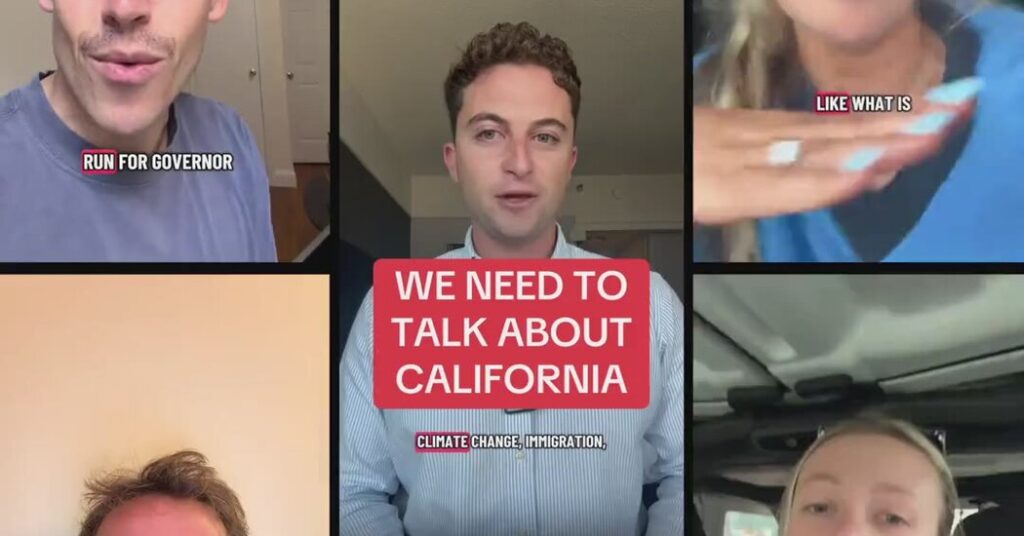
Josh Greene is a rising left-wing social media star with his own podcast, nearly 800,000 followers and access to politicians like Senator Bernie Sanders of Vermont and Mayor Zohran Mamdani of New York.
He has used that platform to support dozens of progressive candidates in the midterm elections, ranging from low-profile, down-ballot contests to some of the nation’s marquee Democratic primaries. In camera-facing videos, Mr. Greene informs his followers of his preferences, calling some candidates “the most viable” and, in other cases, declaring that “this is the candidate for you.”
He does not always tell his viewers that he is being compensated for his support.
But records show that Mr. Greene, 26, has received money from at least seven politicians, or outside groups supporting them, in the current campaign cycle, including several congressional candidates in New York and a super PAC linked to Dr. Abdul El-Sayed, the Senate nominee in Michigan. Tom Steyer, the former candidate for governor in California, paid him $21,500.
Mr. Greene, who lives in Southern California and is best known by his handle @joshtheprogressive, is among a growing number of influencers who, at a moment when campaigns are increasingly willing to pay for online attention, appear willing to put their mouth where the money is.
As more people spend time scrolling on their phones, campaigns view these shows of support from influencers as a vital way to reach voters. They are also significantly less expensive than traditional advertising.
But unlike campaign mailers, billboards and television spots, these messages fall into a legal gray area.
There are no federal regulations requiring disclosure of payments for political support on social media, and only a few states have such rules. That allows influencers, in most instances, to endorse candidates for a fee without ever disclosing those payments in their posts. Creators say some campaigns have even asked them to actively conceal the fact that they’re being compensated, making it impossible to know what’s genuine support — and what is pay-for-play.
In most cases, the only way a viewer would know an influencer is being paid would be to search a candidate’s campaign finance reports, as The New York Times did to discover the payments. Even then, such compensation is regularly obscured by funneling the payments through middlemen.
“It’s completely out of control,” said Suzanne Lambert, a progressive influencer and comedian with more than 1.3 million followers between TikTok and Instagram. She said that while she happily promotes candidates she likes, she has “never taken a cent” in exchange for an endorsement and worries that the practice distorts the democratic process. “People don’t know what’s real anymore,” she said.
Mr. Greene defended the idea of influencers getting paid for their work and noted that he accepts money only from candidates and campaigns that he would support anyway. “I turn down offers every single day because I’m not going to take money from any place if I don’t agree with it,” he said. (In the case of the Steyer campaign, Mr. Greene said he was initially critical but came to see him as the most viable candidate.)
Still, he suggested there was a need for straightforward and consistent rules on disclosure. “If anything, we do need more clear transparency laws so that creators like myself aren’t confused,” he said.
Coordinated networks
The phenomenon is bipartisan.
In June, Representative Barry Moore of Alabama filed a complaint with the Federal Election Commission, alleging that at least eight social media accounts were being paid to attack his military record during the Republican primary. In April, a newspaper in Kentucky revealed what appeared to be a coordinated network of influencers boosting Nate Morris — at the time running in a Republican Senate primary — even though none acknowledged being paid for their efforts. Ken Paxton, the attorney general of Texas and the Republican nominee for Senate, benefited from a paid campaign on X when he was facing impeachment in the state several years ago.
But the question of paid influence has gained particular attention in recent months thanks to aggressive efforts by a handful of Democratic candidates to secure support from well-known influencers.
During California’s hard-fought primary this spring, Mr. Steyer’s campaign paid 17 influencers at least $5,000 apiece, including one, Carlos Eduardo Espina, who has over 14 million followers on TikTok and received a total of $400,000, campaign finance filings show.
Former Representative Katie Porter, who also ran unsuccessfully for California governor, paid 12 influencers a total of $139,500. One of them, a lifestyle creator named Avery Cyrus with 9.5 million followers on TikTok, received $25,000 for what appeared to be a single post claiming “Katie Porter’s thing works.”
Ms. Cyrus’s post was deleted after The Times inquired about it. She did not respond to a request for comment made through the social media agency that represents her, UnderCurrent Media, but the firm’s chief executive, Eric Bogard, said in an email that it “was not asked to oversee disclosure compliance, nor were we provided instructions concerning any required disclosures.”
Under California law, paid political posts on social media must be disclosed. A Times review found three posts supporting Ms. Porter on TikTok from influencers who were paid by her campaign that did not include any disclosures. In seven other instances, the disclosures could be found only after clicking through to a hidden section of TikTok for comments flagged “as potentially offensive or disturbing.”
Sander Jennings, an influencer based in Florida who was paid $22,000, said “the Porter campaign and I agreed to disclose the payment” in TikTok’s comments section in order to get around the site’s practice of removing paid political posts. He said he did not know why the disclosures ended up in the hidden section of the comments.
TikTok’s terms of service bar all paid political advertising, including “creators being compensated for making branded political content.” In an email, Ms. Porter said that “nothing was paid for and posted without review and coordination and compliance with all law.”
Other political efforts have employed a different strategy, contracting private firms that pay little-known content creators smaller sums to put out a large volume of posts. Those companies, known as user generated content platforms, or U.G.C.s, operate on the principle that carpet bombing the internet with hundreds of nearly identical posts is more likely to generate viral content than paying one large influencer the same amount of money to make a single post.
This spring, a woman posted dozens of videos promoting Mr. Steyer in the California primary. Weeks later, she appeared in videos from a different account complaining about the cost of living “here in Michigan” and encouraging people to vote for Representative Haley Stevens, Dr. El-Sayed’s primary opponent in the Senate race. Then she pivoted to a third account talking about affordability in Wisconsin.
Corporate records show that the woman, Paige Dunmeyer, actually lives in Kansas City, Mo., and is registered to work with a U.G.C. company called SideShift. It’s not clear how much she was paid for her Michigan and Wisconsin videos, but she has earned more than $30,000 on SideShift for a variety of political and commercial campaigns, according to company records reviewed by The Times. Filings from Mr. Steyer’s campaign showed she received $1,320 for her efforts in that race. Ms. Dunmeyer did not respond to requests for comment.
A Times analysis found that at least 87 people registered to work with SideShift had made posts boosting Mr. Steyer or Ms. Stevens, or participated in a third campaign to post video clips on TikTok supporting Representative James Talarico, the Democratic Senate nominee from Texas. Most of the posts by those creators included no acknowledgment that money changed hands.
In a statement, SideShift said that it advises creators to follow applicable disclosure requirements, and called for more explicit laws governing how paid content is disclosed on social media.
“SideShift believes anyone can be a creator and that creators should get paid fairly for work they choose to do,” the company said.
In June, Kendall Boyle, a TikToker in Michigan with over 21,000 followers, was contacted by a social media marketing agency called Activate HQ offering her a paid opportunity to post videos about “how rising costs are affecting Michigan residents in real life.”
When she asked who was footing the bill, she was told it was Majority Forward, a dark money group linked to the Senate Majority PAC, a Democratic super PAC, email correspondence reviewed by The Times shows. Ms. Boyle said she was turned off by warnings in those emails from Activate HQ that “disclosure is not required and the paid partnership label will not be included in any posts” and also that Majority Forward “will not be mentioned” in her content.
“It was one of those things where something isn’t fitting right,” Ms. Boyle said.
In a statement, Majority Forward said the language in the email “explains disclosure requirements necessary under F.E.C. rules, which were fully followed.”
Little regulation
Just four states have laws or regulations requiring influencers to disclose paid political messaging, but they apply only to state and local races, not federal contests. Although regulations for social media have been proposed multiple times to the F.E.C., it has never taken action. The Federal Trade Commission, which requires disclosure of paid commercial content on social media, makes an exception for political messaging.
Representative Mark Takano, a California Democrat, introduced a bill in June that would require anyone paid by a candidate or political committee to clearly disclose that fact in the same way that traditional campaign materials are required to note such payments.
In an interview, Mr. Takano said he was inspired to draft the legislation after online sleuths revealed that numerous influencers had been making paid endorsements in the California governor’s race without proper disclosure, as required in that state.
“It’s unfair when an influencer is allowed to be silent or not transparent about money they’re taking from a candidate, making it seem like what they’re saying is authentic and not influenced by money,” he said.
Mr. Takano acknowledges that there are some potential loopholes in the bill. For instance: Campaigns often obscure payments to influencers by hiding them under layers of vendors and sub-vendors.
Ms. Porter, for example, hired Activate HQ for “influencer marketing services,” and it in turn paid 13 different creators to bolster her campaign for governor. One of them, a political influencer in Los Angeles named Dash Dobrofsky, who also posted in support of Ms. Stevens in Michigan, received $15,500 from Ms. Porter’s campaign. Mr. Dobrofsky did not respond to a request for comment.
Mr. Steyer’s campaign, for its part, hired multiple digital strategy firms to manage social media, including one called Group Project, which hired a Los Angeles company, Gutsy Media, which paid Mr. Greene through UnderCurrent, which represents him.
Those payment chains are visible because California is one of a handful of states that require campaigns to report payments to sub-vendors. There is no such obligation for campaigns for federal office. “Every dollar spent by this campaign is publicly disclosed and available for anyone to see,” the Steyer campaign said in a statement.
‘Social media consulting’
Occasionally, campaigns or independent expenditure groups will reveal direct payments to influencers, such as the super PAC Freedom PA, which supported the socialist candidate Chris Rabb’s successful bid to win a Pennsylvania House primary in May. It has disclosed payments to nearly 50 influencers for “social media consulting,” among them Mr. Greene, who received $750 and posted a video celebrating the candidate’s victory.
Other committees listing payments to Mr. Greene in federal filings employed less illuminating descriptions. Chuck Park, who unsuccessfully ran for Congress in Queens, N.Y., this year, listed a $300 disbursement to Mr. Greene as “staff salary.” Mr. Greene posted at least five videos promoting Mr. Park, none of which state that he had received payment.
Mr. Park, in an interview, said that Mr. Greene was in fact not employed by the campaign, but said that “our campaign absolutely leaned into new media” and that he spent time with Mr. Greene in Queens filming a series of videos.
Mr. Greene disclosed being paid on three of his posts about Mr. Steyer and told tThe Times that those videos were the only ones that he was specifically contracted by the Steyer campaign to produce. He said he didn’t receive compensation for prior posts about the candidate.
Mr. Greene has also supported Senator Ed Markey, the Massachusetts Democrat in a competitive primary against Representative Seth Moulton, and last month, he posted a video accusing Mr. Moulton of “posturing to be someone they really aren’t.” He posted a second video this month critiquing Moulton, this time for taking corporate political money.
Neither video includes disclosures and F.E.C. filings don’t show any payments to Mr. Greene related to Mr. Markey’s re-election bid. But a spokesman for Commonwealth Together, a super PAC that is supporting Mr. Markey, said it had paid Mr. Greene $3,500 for “digital communications consulting” through his agency, UnderCurrent.
Mr. Greene, in a text message, acknowledged the payment to support Mr. Markey, saying he took it “because I believe he is by far the more progressive candidate in the race.”
The murkiness has left some in the political world uneasy. Last month Rynn Reed, the founder of Creator Congress, an organizing hub for influencers interested in politics, introduced a code of conduct for the group that would require creators to make clear when they’re paid, whether required by law or not.
“With no standards,” Ms. Reed said, “there’s going to be a race to the bottom.”
The post Influencers Have a Lot to Say About Politics. Many Are Quietly Paid for It. appeared first on New York Times.