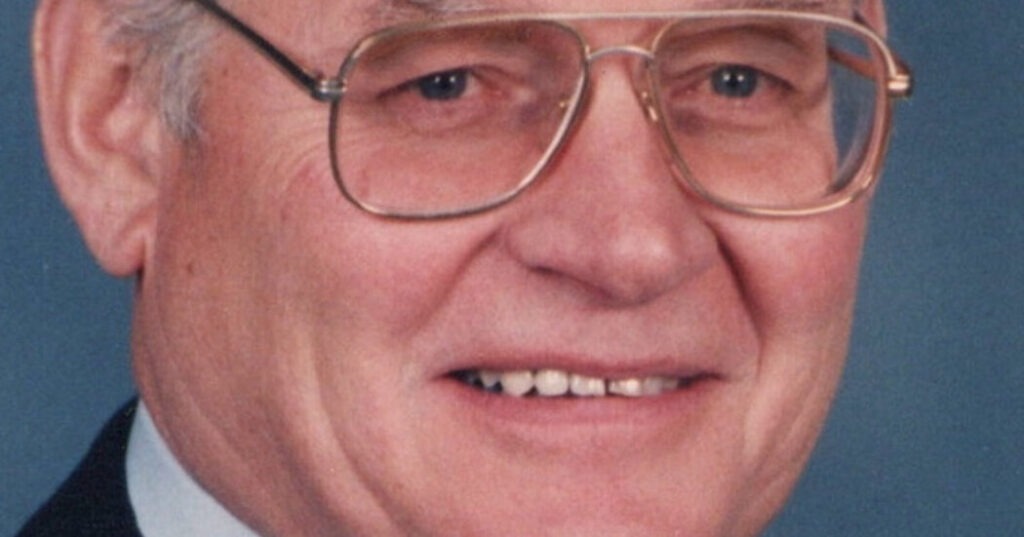
George W. Cave, a C.I.A. agent who after more than 20 years of covert operations in the Middle East and Pakistan was called out of retirement to help free American hostages held in Lebanon, in a crucial piece of the scandal known as the Iran-contra affair, died on Aug. 14 in Olney, Md. He was 97.
His family placed a death notice with a funeral home but did not provide any further details.
Mr. Cave “rubbed elbows with fascinating and even legendary figures, some of whom he recruited as intelligence assets, others who rose to international prominence,” the C.I.A. said in a statement, adding: “He safely exfiltrated agency assets and officers from harm’s way many times, and his career experience helped train generations of U.S. analysts.”
A rare Persian speaker in the C.I.A., Mr. Cave was stationed in Tehran twice during the rule of the western-backed shah of Iran. He understood Iranian politics, knew the hard-liners and reformers, and maintained contacts in the country even after retiring from the spy agency in 1980. By then, Ayatollah Ruhollah Khomeini had been in power for a year following the Islamic Revolution.
In 1986, while under contract to the C.I.A., Mr. Cave agreed to a request from William Casey, the agency’s director, that he join a small group meeting with Iranians in Tehran and other cities over several months to negotiate the release of seven American hostages held in Beirut, Lebanon, by Iranian-backed militants.
The illegal deal that came to pass — selling U.S. arms to Iran to secure the release of the hostages and covertly diverting the proceeds from the sale of those arms to support the U.S.-backed right-wing contra rebels in Nicaragua — bypassed a congressional arms embargo.
As an Iran specialist and translator, Mr. Cave was a reluctant participant in the clandestine operation. One of his misgivings was the role of go-between played by Manucher Ghorbanifar, an Iranian arms merchant who had failed a C.I.A. polygraph test and whom Mr. Cave later called “the most totally amoral person I ever met.”
“I believe him when he said he wasn’t happy to be dragged into this affair,” said Malcolm Byrne, the deputy director of the National Security Archive, a nongovernmental research organization in Washington and publisher of declassified records about U.S. policy. But Mr. Cave, he added, “really cared about the U.S. position in the world.”
Mr. Cave brought a key-shaped chocolate cake to the first meeting with the Iranians in May 1986, an offering that symbolized the Americans’ “desire to unlock the door barring a resumption of American-Iranian relations,” the historian Kai Bird wrote in Guernica, an arts and politics magazine, in 2014.
The American delegation — which included Robert C. McFarlane, President Ronald Reagan’s former national security adviser, and Marine Corps Lt. Col. Oliver North, a staff member of the National Security Council — was met with hostility, as the Iranians enumerated “past sins of the United States,” Mr. Cave wrote in a memo.
In subsequent talks over the next few days, it became clear that the Iranians did not have enough time to secure the hostages’ freedom.
“One of the members of the Iranian negotiating team told me they had not believed we would actually come to Tehran,” Mr. Cave wrote in the magazine Washington Report on Middle East Affairs in 1994. “As a result, they had only sent someone to Lebanon on the evening of May 25, after our arrival in Tehran, to negotiate with the actual hostage holders.”
On the evening of May 27, Mr. McFarlane told the Iranians that if the hostages were not released the next morning, the Iranians would not get the spare parts for Hawk surface-to-air missiles that they needed for their war against Iraq. In the morning, the Iranians asked for more time — and requested that Mr. Cave and Colonel North stay behind — but Mr. McFarlane rejected the proposal, and the Americans left.
There was at least one success that resulted from the meetings Mr. Cave attended. On Oct. 28, 500 TOW antitank missiles that had been sent to Israel in May were delivered to Iran; over the next two days, Mr. Cave and Colonel North were among those at a meeting in West Germany, with Ali Hashemi Bahramani, a nephew of Akbar Hashemi Rafsanjani, the speaker of the Iranian parliament and future president, that led to the release of David Jacobsen, one of the hostages.
By late November 1986 — when the arms-for-hostages trade and the diversion of money to the contras had been revealed publicly and had become a major scandal for the Reagan administration — three American hostages had been freed.
George William Cave was born on Aug. 6, 1929, in Camden, N.J. His father, Walter, who worked for a milk company, died when George was 8. Soon after, his mother, Florence (Clarke) Cave, sent him to the Milton Hershey Industrial School (now the Milton Hershey School) in Hershey, Pa., originally a home and school for orphaned boys.
After he graduated in 1947, he enlisted in the Army, studied Persian at its language school in Monterey, Calif., and was discharged in 1952. He received a bachelor’s degree in Middle Eastern studies from Princeton University in 1956 and contemplated a career in the oil industry, but instead accepted an offer to work for the C.I.A.
Following a stint in Tehran, Mr. Cave was sent to Beirut in 1963. The Lebanese capital was “kind of an intelligence paradise,” he said on an episode of the “Spycast” podcast in 2012. For five years, he used deception and propaganda to help break up the local Communist Party and recruit sources within Palestinian organizations.
In 1968, he began a two-year stint at the C.I.A. headquarters in Langley, Va., where he was in charge of so-called denied-area operations, missions into hostile countries like Iraq and Syria. In 1970, he returned to the field as deputy station chief in Islamabad, Pakistan; in 1973, he returned to Tehran, where he held the same position for three years.
He moved on to Saudi Arabia as the agency’s station chief in 1976. But in 1979, the Carter administration recalled him; the Saudi leadership had declared him persona non grata after he “aroused concern among the ruling family by his efforts to ascertain the extent of internal dissension” within the monarchy, Cord Meyer Jr., a former C.I.A. operative, wrote in his syndicated column.
Mr. Meyer did not name Mr. Cave, but in the podcast, Mr. Cave admitted that he was the station chief in Jeddah that Mr. Meyer had mentioned.
In retirement, Mr. Cave wrote novels, including “October 1980” (2013), set during the 1980 presidential election and the hostage crisis in Iran.
Mr. Cave married Joan McCarthy in 1955. She died earlier this year. He is survived by three daughters, Sharon, Constance and Eileen; two sons, George Jr. and William; and numerous grandchildren and great-grandchildren. His son James died in 2020.
He was never accused of wrongdoing in the Iran-contra affair.
In 1992, Mr. Cave testified in federal court — although The New York Times described him as “clearly reluctant” — in the trial of Clair E. George, the C.I.A.’s former chief of covert operations and so-called spymaster, who had been charged with lying to Congress and investigators about the agency’s knowledge of the once-secret operation. Mr. Cave’s undercover status was protected by U.S. District Court Judge Royce C. Lamberth, who would not allow sketch artists depict him on the witness stand.
During his testimony, he described critical meetings attended by Mr. George, some of which, he said, were about Richard V. Secord, a retired Air Force major general who had helped coordinate the sale of arms to Iran. Mr. George had previously told House and Senate intelligence committees that he had only a passing knowledge of Mr. Secord.
Mr. George was convicted in late 1992 of two felony counts of lying to Congress but was pardoned on Christmas Eve by President George H.W. Bush, along with five other members of the Reagan administration, including former Defense Secretary Caspar W. Weinberger.
During his testimony, Mr. Cave said that while Mr. George had been skeptical of the arms-for-hostages mission, he himself had believed that the goal of Iran-contra was “worth pursuing,” although he had “no great hopes for success.”
The post George Cave, C.I.A. Agent With a Role in Iran-Contra, Dies at 97 appeared first on New York Times.