This is an edition of The Atlantic Daily, a newsletter that guides you through the biggest stories of the day, helps you discover new ideas, and recommends the best in culture. Sign up for it here.
Three hundred thousand metric tons of ground beef are on their way to the United States. There’s no easy way to visualize 300,000 metric tons of anything (for context, that’s about 12 times the weight of the Statue of Liberty). All of that beef could fill an important gap in the American market—but not everyone’s happy about it.
President Trump announced last Friday that he’ll be temporarily lifting some tariffs on beef and that, as part of an ambiguous deal, the imports will be sold at “25 percent below current market prices.” He was likely hoping for a political win here: Affordability has been a losing issue for Trump and his party ahead of the midterms, and increasing the beef supply in an attempt to lower prices could be one way of giving shoppers a reprieve. But industry leaders immediately condemned the move, warning that it will do little to address the underlying dynamics that have driven up prices in recent years—and their allies in Congress joined them in the revolt. Now Trump’s on-again, off-again relationship with ranchers is becoming the whole country’s problem.
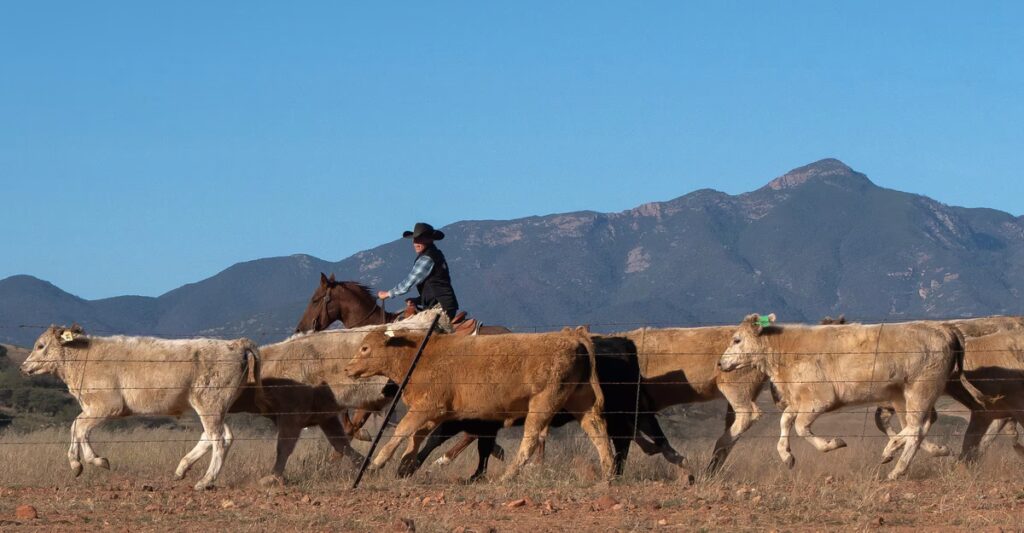
There’s no great mystery as to why American beef is so expensive. The steaks we get from the supermarket represent the end product of a long, multiyear chain involving ranchers, auctioneers, feedlots, meatpackers, and grocery stores. But beef starts with cattle, and after years of drought, the number of cows now grazing on U.S. soil is the lowest it’s been in 75 years. The return of a certain flesh-eating parasite hasn’t helped things, either. This, combined with the fact that Americans are still hungry for beef, has created a basic supply-and-demand problem.
Economists told NPR this week that the president’s move, which was made official on Wednesday, may shave only a small amount off what shoppers are currently paying for ground beef at the grocery store. It’s too soon to tell whether this will actually happen—the government won’t release its August data for another few weeks—but Trump’s announcement did depress cattle prices somewhat, which suggests that traders at least think that beef could become less valuable, as the president intended. This is a problem for ranchers, who applauded last year’s restrictive Liberation Day tariffs. Most of the beef that Americans consume is produced in the United States, and the duties had been helping prevent foreign imports from undercutting domestic producers; without these protections, meat-processing companies are free to buy the cheapest option, wherever it may come from. In a joint letter to the president, the heads of four livestock-industry groups expressed “deep concern” that the plan would undermine beef producers by devaluing cattle and would prevent the rebuilding of the dwindling herd.
Ominously, the White House has declined to say where all of this beef will be coming from. When asked which countries will be supplying the beef, Agriculture Secretary Brooke Rollins told reporters on Tuesday that she was “not part of any of those conversations” and is “not privy to talk about that.” Trump mentioned that “a few” different countries will be involved but hasn’t said which. (Thirty thousand pounds of Argentine beef were recalled earlier this month over concerns that it hadn’t been properly inspected; the White House declined to respond to my question about where the beef will be coming from but claimed, without elaborating, that the plan would reduce beef prices while allowing the U.S. cattle herd to grow.)
Despite being a core MAGA constituency, beef producers and ranchers have been periodically annoyed at Trump’s tariff changes over the past year. What’s more unusual is that high-profile Republicans have also been breaking with the president on this issue. At least 13 GOP senators have publicly criticized the tariff adjustment to varying degrees over the past week. “Beef prices are too high for a simple reason: Our cattle herd is too small,” Senator Tom Cotton wrote on X. “I have advised the President against this ill-advised action in the past and I now urge him to reconsider.” Others suggested that what Trump is doing is unfair, a way of rigging the market against American producers, who “simply want a fair marketplace,” per Senator John Barrasso. (Rollins seems to be supporting the current plan, though she reportedly opposed a similar tariff rollback in May.)
This isn’t the first time in recent months that the Trump administration—whose war with Iran has driven up consumer prices—has turned its attention to short-term solutions. As I’ve written, both Trump and Rollins have publicly praised business owners who have lowered their prices on certain goods, such as fuel and groceries. But these kinds of temporary cuts don’t amount to a lasting policy solution, and companies can’t be expected to shoulder this burden forever. The private-sector “commitment” to selling this imported beef below market price has a similarly short-term focus. The bigger issues remain unaddressed, and voters don’t believe that the administration has the economy under control.
The president attempted to make peace with ranchers this morning, writing on Truth Social that he’d give them the “right to PROCESS THEIR OWN FOOD”—a nod to long-standing complaints about what farmers say is a monopoly among the Big Four meatpackers. But this olive branch is effectively just a promise to disrupt a different part of the industry. In trying to please everyone, Trump may end up creating even more beef.
Related:
Here are three new stories from The Atlantic:
- Jonathan Chait on how Karoline Leavitt debased her job
- Pennsylvania’s public-health officials may be wrong about a measles death.
- The AI backlash gets professional.
Today’s News
- In his speech in Jackson Hole, Wyoming, today, Federal Reserve Chair Kevin Warsh said that inflation is “concerning” but gave no clear indication of where interest rates are headed.
- At least 579 people have been killed and nearly 2,000 are still missing in Nepal and Tibet after catastrophic flash floods triggered by a Himalayan glacier’s collapse, according to Nepali authorities. Rescue operations have resumed in Nepal and China, and the State Department says that about 90 Americans remain unaccounted for in the two countries.
- The far-right commentator Milo Yiannopoulos was arrested by ICE at Louis Armstrong New Orleans International Airport yesterday and is being held, according to the Department of Homeland Security. The British national had overstayed his visa and failed to appear for an immigration hearing last month, after which a judge had issued a final order for his removal from the United States, DHS said.
Dispatches
- The Books Briefing: Emma Sarappo explores what Dolly Parton knew about reading.
Explore all of our newsletters here.
Evening Read

The Sailors on the USS Abraham Lincoln Deserve Better
By Andrea N. Goldstein
When I was deployed at sea as a junior officer, I used milestones to track the passage of time. Each day counted toward something: a port call, when you get a break on land from the monotony at sea; the “crossing the line ceremony” when a ship crosses the equator (unfortunately, canceled at the last minute for my ship); and, eventually, the date I knew that, no matter what, I would be going home. Even on my worst days, that end point helped me stay focused on the mission and gave me something to be hopeful for.
The USS Abraham Lincoln left its home port of San Diego in November and was scheduled to return home in May. That did not happen.
More From The Atlantic
- A turning point in AI writing
- The crisis for Democrats in Michigan
- Alexandra Petri: Everything is called America now.
- Watching Tim Curry have fun was the most fun thing.
- Claudia Rankine’s new post-“woke” book
- Galaxy Brain: Welcome to the scrolling backlash.
Culture Break

Reminisce. Sebastian Smee explores the limits of Yayoi Kusama’s infinity.
Watch (or skip). KPop Demon Hunters’ inclusion in a high-class cinema catalog may signal a changing tide, Sophia Nguyen writes.
Rafaela Jinich contributed to this newsletter.
When you buy a book using a link in this newsletter, we receive a commission. Thank you for supporting The Atlantic.
The post Trump’s Bad Bet on Beef appeared first on The Atlantic.