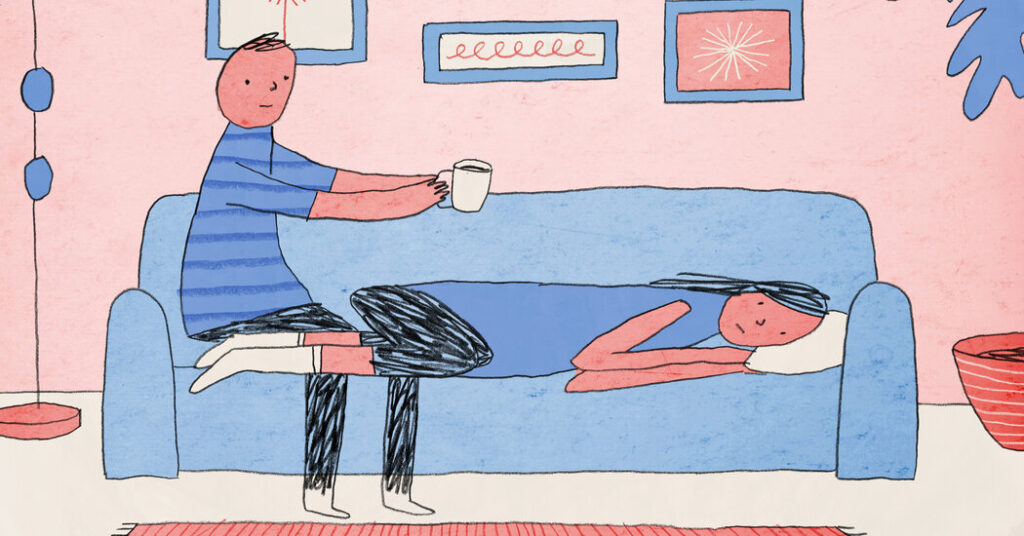
When my husband and I read our wedding vows nearly four years ago, he said, “I vow to make you coffee every morning for the rest of our lives.”
And he has. If we’re traveling, he finds a coffee shop. If we’re at home, he makes it himself and sets it on my night stand without saying a word. He even did it the morning after my mother killed herself.
The first time we met, at an awkward cocktail gathering of incoming Wharton School students, he said, “I’m Matt, but my friends call me Gordo.”
He was attracted to my confidence and willingness to stir the pot. I was drawn to his sense of humor, kindness and drive. We fell in love quickly, went through business school together and then moved across the country to San Francisco. We drank too much bourbon on Fridays, slept in too late on Saturdays and made fried egg sandwiches on Sundays. Life in those days was all about the two of us.
Until we got our dog, Bruce, who was defiant and energetic — the perfect preparation for parenthood. And soon we moved 30 miles south to the suburbs and had our son, Wes. Gordo stepped into the role of father easily, while never failing to bring me coffee.
When you get married, you promise “for better or worse,” and “in good times and bad,” but we didn’t realize how soon the bad times would hit. While most of our friends reveled in their blissful newlywed stage, we were thrown into the trenches. Before our son turned seven months old, my mother killed herself in her garage.
My mother was a powerhouse real estate broker in the Bay Area with a zest for life. We were the mother-daughter duo that spoke every day and jointly hosted a birthday party when I turned 25 and she turned 50. We looked like mirror images of each other except she was four inches shorter and always impeccably dressed.
Around the time Wes was born, she began to struggle, and I, her only child, along with our extended family, began to worry about her. I did the best I could, managing her needs along with those of my growing family and career. Right before she died, she had seemed to rebound, to the relief of everyone who loved her. Of course, now I know that kind of rebound can be typical just before someone takes their own life.
Losing her meant losing the one person who had gotten me through every hard moment of my life. Yet Gordo was there for me.
One night after Wes was asleep, as I waited for the shower to warm up, I collapsed on the bathroom floor, my sobs so loud I couldn’t hear the shower. If pain were a sound, this was it. Gordo rushed in and held me silently.
He knew the choreography of my grief before I did — how on some nights I needed to talk in circles and on others I needed to watch TV and say nothing at all. He knew when to rub my back and how to handle my grief bursts and panic attacks, when to order pizza or burritos.
In those early weeks and months, we would go on walks with Wes and Bruce. On one walk, I was agonizing about how hard this all was and how unlucky I felt when he said, “You are not special,” which was a line from one of my mother’s favorite shows, one she used to say to me often.
I laughed. He always knows when to drop a joke.
“Is there anything I can do to make it easier?” he then asked.
In our marriage, I was the one who had kept life on track. I ran our household. Yet after my mother died, all I could manage was getting out of bed and breastfeeding Wes. While also handling his new job, Gordo took on everything else: grocery shopping, dinner planning, doctors’ appointments, dog care. He didn’t complain. He did them all silently, as if they always had been his responsibility.
“Go shower,” he would say. “I’ve got dinner.”
“I love you,” I would say.
I would go straight from the shower to the couch. I had no words or energy for anything else; I had used it up being present for Wes. I would turn on the TV and later have no memory of what I watched.
As the TV played, I could hear the kitchen cacophony in the other room — the roasting pan landing on the stovetop, the salad tongs hitting the metal bowl, the sink turning on and off. I wanted to help but couldn’t.
My guilt grew — this time not for failing as a daughter or a mother, but as a wife. This wasn’t the marriage I promised. This wasn’t the version of me I promised. We worked best as a team, dividing and conquering. Yet here he was, holding up our entire world himself. And I was watching from the couch.
A little later, Gordo brought me dinner, setting up the dinner trays we had for TV nights, filling up my water, laying out a fresh cloth napkin and delivering a hot plate of food. I started to eat, wanting the salt and the peri-peri sauce we liked with our chicken, but I kept quiet, not wanting to ask for something else. A moment later, Gordo appeared with both.
“Thank you so much,” I said, trying to hold back tears. “I’m so sorry.”
“You have nothing to be sorry for,” he said as he kissed my forehead. He sat down next to me and started eating.
After we were done, he took the plates into the kitchen and started cleaning. No requests for me, no asks for help. I heard him loading the dishwasher and scrubbing pans. After the dishwasher started, I heard the hiss of the spray bottle as he wiped down the counters. He not only was cleaning up but doing it to my standards.
When we got the suicide note from the coroner, I could tell Gordo was on edge. At first, I figured it was because he had just gone to pick up a suicide note left for his wife, an errand bizarre enough to unnerve anyone. But before coming home, he’d read it and saw that it lacked what we naïvely had assumed a suicide note would include — some reassurance that it wasn’t my fault. Instead, it said she’d been feeling distant from us.
“I can’t believe she wrote those words to you,” he said. “It’s so unfair.”
He was trying not to criticize the woman I loved more than anyone when she clearly had been sick and suffering, and I appreciated that. Yet it also felt good to have him not just share my sadness but my anger. I wasn’t alone in my guilt and fury.
Outside of that, I rarely saw his anger, grief or fear. He bottled up his emotions, knowing I couldn’t take them on. He buried his own grief so mine could have the space it needed. And still, I was terrified.
I kept waiting for cracks to form in our marriage and for the morning coffee to stop coming, because losing her had made me ugly. I was opinionated and high maintenance before my mother died. After, I became someone I didn’t recognize — reactive, vicious, unreachable. One night, I said something cruel in the way grief can make you cruel, and I watched his face, waiting for him to tell me it was too much. That I was too much. Instead, he pulled me close.
What I eventually came to believe is that my mother knew our marriage would hold, even if I didn’t. My mother thought the world of Gordo. We always used to joke that she liked him more than me. In her speech at our wedding, she said, “I adore you, Matthew Gordon.”
She trusted one thing above all else: that Gordo loved me deeply and knew how to stay. I believe she took comfort in this toward the end. That he would get me through it. That he would stay when she couldn’t.
Less than 24 hours after my mother killed herself, I woke to get Wes. He smiled at me, unaware of what we both had lost. I picked him up, feeling the weight of his body in my arms. I changed his diaper, brought him into bed and started to breastfeed. As I stared at him and ran my hands through his tufts of hair, Gordo walked in with my coffee, set it on my night stand and kissed my forehead.
He has kept every promise she couldn’t.
If you are having thoughts of suicide, call or text 988 to reach the National Suicide Prevention Lifeline or go to SpeakingOfSuicide.com/resources for a list of additional resources.
Kate Gordon is a technology executive in San Mateo, Calif.
Modern Love can be reached at [email protected].
To find previous Modern Love essays, Tiny Love Stories and podcast episodes, visit our archive.
Want more Modern Love? Watch the TV series, sign up for the newsletter and listen to the podcast on iTunes or Spotify. We also have two books, “Modern Love: True Stories of Love, Loss, and Redemption” and “Tiny Love Stories: True Tales of Love in 100 Words or Less.”
The post This Wasn’t the Marriage I Promised Him appeared first on New York Times.