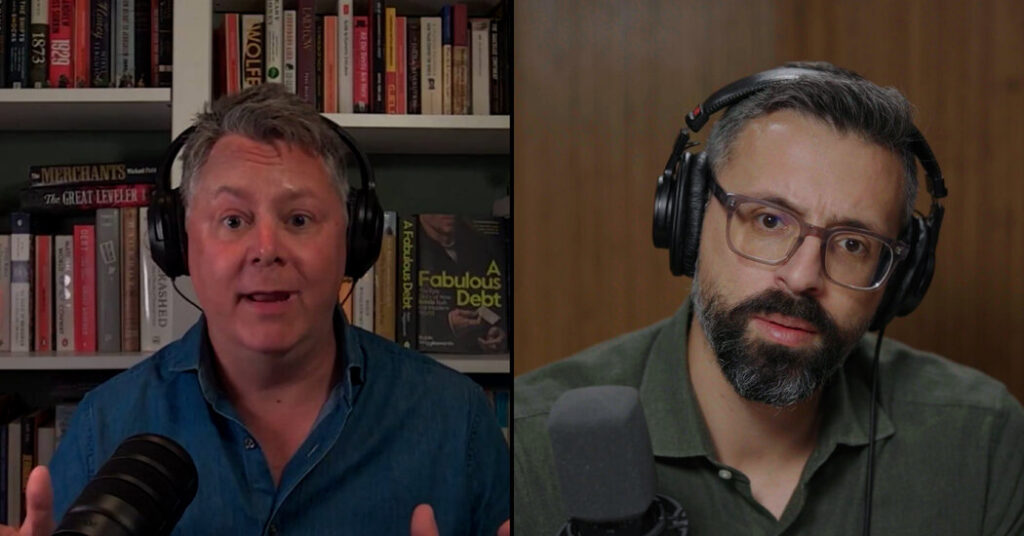
This is an edited transcript of “The Ezra Klein Show.” You can listen to the episode wherever you get your podcasts.
The U.S. Treasury market is the most important financial market in the world, bar none. Most of us don’t participate in it directly — we don’t go in the morning to buy Treasury bonds — but Treasury bonds define everything from how the stock market ends up performing to the cost of a mortgage, a car loan, a credit card. There is almost nothing financial they do not touch.
The U.S. Treasury market has been looking a little weird lately. The cost of borrowing for the U.S. government is going up, probably because our debt recently surpassed $40 trillion. We now spend more on interest on that debt annually than we spend on the entire defense budget.
Donald Trump has also been more and more erratic.
Archival clip of Donald Trump: There’s never been in history the kind of money coming into a country as we have right now.
Scott Bessent, his Treasury secretary, has been making some more aggressive moves into the market.
Archival clip of Scott Bessent: Think of it as pulling back the slingshot here. We have a lot of potential energy that will turn into kinetic energy.
What is going on with U.S. Treasuries? Why does the Trump administration seem so freaked out? And what might happen from here?
Robin Wigglesworth is the editor of the Financial Times blog Alphaville. He’s the co-host of their podcast “The Story of Money” and the author of a forthcoming book, “A Fabulous Debt: The Epic Story of How Bonds Built the Modern World.” We spoke on Monday, Aug. 24.
Ezra Klein: Robin Wigglesworth, welcome to the show.
Robin Wigglesworth: Thanks for having me on.
I want to begin with this clip of Donald Trump’s being asked last Friday about Treasury Secretary Scott Bessent’s recent interventions in the bond market.
Archival clip of journalist: Did you direct Bessent to intervene in the bond market? Was that your idea?
Donald Trump: No, not at all. No, he’s a very capable man. He wanted to do it. He’s very good at it. He has a good touch, a very good, natural touch for the bonds and interest. And he did that, yeah.
Journalist: The yields have come back up since then. Have you talked to him about another type of intervention? Is that something he will be doing?
Trump: We have many types of intervention. That’s one. The ultimate intervention is our military, and if we have to use that, we will, yeah.
[Both laugh.]
So I’d say that escalated fairly quickly. I’ve not heard of people trying to use the military against the bond market before.
Why don’t we start in the more comprehensible part of it before we go there. What has Scott Bessent been doing?
It feels a little bit like he’s doing a kitchen sink approach to bringing down bond yields.
The core reason is that bond yields, the price of the U.S. government borrowing, flow into everything else. Clearly, before the midterms, they would like interest rates and bond yields to be lower, to make affordability better for American households.
But in the tool kit that the Treasury secretary has, there’s actually not that much. Bessent seems to be trying to use some weird tools for purposes they weren’t really designed for.
Archival news clip from CNBC: Breaking market news for you. The Treasury Department is doubling the support of the liquidity support buyback operations that are being used for longer-dated nominal coupon securities.
Jacking up the buyback program by a few billion dollars, even times 10, is not going to move the needle, which is why people are scratching their heads over why he would do this and why, frankly, after the initial reaction, Treasury yields have started climbing again.
I think to have this conversation, we need to set the table on this whole structure that people sometimes see flash by them on CNBC or in the financial pages but maybe don’t have that much familiarity with.
At the simplest level, what is a U.S. government bond?
A U.S. government bond is a tradable loan issued by the U.S.
Bonds are just tradable loans. You can buy them, sell them, they pay a fixed interest rate. They’re designed so you can buy and sell them very quickly, unlike a conventional loan.
The U.S. government is the biggest government in the world. It’s the most powerful country. It is at the apex of the entire global financial system, so that’s why Treasuries are so important and why everybody loves having them. They’re the most easily tradable bond on the planet and one of the reasons the U.S. government can fund itself so cheaply. Everybody loves buying them.
They love buying them because they’re safe. If you have a share of Tesla stock or of Apple stock or of all kinds of things — even a good bet for a company over a 10-year time frame is pretty unpredictable.
But if the U.S. government says: You’ve bought this bond at 5 percent, — that bond is going to pay you 5 percent for 10 years, or 20 years or 30 years or whatever it is, and then give you the underlying money on the loan back at the end of that like clockwork.
Yeah.
And that’s what makes it such an important global financial instrument: People need something that is perfectly reliable, and the U.S. Treasury bond is considered as close to perfectly reliable as any financial instrument on Earth.
As crazy as it sounds sometimes to Americans — but yes.
I would say that there are multiple pillars to this, and one is that it’s safe. If I lend money to the government — not just over the next five years but the next 30 years — I’m pretty confident that there will be a U.S. government around in 30 years.
You couldn’t say that about every country on the planet or even most companies. Companies do go bankrupt. But the U.S. government feels pretty safe.
But I’d say one of the underappreciated pillars of the Treasury market is that it’s so easy to buy a ton of them or sell a ton of them. It’s “liquidity,” which is a weird financial jargon word that gets abused a lot, but it just means that you can buy and sell something very easily.
The Treasury market trades a trillion dollars a day, and that’s why, whether you’re a pension plan in Denmark, a sovereign wealth fund in the Middle East, a central bank in Brazil, for example, everybody likes Treasuries. Because even if you have hundreds of billions of dollars’ worth of them, you know you’re going to be able to sell a lot of them very quickly if you have to.
That’s almost like the magic sauce that helps keep the Treasury market aloft, even though concerns about U.S. indebtedness have been growing for generations now.
So that’s the financial plumbing side of it. That’s why Treasuries end up being so crucial to the financial system. They’re the liquidity. They’re what runs through the arteries of the global financial system.
But let’s say I am not a pension fund. I am not Brazil’s central bank. I don’t, to my knowledge, own any bonds. Why do I care?
Does this affect me as a normal person?
Unfortunately, yes. It will affect you.
Stepping really far back, the bond market seems boring. People don’t care about it as much as the stock market, but it really is the bedrock of the entire global financial system. It’s where governments fund themselves. It’s where banks fund themselves, largely.
It sets the cost of money for governments, for companies, for households through mortgages, car loans, student loans — the whole nine yards, essentially.
And it flows into the stock market, as well. If bond yields go too high, if borrowing costs are too high for companies, it actually causes the stock market to wobble, as well.
That’s why we’ve seen that people like Bessent and Trump actually care less about the stock market than people think. Remember Liberation Day? The stock market [expletive] out quite violently.
But it was actually when the bond market started to buckle that Bessent and Trump very quickly said: Hang on, the bond market is getting yippy — as Trump put it — we need to take a timeout.
Archival clip of Trump: They were getting yippy. You know? They were getting a little bit yippy, a little bit afraid.
I think that’s quite indicative of how they see the relative strength and importance. The stock market can fall, and it’s not great — Trump wants it to be higher. But the bond market buckling, throwing a bit of a tantrum — that has a real economic impact very quickly and can get quite scary sometimes.
I want to hold on this point that the bond market is the bedrock of how much everything else costs, because I think it’s worth expanding this.
If you think about an affordability agenda, the cost of everything is the central political issue now. The stock market affects how rich people both feel and are. The bond market affects how much you pay for things right now.
So when you are getting an auto loan, when you are getting a credit card or paying credit card debt in the future, all of these things are set on top of the cost of money in the Treasury market.
So if Treasuries are paying out at 3 percent, it’s 3 percent plus X — plus whatever they think they need to add on top of that. If Treasuries are 5 percent, if they’re 7 percent, then mortgages, autos, everything else are 5 percent, 7 percent, 9 percent — plus something on top of that.
So you’re creating the base layer of how much everything that includes debt is going to cost. To say nothing of what happens if you actually begin having volatility in that market. Then things get really scary. We’ve not really seen too much of that yet.
But this has been going up now in a persistent way for a couple of years, and if you’re Donald Trump and the Republicans, and you want people to feel things are getting cheaper, it is very, very hard to get people to feel that life is getting cheaper if the cost of money, which feeds into everything else, is going up.
Well, Treasury Secretary Scott Bessent has a “3-3-3” plan, as he’s dubbed it. He wants to lower the budget deficit to 3 percent of gross domestic product. He wants to get 3 percent economic growth, and he wants to increase oil production in the United States by three million barrels a day.
How are we doing on that?
Not well, I think.
[Laughs.]
But this is a global issue — because the U.S. is the world’s most important economy, and its financial system is huge. When I borrow money here in Norway, I’m essentially competing with the U.S. Treasury.
The U.S. government is the risk-free rate. It’s the safest government bond market, the biggest, the most liquid government bond market in the world. The U.S. Treasury market is $32 trillion.
So when Treasury yields go from 2 percent or 3 percent or 4 percent or 5 percent, I’m paying a spread on that. Essentially, when I borrow from a Norwegian bank, everybody is, in some way or respect, competing with the U.S. government for money.
But broadly, that’s why, when the U.S. bond market sneezes, the world can catch this cold. And that’s just when it sneezes. When it has the flu, it gets really nasty. That’s the volatility that you mentioned.
I have probably thought about Treasury bonds more than most people have. I’ve covered this in and out and debt ceiling crises and all the rest of it for many years.
But even to this day, I don’t have a concept, really, of how these bonds are bought and sold. Is there a website they all log on to? Quite literally, how are these bonds bought and sold?
They are quite literally bought and sold all the time, albeit not in a big marketplace.
The first bond market is now a food market in Venice, Italy. Now it’s all electronic on Bloomberg terminals, for example.
It has evolved over the years, but the U.S. now is a big borrower, so it’s got pretty strong processes built up around this. It wants to be predictable. It wants to be steady. It’s a responsible actor.
You can buy Treasury bonds. You can put in bids on a website the government has set up — you, as an individual.
But most of the big buyers, the central banks of Tajikistan or a pension plan in Mexico, they’ll buy through banks — a club of banks called primary dealers. They’re serious big organizations like JPMorgan and Goldman Sachs. In return for promising to make sure that the markets are steady — that there are buyers and sellers, and they’ll match them — they are allowed to bid at auction from the U.S. government.
This is a very basic question, but: How is the yield we’re talking about — whether it’s 3 percent or where it is now, 4 to 5 percent — set?
It’s supply and demand that morning? How many people are buying? How many people are selling?
What is happening that lands us on any given day at 4.2 percent — or whatever it might be?
Well, they look at where they’re already trading, but the banks will basically come up with an idea of what they think they should pay depending on what the demand is.
Most of the time, these auctions are nonevents. They’re designed to be boring. You don’t want excitement when the U.S. government is issuing debt. But occasionally there are little curveballs.
For example, we saw this recently: There was slightly limp demand for an auction of a 30-year Treasury bond, and suddenly that yield, the U.S. government had to pay a bit of extra on top, and that caused concerns, a frisson of excitement.
Well, things are getting less boring.
So walk me through the story of the bond market over the past — you can choose the time range here — but five or 10 years.
How much higher is it than it was? And what is it that is starting to get people nervous about where it’s going from here?
So much in the world can be divided into the pre-global financial crisis and the post-global financial crisis. So let’s start then.
It’s crazy to us now, but Ezra, when you and I were younger, a debate in the United States was: What would happen if the U.S. government had no debt?
In the 1990s, people were genuinely worried that the U.S. government might run out of debt. It had budget surpluses, and it was paying down debt. So how does the financial system operate when the bedrock just doesn’t exist?
Now, of course, it’s just radically different. The big change was the financial crisis. Countries around the world had to borrow money and support economic growth for years afterward, and we’ve never really recovered from that.
Now, financial crises cause these massive, usually seven-year hangovers, economically speaking. Governments quite rightly decided we need to spend our way out of this.
But then, of course, it’s a hard habit to kick. And then Covid came and just jacked up all those trends to new levels.
We saw recently that the U.S. government debt burden has crossed the $40 trillion mark. That’s a lot of debt. It’s a record-shattering amount of debt.
I want to give people a bit of context on this.
So that means we are now paying more in debt interest every year than we are spending on defense.
Yes, for the first time in almost a century, in fact — since World War II.
It’s huge. That’s because the U.S. borrows a lot of money and has borrowed a lot of money in the past, but also that debt is becoming more expensive as interest rates have gone up.
So the U.S. essentially has lots of bonds that used to cost it maybe 1 or 2 percent a year. They’re getting refinanced — because governments always borrow more money to pay back the old money — at a higher and higher rate — and that’s just jacking up the interest rate burden.
I’ve never been hugely worried about government debt, the size of it. It’s big, but it’s not money we owe to Mars — it’s money we owe to ourselves, broadly speaking.
But now, it’s half a decade since we emerged from the hangover of Covid, and budget deficits are, in most countries, as large as they’ve ever been — certainly not much smaller — and that debt burden just keeps growing bigger and bigger.
Jay Powell was asked about this by some students shortly before he stepped down as chair, or was pushed out as chair. The students asked him: Should we worry about this? And he said:
Archival clip of Jerome Powell: The level of the debt is not unsustainable, but the path is not sustainable.
I think that’s the nuance here. People are too worried about the debt, where it is now. But, of course, the trajectory just doesn’t look good.
The U.S., like you said, is already spending more money on just paying its interest bill than it does on defense. That typically only happens to great powers in times of great emergency, major wars and things like that.
I think over the next 20, 30 years, if the present conditions continue, the U.S. debt burden is going to go from uncomfortably high to monstrously big. That’s a worry.
All right, so that’s one thing that’s happening. The government has to sell more bonds because it has to finance this increasingly large debt.
What else is going on?
Well, there’s inflation. We had that massive burst of inflation after Covid. Supply chains went kind of haywire. Russia invaded Ukraine. There was a lot going on.
Lots of people always think inflation is uniquely domestic, but this has been a global problem. Central banks, maybe belatedly, jacked up interest rates to dampen down the economy, dampen down prices. It has worked, but they haven’t gotten that last mile down. So inflation is, in most countries, slightly above target, including in the United States.
And the recent war on Iran has not helped. That has blocked off large parts of energy that used to flow through the Strait of Hormuz, and that has pushed up energy prices and has made people uncomfortably aware that inflation never got back down to the central bank’s 2 percent target — and might very easily drift higher from here.
That’s not great for bonds. Inflation is the arch-nemesis of bonds. Because a bond pays a fixed interest rate.
So let’s say it pays 5 percent a year. Well, if inflation is 5 percent, then, essentially, you’re just running at a standstill, so it becomes less valuable.
If I had to be maximally generous to that Trump clip I played at the top, this is what I think he was saying: If you listen to Scott Bessent, if you listen to Trump when they’ve been talking about bonds, they’re talking about bonds as if often the primary problem is Iran.
I don’t think that’s true, but I think that when Trump is saying the ultimate intervention is military, he’s saying that they could re-engage military intervention against Iran.
Now the reality is that it hasn’t worked. So again, I’m not sure why that would bring down bond yields.
But the Bessent and Trump argument seems to be that the Treasury markets are looking weird, and bond yields are going up because of the transitory influence of Iran’s closure of the Strait of Hormuz.
Do you buy that argument — that this is all a transitory Iran-driven phenomenon?
Well, I agree with your interpretation of what Trump was talking about, even though I got a lot of panicky text messages from bond investors after that clip. Slightly tongue-in-cheek, of course.
To a certain extent, I agree that if you open the Strait of Hormuz and bring peace to the Middle East, energy prices come down, and things will quieten down.
But the underlying issue is the size of the U.S. indebtedness, the size of the budget deficit. We are now running full wartime levels of deficit at a time when the economy is actually doing pretty well. But also the fact that Trump has put a new Federal Reserve chair in, and he seems unwilling, maybe because of instructions from his boss, to raise interest rates.
The Fed could actually do a lot to bring bond yields down and inflation down if it just raised interest rates a little bit. And that seems to be the step they just are unwilling to take for whatever reason.
Why does raising interest rates bring down bond yields?
Well, inflation should be a sense that there’s too much money sloshing around the economy. If you raise interest rates, you raise the cost of money, there’s less of it, and it should dampen the economy. But a lot of it is just signaling, it’s vibes.
And for bond investors, a Federal Reserve that says: We are willing to raise interest rates — it shows that they’re willing to do what it takes to bring inflation down.
They will feel reassured, and you’ll see those 10-year bond yields, the 30-year Treasury yields, come down pretty quickly if the Fed manned up and decided to raise interest rates.
One other argument I’ve been hearing is that the level of A.I. build-out, the amount of money that the various A.I. companies are borrowing in order to finance all this infrastructure, the data centers, the energy — it’s creating a situation where the private sector is almost crowding out demand for bonds.
They’re soaking up so much investment that might normally go to Treasuries, and that is reducing the demand for Treasuries and pushing up the amount of yield the government has to pay.
Do you buy that?
On the margin, yes.
The A.I. buildup is staggering, remarkable in scale. It is huge. And that is having an effect on the margins. But we’re still talking globally, in A.I.-related bond issuance, half a trillion dollars.
That’s big money — even today. Half a trillion dollars matters. But it’s mostly displacing other corporate issuance. Other companies are finding it a little bit pricier to borrow.
The U.S. Treasury, yes, I’m sure maybe adds a few basis points, like a smidgen of a percent on the top, but it is not massively meaningful for the cost of U.S. borrowing. There are so many other larger forces at play here. So it’s a factor, but not the factor.
And then one of the other things people have been talking about is that hedge funds are playing a different role in the Treasury market, and they are introducing volatility that wasn’t there before. Can you explain why?
Yes. This is a huge topic, and I think, still probably underdiscussed. So if you cast your mind back to the 2000s, there was all this talk of a global savings glut. You had all these central banks and investors around the world who were saving a lot of money, and they were putting it into Treasury bonds.
You could see the foreign ownership of the Treasury market became very big, and it was mainly central banks and sovereign wealth funds, and they were known as price-agnostic investors. They were buying Treasury bonds because of their liquidity. They were very easy to buy and sell — not necessarily as a way to make great returns.
That has stabilized and even shrunk a little bit. This global savings glut is looking a little bit less glutty these days. The Treasury market has, at the same time, grown enormously over the past decade.
And we’ve seen hedge funds step into the breach. But it has meant that the Treasury market has become increasingly beholden to hedge funds. I think it has gone from around 2 percent to close to 8 percent. So officially now, hedge funds own more of the Treasury market than Japan and China and Saudi Arabia combined, and that’s a huge change.
Normally, that doesn’t matter that much because you want a diverse ecosystem, and hedge funds are playing an important role in the Treasury market — a valuable role, I’d even say. But they are also very leveraged. They borrow money to hold these Treasury bonds.
So let’s say you put down $10 million, or certainly $100 million. You can buy a billion dollars’ worth of Treasuries.
If suddenly, the cost of your leverage, your borrowing, goes up, then you’re just shaken out of that trade. That is something that policymakers — Janet Yellen has talked about this before. I’m sure Scott Bessent is aware of this issue. I think this is one of the reasons they backtracked quite quickly when the bond market started quivering a bit after Liberation Day, in April 2025. But it is definitely one of the biggest fault lines running through the financial system right now, potentially.
The concern here is that hedge funds, when they’re leveraged, compared to the way pension funds act or the way other central banks act, things can happen that require them to move much faster to keep themselves from going under.
So you could have correlated sell-offs of Treasuries happening very, very quickly in a way that would not be typical of the way central banks act under pressure.
Yeah. Normally, when there’s an economic crisis, Treasury yields fall because people buy Treasury bonds — they’re safe and solid, and you want to get the hell out of stocks. But because of this dynamic, you can see different phenomena happen.
We saw this in March 2020. We saw this in April 2025 when Treasury yields actually started shooting higher as Treasury bonds were sold off. Because hedge funds were essentially being shaken out of those trades. They were very heavily leveraged. That means that they’re not strong hands.
You know how meme-stock traders talk about diamond hands that were never going to sell GameStop? Well, hedge funds are not solid hands all the time.
We’ve gone — in this post-financial crisis period to where we are now — from a place where the borrowing cost for the U.S. government was just incredibly low.
I remember when I was at Wonkblog, at The Washington Post, and we were arguing that we should actually borrow more at that time and invest in infrastructure.
We constantly put up these 10-year tables showing that at a real rate, the borrowing cost was negative, that when you took inflation into account, people were almost paying the U.S. government to borrow because they were so desperate for U.S. government debt — because it was safe, because it was liquid, because you could actually work with it at a time of great uncertainty.
One dimension of the U.S. economy in that period was that we had incredibly low borrowing costs. And slowly, then more rapidly post-Covid, and then more unpredictably post-Trump, that has been changing.
You’re not going to get that 2 or 3 percent mortgage anymore. You’re having this step up the ladder of how much our money costs. This year has felt, to me, like the year when people are starting to think: Oh, this is going to change the way you should think about the U.S. economy going forward if something doesn’t happen.
Because people felt the inflation a couple of years ago was transitory. The Fed would bring up rates, and it would bring them back down.
But the way the Trump administration is spending, the lack of predictability in U.S. policy, it seems to me that there is a shift in bond markets, in the conversation about how to think about the U.S.
So what is the shift?
It has multiple dimensions. I agree with everything, and it was remarkable how low bond yields were for a long time, and obviously, it was a sign of malaise. It was not a healthy thing, and it showed that we should have been spending more money then, arguably.
The year of the reckoning was 2022. That was the annus horribilis for the bond market. It was one of the worst years for the global bond market in centuries — in three centuries by some reckoning.
People think that after you have a reckoning, then there’s catharsis. You move on, and things settle down to a new level, and inflation will come down. The Fed finally jacked up interest rates. The European Central Bank jacked up interest rates. Governments would start tightening their belts after Covid.
So there was also, and we can see this on the prices, the bond market agreed with the Fed, that inflation would be transitory and we would return to — it’s a massively overused phrase — “a new normal.” And that new normal would be inflation back to where it should be and bond yields and maybe Treasury yields at 3 percent, maybe 4 percent.
And then pre- and post-Trump also mark a sense that things you thought were unimaginable before are now certainly not unthinkable anymore.
The U.S. still depends on a lot of money coming in from foreign investors to buy Treasuries, and that money doesn’t feel quite as welcome as it used to. You can see China and other countries tiptoeing a little bit away from the Treasury market.
Suddenly, things that even I foolishly believed firmly a few years ago, I think you wouldn’t feel quite as confident about today. And I think that ripples through the financial system, as well.
One thing that has been a little unusual here: In my political lifetime, presidents and administrations typically tiptoe quite gingerly around the bond market.
James Carville, when he was a top adviser to President Clinton, had this joke that when he was reincarnated, he wanted to come back as the bond market. Because then everybody would have to listen to him.
That’s a great quote.
In general, presidents tend to do two things around the bond market. One is, if it’s going up, you want to put somebody in charge of the Fed who markets are going to treat with a lot of respect and esteem.
The other thing you’ll tend to see presidents do when they are worried about the price of money, and they have a big debt or deficit, is to begin to move toward deficit reduction, fiscal contraction.
Donald Trump is not really doing either of these things. He was very aggressive in pushing Powell out. He talked a lot about how he wanted to see the Federal Reserve bring down rates. He brought in Kevin Warsh, who is a relatively well-respected guy, but he’s coming in under this cloud of: What did he have to tell Donald Trump — and what has he promised — in order to get that job?
Then, on the other side, Trump has done huge amounts of spending, huge amounts of tax cuts. Nobody thinks they’re about to do a big pivot to a grand budget bargain.
So you have a very different orientation right now, it seems to me, from the U.S. president toward the bond market and toward what you should do if yields are going up and you don’t like it.
As he said, Bessent has a touch with the bond market, a touch with interest rates. He’s a former currency trader. But you don’t usually use the head of the Treasury Department as a trader. He’s supposed to implement fiscal policy.
So how would you characterize where they’re going on this and what that might mean?
I’m a journalist, as well, and I always try to almost steel-man the other side’s argument. But I do feel some of the policymaking around this has been, charitably, incoherent.
Some of it is due to some very natural misunderstandings. Like, people think of interest rates, but there are obviously lots of different interest rates.
The Fed decides interest rates on the short end — essentially, what overnight interest rates are — and that filters through the banking system. But the Treasury market’s interest rates, the bond yields, are set by markets, they’re set by price and demand, and they’re obviously affected by interest rates and all sorts of things.
Donald Trump wants bond yields and the bond market to behave because he wants that affordable mortgage for Americans. Clearly, he’s talked a lot about that. But he also wants the Fed to lower interest rates, and they don’t really play well together, if at all.
If you want bond yields lower, the quickest way is for the Fed to jack up rates or just engineer some sort of massive recession. Neither is really that much fun, right?
But, like you say, you want a credible Fed chair. I think that’s why he chose somebody like Kevin Warsh, who — in a fairly horrific long list of candidates — was by far the most credible one, certainly on the short list.
Because he realized if you put somebody completely unqualified in the Fed chairmanship, then suddenly, you’ll see quite a violent bond market reaction.
Yeah, Peter Navarro would not have been good for yields as Fed chair.
Bill Pulte was the one that really — I mean, as a financial journalist, I love messy stuff. But ——
[Laughs.] That would be pretty messy.
Fed chair Pulte would have been pretty bad, I think. But he and Bessent don’t play well together, either.
I want to bring up a clip of Bessent from the other day on CNBC.
Archival clip of CNBC:
Sara Eisen: Yeah. I was going to ask how big this could get. If the signal here is that you’re not happy with the direction of yields, they’ve gone back the other way.
We’ve erased most of the Treasury rally that you got yesterday with that big surprise. So how much more are you willing to do?
Bessent: Well, again, we have a big tool kit, so we’ll see. Part of it is signaling here and to show that we believe that the yields don’t reflect the underlying fundamentals.
This Iran conflict, we will get on the other side of this. We don’t know when, and we can talk about the economic measures we’re going to be taking against Iran in a minute.
And we, in the administration, are announcing, probably at the end of this week or beginning of next week, an increased focus on fiscal consolidation.
It’s coming from President Trump. Russ Vogt and myself will be examining both on the revenue side and the cost side what we can do.
I want to go through a couple pieces of that. Because one thing you hear there is something I was mentioning a few minutes ago, which is at least beginning to signal they would like to do fiscal consolidation. But given how little they’ve done with Congress, I don’t think anybody is taking that seriously at all.
But what does he mean when he says: We don’t believe the yields reflect the underlying fundamentals?
It reminds me a little bit of the John McCain quote that was very famous when the markets were collapsing.
Archival clip of John McCain: The fundamentals of our economy are strong.
That quote did not age well. What do you hear when Bessent says that?
Truthfully, I hear a little bit of desperation. I don’t think bond yields are going to go massively higher. This is not a massive crisis, but the rolling out of an enlarged buyback program, a technical program — very nerdy — it’s not supposed to be something that has a major effect
So when the U.S. government sells a 10-year bond, for example, which is the standard type of bond, that’s super-tradable. It’s supereasy. You can sell a billion dollars of it without moving the price.
But as that becomes a nine-year bond, an eight-year bond, a seven-year bond, it becomes a bit stale. It’s locked away in vaults and pension plans at banks, so it doesn’t trade that much. The price usually reflects that, and then you can typically buy them at a slight discount.
So what the Treasury has been doing for a while is spending a few billion dollars on buying some of those stale, slightly cheap bonds and paying for it by issuing those superliquid 10-year bonds, 20-year bonds.
Bessent enlarged that program, he says, because the liquidity was getting worse in some parts of the Treasury bond market. But it looks like a fairly naked attempt at lowering those bond yields again.
But completely ignoring the scale of what we’re talking about. We’re talking a few billion dollars. There’s over a trillion dollars’ worth of Treasuries that trade every day.
This is like putting out a wildfire with a water pistol.
That’s why you saw the bond market first reacted to the signal he was sending that we want yields down. When the Treasury secretary says that and acts that way, the knee-jerk reaction is: Oh, we’re going to buy bonds.
But then people realize: Well, actually, no, this is clearly not going to have an effect.
It’s one of the reasons the bond market is so tricky for people, why Carville made that amazing quote about how it can intimidate everybody, because you can’t push around trillions of dollars very easily.
The only people who can really do it, who have the resources to do it — there’s only one place in town that can print unlimited dollars, and that’s the Federal Reserve.
So the Federal Reserve has done this in the past, has beaten down bond yields after the financial crisis and during Covid, but the Treasury just doesn’t have the resources.
Well, one thing that I’ve heard a lot of traders talking about, and one reason maybe you saw this rapid movement — where Bessent announced a policy where they increased these buybacks, and that seemed to bring yields down for a minute, and then yields bounced back up — is that you keep saying this is looking a little bit desperate. But it’s maybe worth expanding on what that actually means.
Because what he is saying is: I am trying to bring things into alignment with the fundamentals. We’re even willing to put our money where our mouth is on this.
It seems in many cases to have the opposite effect — of actually scaring people a little bit. If they’re willing to do this, what does that make you think about where this is all going?
But how do you see that dimension of it? Why does it have this effect on expectations that is in the opposite direction of the Treasury’s purchases?
Well, it just boils down to credibility. The U.S. has, for a very long time, across many administrations, from both sides of the aisle, built up a ton of institutional credibility about how it acts, how it behaves and its predictability.
When you see the world’s most influential economic policymaker acting — I wouldn’t say erratically, but acting in a way that most bond traders sussed out very quickly was not going to work, it makes you doubt: What else are they thinking about? If they’re unpredictable, what else could happen?
That makes people skittish. I don’t think people are panicking about the U.S. or are worrying at all. Frankly, it was weird that Bessent would respond so forcefully to what looked like an unfortunate but entirely natural increase in Treasury bond yields.
Because people think inflation might stay a bit higher for a bit longer to compensate for that extra risk you’re taking. But it wasn’t out of whack. This was not like we saw on Liberation Day. This was not March 2020 when the Treasury market really [expletive] out under pressure from Covid.
So I’m almost a little bit baffled. Because Bessent — as Trump said himself in that opening clip — I’m not sure Bessent has a deft hand with the bond market, but he is a former bond and currency trader. He does understand these things. He’s doing things he knows to be wrong and won’t work.
Didn’t Bessent criticize Yellen when she was doing a more modest version of these same buybacks?
He did, and he also criticized the Biden administration for issuing more bills. The idea was that this was activist Treasury policy.
Of course, they’re doing the same thing.
I chalk that more up to standard political partisanship. You’re always going to criticize the incumbent government for anything. And yes, it looks massively hypocritical when you do exactly the same thing. But that feels standard.
What doesn’t feel standard is this incoherence and doing things that people in the administration know won’t work.
Well, usually when there’s incoherence in the Trump administration, it arises because either Donald Trump wanted something or people thought Donald Trump wanted something.
Now, when asked, Donald Trump said: Of course, I had nothing to do with my Treasury secretary engaging with the bond market and intervening in this way.
I take that as something that I don’t believe has truth value, one way or another. Bessent also came out this week with this Financial Times Op-Ed about a complete trend to do an economic annihilation of Iran, to end that.
This feels to me like there is a debate happening inside the Trump administration somewhere, where they’re upset about what is happening in Iran, upset about the bond market.
How much of Bessent doing things that, at another time, he seemed to know you shouldn’t do, is simply that the president is telling people that he does not like the path of the bond market, and he wants it to behave?
He wants yields lower. He wants money cheaper. He wants things more affordable. He wants the economy growing faster. And even though that is maybe contrary to a bunch of other things he’s done on the policy side — maybe some of the problems here are actually of his causing — he wants all these things at once.
Yeah, who doesn’t want all the good things at the same time, right? I’m the same. I like my cake, and I like to eat it.
I’m not an administration watcher. I just watch the bond market. But it does feel that it has elements of — I can’t remember which Henry it was — one of the English kings who said: Who will rid me of this troublesome priest? And then somebody went out and murdered Thomas Becket.
Trump will say that he wants certain things, and people will feel the need to go out and somehow do it, even when they know that, in practice, this is not going to help the king. It’s probably going to harm him. It’s a very sort of short-termist way of thinking.
Like I said, the simple solution here is that the Fed raises interest rates or at the very least signals a strong willingness to do so. That, I think, would restore a lot of calm. It would do way more than these measly buybacks. Ending the war in Iran and restoring free passage through the Strait of Hormuz would certainly help a lot, as well. But there are a lot of things going on.
We’re talking in the week of the Jackson Hole Economic Policy Symposium, which is the annual big central bank conference. This will be the first where Kevin Warsh is there as Fed chair. What are you expecting him to say or do?
Normally, Fed chairs have not wanted to rock the boat too much at Jackson Hole. Warsh does not think that.
And I have to admit, I have some sympathy with his view that maybe some volatility in the bond market — just a little bit — might actually be a healthy thing in the long run.
The central bank view, and I have some sympathy with that, too, is that predictability means that bond market volatility and interest rate volatility is low, and that’s better for economic growth.
That is completely true. I believe that wholeheartedly. But some unpredictability can maybe make the system, as a whole, safer.
If you think back to the 2000s when the Fed was actually jacking up interest rates because the housing bubble was inflating, they saw some of this. They were raising interest rates in a very predictable, steady way, in a way that maybe didn’t really blow away the froth.
And a bit of uncertainty about what the Fed might do might, on the whole, be healthy for the system because it reins in a bit of risk-taking. You feel less confident about doing dumb stuff if you don’t really know how the Fed is going to react to certain things.
I’ve never seen Warsh articulate it quite in that way, and maybe he does so at Jackson Hole, but it’s going to be fascinating to see. Because this is a new era of central banking at the world’s most powerful central bank.
So it’s going to be probably one of the most interesting Jackson Holes for a very long time. I’m certainly getting my popcorn ready.
This is a way in which Warsh differs a little bit from those who came before him. It’s a weird thing to be arguing over, but recent Fed chairs have been very into forward guidance. They tell you what they’re going to do well before they do it, so you know what they’re going to do, and you can react, and everybody can plan.
And Warsh has been — I won’t say opposed to all forward guidance, but his forward guidance has been that there will be less forward guidance.
[Laughs.] Yes.
Why?
I should say that I think both the proponents of forward guidance, and that’s most central bankers around the world, and enemies of it, have overstated the case for and against it — almost to a comical degree.
The enemies of forward guidance have indicated this is central banks binding themselves to the mast, and that if they say they’re going to do X, they have to do X, and it takes away the flexibility to be able to respond to incoming data.
That’s just baloney. Central banks have issued forward guidance, and when the data changes, they change their mind. We’ve seen that happen in every central bank, including the Federal Reserve.
I think central banks have, frankly, overstated the advantages of forward guidance as a way of stimulating the economy. They say that if we say we’re going to keep interest rates low for superlong or until X or Y, sometimes there being concrete triggers will give people so much safety that we’re not going to raise interest rates that they’ll go out and borrow money, stimulate the economy, get all that economic growth going.
And I think also, again, people don’t really listen to that because they also do understand that if inflation suddenly erupts, as it did in 2021, 2022, then central banks are going to very hurriedly backtrack on this forward guidance. It just doesn’t matter that much.
When people used to worry about bonds and the U.S. government debt, the thing you would hear them talk about was the coming of the dreaded bond vigilantes.
Who are the bond vigilantes, and is there any reason to still worry about them?
These are the people whom Trump is going to deploy the military against, right? [Laughs.]
Only if it’s our last option. [Laughs.] Our last option is jailing all the bond vigilantes.
Yes, exactly.
You and me — it’s our pension plans, our mutual funds, our banking, our money that we have in the banking system.
“Bond vigilantes” is a very amorphous phrase. I’ve used and abused it many times myself because it’s so evocative.
But in reality, it’s just a vast ecosystem of money that is in a mutual fund, a pension plan, an insurance company, a bank, a sovereign wealth fund, a private bank in Switzerland. Even you and I, we can buy Treasuries directly from the U.S. government.
And the idea is that the vigilantes would stop lending to countries. It’s really the only power. They can’t go around beating people up or shooting them up.
Which is to say they would stop buying these bonds.
Yeah, or maybe just buy less of them or want a slightly higher interest rate.
So it’s an overdone phrase. Certainly in a place like the United States, which can literally create dollars, the U.S. bond market is a very different beast than it is in a Pakistan or a Sri Lanka or an Argentina that tends to borrow a lot in foreign currencies.
But it does actually have a bit of truthfullness to it. Because in a global economy that runs on credit, the ability to raise the cost of credit or deny it altogether is an incredible power. And this is not set by bond investors in a secret WhatsApp group. It is the individual decision of a million people sometimes acting in concert.
You do sometimes see the bond market get jittery about certain countries, certain companies at certain times. Most famously, in the U.K., in 2022, they managed to oust a prime minister in, I think, 45 days. But typically more in poorer countries that frankly don’t have the resources that a large, advanced, developed economy does.
You have more conversations with bond traders than I do. Not a superhigh bar to clear, but you clear it.
Some of my best friends are bond traders.
When you guys are a couple of drinks in, and they’re describing the bad scenarios, the stuff they worry about or they think about, the stuff that maybe Bessent is worried about in the wee hours in the morning, what does this look like over the coming couple of years if this goes wrong?
What do informed people think bad outcomes here might look like?
Ezra, one of my favorite topics in the whole world, and this does make me a very sad human being, probably, is sovereign debt crises and sovereign debt restructuring.
I just think it’s this fascinating collision of finance, economics, politics, geopolitics — everything comes together. But they usually affect smaller, poorer countries, of course.
But because of my interest, I have actually thought — for probably an unhealthy amount of time — about what a U.S. debt crisis would look like.
A U.S. debt crisis would not look like anything else in the world.
First of all, the U.S. can’t really go bankrupt unless it chooses to. The U.S. only borrows in dollars, and it can create dollars. It’s very hard to go bankrupt if you can create the currency that you’re borrowing.
Now, that can have other crisis-like outcomes, like runaway inflation, a financial system that convulses with all this dollar printing. But a classic default is unlikely, or vanishingly unlikely.
That’s why, when I’ve talked to bond investors, including in the early hours of the morning and a few drinks in, very few bond investors I know are genuinely worried about a debt crisis in the conventional sense.
But you can see lots of unconventional types of severe debt issues in the United States. For example, if they suddenly manage to co-opt the entire Federal Reserve and start creating dollars, and Trump says: I want interest rates lower, and we’re just going to print as many dollars to do so as possible — that has ripple effects everywhere.
What is the Treasury rate right now? You probably looked at Bloomberg this morning, and I didn’t.
Well, the 10-year has been between 4 and 5 percent for a while, which is why I don’t get why they were freaking out so much.
What’s the chance, in your view, that come November 2028 — we’ll use Election Day here as a marker — the rate is 6 to 7 percent?
I mean, one thing that I love about the bond market is that it synthesizes just an insane amount of information — economic growth, inflation, productivity, health of institutions, things like that. And I’d say that people smarter than me embarrass themselves trying to predict the markets all day long. So I just don’t know.
But as long as the economy is booming, and we want that, then Treasury yields should go higher. That would be a healthy signal.
If you and I are talking in November 2028, and Treasury yields are at 1 percent again, well, that’s a very terrible economic backdrop.
Which way it would go right now, I don’t know. A.I. is the big factor right now. The investments that are happening in data centers may be on the margins, sucking a little bit of investment away from the Treasury market, but they’re certainly juicing the economy.
The U.S. economy would look, I think, rather different if we weren’t seeing these huge Capex programs that are the biggest since the railway splurge.
And then it depends on whether this is going to get the economy going or if it’s just going to end in another infrastructure bust. That will probably decide what things look like in November 2028.
To draw that out, you can imagine a world where A.I. proves to be a bubble. There’s a big pop.
This investment that is powering so much collapses, and then you probably would get to lower bond yields because, first, there would be less private demand for debt, so more of those funders could buy Treasuries.
Second, the Fed would probably have to bring down rates because you’d be going into a recession. They’re very likely going into a recession.
So that would be a world where maybe bond yields are down to 3 percent, but it’s not a good world. They’re down there because the economy has gone into crisis.
We want bond yields to go down for the right reasons, and that is that inflation is low and stable and quiescent and not very volatile. And you want some interest on your Treasury bonds. It should be fair to expect that.
But whether they’re up at 6 percent or 7 percent — you talked about — that also is probably a very unhelpful world. Because that would imply that inflation is not under control. It probably implies the Fed has tacitly, probably unstatedly, given up on controlling it to a large extent and that we are heading into what we have seen in the past as a proper stagflation — where growth is too low, inflation is too high, and interest rates have lost the power to move things around too much.
Well, there’s something weird in all this. You wrote about a National Bureau of Economic Research survey that I found genuinely shocking. It said, among bond investors surveyed, they believed there to be a 50 percent chance of a U.S. debt crisis in the next decade. But then almost all of those investors said they had no change in their portfolio strategy based on this.
So I had trouble making heads or tails. On the one hand, if the bond market actually believes we’re going to have a 50 percent chance of a debt crisis, I wasn’t clear what that actually meant. But then also, if they believe it’s that high, and nobody’s doing anything, that’s weird.
What did you make of that? How would you explain what that survey was revealing, and what did you make of it?
I mean, was it St. Augustine who said: Lord, make me chaste, but not yet?
It’s how we humans respond to so many things, like climate change. We know it’s a big deal, and it’s coming, and we maybe might tweak a little bit around the edges of our own lifestyle, but in reality, we don’t.
And we might say we want politicians to do X or Y, but in practice, until it actually starts affecting us on a daily basis, you can see people don’t really like that.
I think it’s shocking but also incredibly unsurprising. Because it just sums up human nature. Even when you can see something big and nasty potentially coming down the tunnel toward you, you still think that light might be something favorable.
I think that is a good place to end. Always our final question: What are three books you’d recommend to the audience?
I have to admit, I’ve been dreading this because, if you ask me tomorrow, they’ll probably be different books. But I’m going to choose three books that show that finance, economics and business can actually be really fun and, even, interesting and riveting.
I think the obvious first book is “Barbarians at the Gates” by Bryan Burrough and John Helyar. I genuinely think it’s the gold standard of narrative business journalism today. It’s a history of American business over the past century told through the prism of this private equity deal and all the crazy characters involved. It is astonishing.
My second book is Daniel Yergin’s “The Prize.” It’s the history of the oil market. It’s the model for a lot of similar books that came later, but Yergin is the O.G.
I love those histories that tell a history of the world. This is almost a history of the 20th century but through a completely different angle — told through the oil market. It’s tremendous, has crazy characters, of course, and I learned so much as a journalist but also as a person.
My third one — God, I can almost feel some of the books behind me screaming at me.
Just hoping to be picked.
Hoping to be picked. They’re glowering at me. I can feel it.
I’m going to go with Liaquat Ahamed’s “Lords of Finance.” It’s just a fabulous book about this tumultuous interwar period in the run-up to the Great Depression.
It tells what is an incredibly complex, multifaceted financial economic story through the heads of the major central banks at the time. In my day job at Financial Times, I spend a lot of time trying to parse these things and make them digestible to a general audience and make them riveting and fun.
And I don’t think I’ve seen such a complex story told with such verve as well as in Liaquat’s book. So I think that will have to be my third pick, and I’ll just have to accept some of the books behind me staring down at me angrily.
Robin Wigglesworth, thank you very much.
Thanks for having me on.
You can listen to this conversation by following “The Ezra Klein Show” on the NYTimes app, Apple, Spotify, Amazon Music, YouTube, iHeartRadio or wherever you get your podcasts. View a list of book recommendations from our guests here.
This episode of “The Ezra Klein Show” was produced by Rollin Hu. Fact-checking by Michelle Harris, with Kate Sinclair and Mary Marge Locker. Our senior engineer is Jeff Geld, with additional mixing by Aman Sahota. Our recording engineer is Aman Sahota. Cinematography by Marina King. Video editing by Kristen Williamson, Brandon Belk-Yee and Dani Dillon. Our executive producer is Claire Gordon. The show’s production team also includes Marie Cascione, Annie Galvin, Kristin Lin, Emma Kehlbeck, Jack McCordick and Jan Kobal. Original music by Pat McCusker. Audience strategy by Shannon Busta. The director of New York Times Opinion Shows is Annie-Rose Strasser. Transcript editing by Sarah Murphy and Marlaine Glicksman.
The Times is committed to publishing a diversity of letters to the editor. We’d like to hear what you think about this or any of our articles. Here are some tips. And here’s our email: [email protected].
Follow the New York Times Opinion section on Facebook, Instagram, TikTok, Bluesky, WhatsApp and Threads.
The post The Bond Market Chaos Is Coming for Us All appeared first on New York Times.