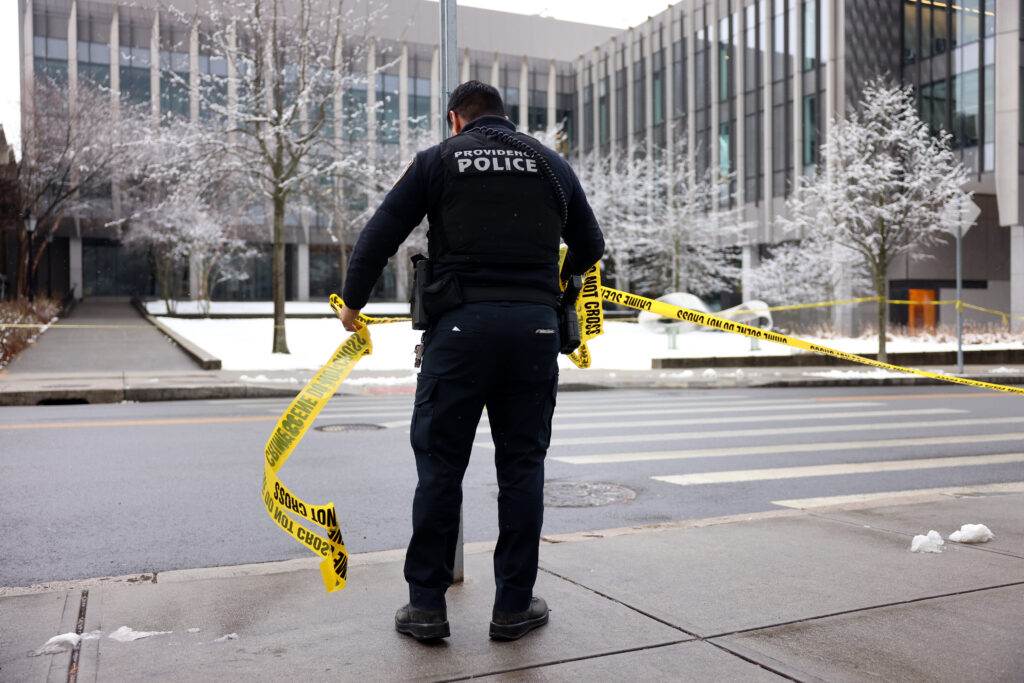
The search for the Brown University shooter who killed two students and wounded nine others last December was complicated by a fragmented system for collecting and sifting through tips, delayed access to video from university cameras and valuable time spent investigating the wrong person, according to a report released Friday.
The findings, contained in a review commissioned by the city of Providence, Rhode Island, raise questions about whether law enforcement could have identified the shooter earlier, before he went on to kill a Massachusetts Institute of Technology professor near Boston.
“There’s all kinds of things that we know now that we didn’t and couldn’t have known then,” Providence Mayor Brett Smiley said in an interview. “But the ability to access additional video feeds and then to get that information out into the public to help with an identification, any of those little things could have helped.”
The shooting at Brown kicked off a five-day search for the killer.
A man burst into a classroom at the Ivy League school shortly after 4 p.m. on Dec. 13 and opened fire on students studying for an economics final exam. Ella Cook, 19, and Mukhammad Aziz Umurzokov, 18, were killed. Two days later, the man fatally shot MIT professor Nuno Loureiro at his home in Brookline, Massachusetts.
Police at the time did not know who committed the shootings, if they were related or whether the killer might strike again.
Law enforcement officers eventually tracked down the suspect’s rental car — in part thanks to a tip from a Brown alumnus publicly identified only as “John” who shared what he saw on Reddit and later with police.
That breakthrough helped police identify the shooter as Claudio Manuel Neves Valente, 48, a former Brown student who decades ago probably attended classes in the same building where the shooting occurred.
Valente was a former physics student from Portugal who attended graduate school at Brown for three semesters before taking a leave of absence in 2001 and formally withdrawing in 2003. Before that, he and Loureiro studied in the same physics program in Lisbon.
Authorities used financial records to identify Valente’s storage unit in New Hampshire, where they ultimately found his body and videos confessing to both shootings. A medical examiner determined Valente had died by suicide about two days before he was found.
The FBI said Valente did not reveal a motive in the videos. He was unemployed at the time, and the FBI said Brown and the MIT professor probably represented his personal failures and perceived injustices.
The after-action report was commissioned by the city and written by the Police Executive Research Forum, a D.C.-based nonprofit that provides guidance to law enforcement.
Overall, the report praises the city’s response to the shooting. It noted that Providence police and fire units arrived at the scene five minutes after the first 911 call. And the nonprofit found that the investigation and operational response demonstrated a “disciplined and effective approach.”
But the report also identified challenges.
Providence detectives did not immediately have access to Brown’s cameras, because they were separate from the city’s and did not feed into the Providence Police Department’s Real-Time Crime Center. The report also said there were further delays obtaining Brown’s surveillance video because of unidentified “access-related issues” at the school’s Department of Public Safety.
Once detectives saw the video, they noticed the shooter stood out: Cameras captured him calmly walking away from the scene while others frantically fled.
The report also said Brown officials initially told Providence detectives that campus shuttle buses could not record video. That proved incorrect, delaying access to additional footage showing where the shooter was headed.
Had Providence police in the crime center had real-time access to Brown’s cameras, “it is possible that the assailant could have been identified and tracked as he left campus,” the report said.
Brown spokesman Brian Clark said the school is “committed to the strong collaboration and coordination with Providence and other local agencies.” He added that the school will soon release a public report based on its own external reviews of what transpired.
The report also notes that investigators spent significant resources investigating the wrong person after the shooting. The FBI had detained a 24-year-old Wisconsin man at a Hampton Inn southwest of Providence for hours before concluding he was not involved. That temporarily narrowed the focus of the investigation, the report found.
To prepare for future emergencies, the report lists 18 recommendations, some of which the city says it has already implemented or begun to do so. Those suggestions include creating a new system to manage tips after a major incident, integrating Brown’s cameras with Providence’s crime center, and building a better structure for investigations involving multiple agencies.
“This isn’t a victory lap,” said Smiley, the mayor. “I want the community to know that we’ve asked hard questions of ourselves and we’re going to be making changes.”
Smiley and the report also noted that Valente took steps to avoid detection, including replacing his rental car’s Florida license plate with one stolen from Maine, complicating efforts to track him down.
Still, the report leaves questions, such as whether the shooting could have been averted.
Three students who were injured in the shooting sued the university in state court in April, alleging the school bears partial responsibility.
The students’ lawsuits contend Brown had inadequate security for an urban campus — including key gaps in its camera coverage.
The filings also note a Brown custodian tried to alert campus security after spotting Valente hanging around the building roughly a dozen times in the weeks before the shooting, including peering into classrooms. They say Brown did not act on that information. The law firm representing the students declined to comment.
Brown would not comment on the allegations in the lawsuits but said it expects to release more information from its reviews.
“We understand that many questions have been raised about Brown’s response, which is natural following a tragic incident like the one that impacted our campus,” Clark said.
The city’s report did not cover what happened before the attacks or whether they could have been prevented. Smiley said that’s because the report was focused on the city’s response to the Brown shooting. The mayor also said he thought the custodian’s report appeared to go nowhere because it was made to a private security contractor, rather than Brown or Providence police.
Another question is whether John, the reportedly homeless Brown alumnus who helped identify the shooter, ever received the $50,000 reward offered by the FBI for tips leading to the identification, arrest and conviction of the person responsible.
In December, Rhode Island Attorney General Peter Neronha said that John’s tip “blew this case right open,” and the Providence mayor urged the FBI to give him the reward, even though the suspect could not be convicted of the crimes because he was dead.
The FBI declined to say whether it paid out the reward money, citing its long-standing policy, and John did not respond to a message via Reddit.
Smiley said he hasn’t heard whether John ever received the reward.
“I don’t think I’ll ever know if he did,” Smiley said.
The post Report finds flaws in hunt for Brown University shooter who went on to kill again appeared first on Washington Post.