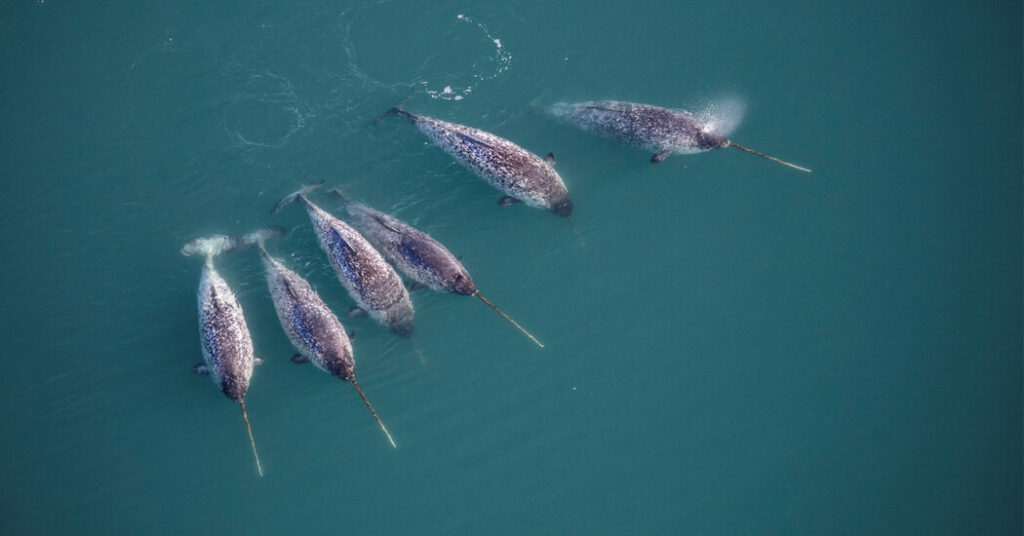
Narwhals may not have magic powers, but they certainly seem magical. Their spiraled, unicorn-shaped “horns” are the only known tusks in the world that don’t curve. Now scientists have discovered that the tusks have not just one stunning twist, but two. The second, internal twist was revealed with X-rays and may help explain how the tusk grows so straight.
“You look at it and it’s almost unbelievable,” said Greg O’Corry-Crowe, a geneticist and marine mammal expert at Florida Atlantic University who was not involved with the research, which was published in the journal Nature Communications. “It’s probably one of the most impossible features in the natural world.”
A narwhal’s tusk, which can grow to more than nine feet long, actually starts off as a tooth — specifically a left canine. As it grows, it eventually shoots through the mouth and becomes a tusk, always spinning to the left. Typically only the males sport the tusk, but it does appear in females from time to time. And sometimes a rare double-tusked narwhal will make a showing, where both the left and right canines extend.
The tusk becomes such a prominent feature that it reshapes the whale’s skull as it grows. “You can actually see how it gets deformed,” said Marianne Liebi, a physicist at Chalmers University of Technology and an author of the new study. The bones in their skulls contort to keep the tusk relatively centered on their heads, she said, which makes for more symmetrical swimming.
Dr. Liebi and her colleagues decided to look inside the tusk to better understand its internal structures. The researchers used several X-ray machines with different resolutions to scan fragments of the tusks. The largest machine they used was a synchrotron in France with a circumference that measured a whopping 2,800 feet (850 meters) across.
The results revealed that beneath the leftward-spinning outer layer of the tusk, the internal layer spins in the opposite direction, to the right.
“We were honestly flabbergasted,” said Henrik Birkedal, a chemist at Aarhus University and an author of the study.
The researchers found evidence of this twisting at every scale they analyzed, like wood grains in a piece of timber. They think the opposing twists help the tusk to endure the extraordinary pressures of underwater life, and may be what allows it to grow so straight.
“Clearly this is physics,” said Dr. O’Corry-Crowe, that gives the narwhal the strength to brandish its lengthy lance. “You try to go underwater and swing a two by four,” he added.
Mysteries still surround the tusk and why it evolved. Narwhals have been spotted using them to play with one another and to bonk Arctic cod into a temporary state of paralysis to make them easier to eat. But the tusk is also filled with sensitive nerve endings, leading some researchers to think it might help detect subtle chemical signatures in the water.
It most likely evolved “to look nice for the ladies,” Dr. Birkedal explained, and then took on secondary functions for the intelligent and highly social marine mammals.
The narwhal’s general mysteriousness stems from their remote and harsh habitat, which makes them difficult to research. They live in the Arctic Circle in places like Canada, Greenland and Svalbard, and regularly dive more than 6,500 feet (2,000 meters) deep for food. “It is quite surprising how little we actually know about them,” Dr. O’Corry-Crowe said.
That’s especially true since humans have been seeking them out for a long time. Narwhal tusks were most likely introduced to places like Europe by Viking traders before the second millennium. The unique tusks were thought to provide protection from poisonings — a common plight among medieval nobility — and were frequently ground into powder for consumption. The beauty of the tusks was also widely recognized, and they were regularly worked into royal jewelry and other regalia. King Frederik III of Denmark even built his coronation chair almost entirely from carved narwhal tusks in the 17th century.
Now we know that the beauty of the tusks goes many layers deep.
The post Narwhals Have Stunning Spiraled Tusks. That’s Not the Only Twist. appeared first on New York Times.