President Trump plunged parts of upstate New York into an identity crisis on Thursday with a flick of his wrist and a scribble of his Sharpie pen.
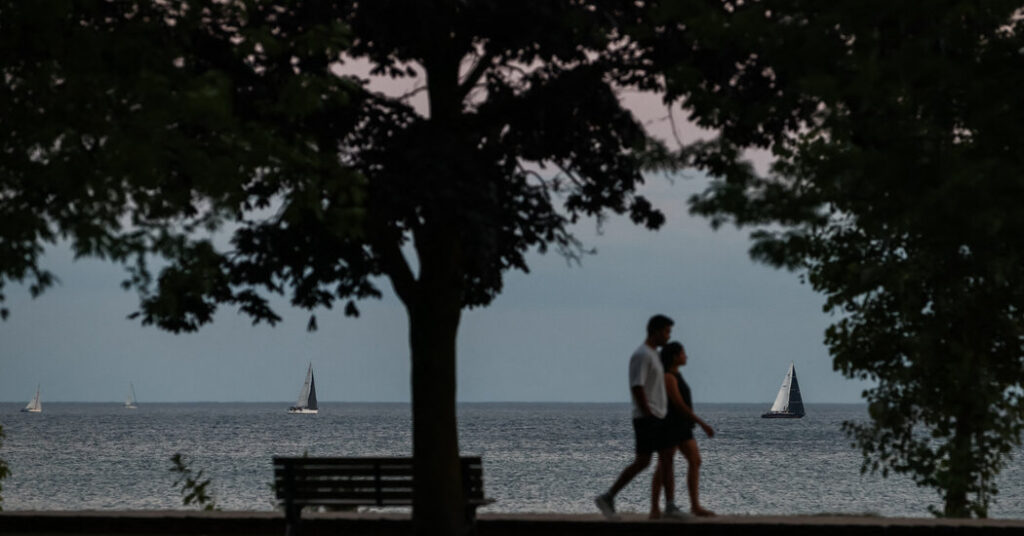
Sitting some 400 miles away from Lake Ontario in the Oval Office, Mr. Trump declared that the Great Lake would now be known as “Lake America.” He signed an executive order to that effect, billed as an effort toward “Making the Great Lakes Even Greater.”
For some of the over two million New Yorkers who live along the shores of Lake Ontario, named for an Iroquoian word that roughly translates to “lake of shining waters,” its new name seemed like an unworthy distraction.
David Hedley, 64, is the fourth-generation owner of Hedley Boatyard in Olcott on the shores of the Great Lake. He lamented that the president was distracting from what he saw as the real issues facing the country, such as affordability, by renaming the lake. His great-grandfather started the family business in 1900 — and Mr. Hedley said he would not be incorporating the lake’s new name into any business dealings.
“Next they’ll be calling Canada geese ‘Donald ducks,’” he said.
Sherri Middlestate, who answered the phone on Friday at Shangri-La on Lake Ontario, a marina, restaurant and campground in Three Mile Bay, laughed when asked about the lake’s name change and whether Shangri-La would be changing its name.
“No way,” Ms. Middlestate said. “It’s always Lake Ontario.”
Jim Baker, co-owner of the Chateau Niagara Winery in Newfane, has run his vineyard with his wife, Kathy Baker, for more than 20 years. He said his roots in the region dated back to the early 1800s when his family moved there to grow fruit. Mr. Baker said he would not be using the “Lake America” moniker in the spiel he gave during guided tastings.
“To be part of a senseless trade war, this is tremendously silly,” he said.
Lake Ontario’s name dates to the 17th century, when mapmakers adopted the Native American nomenclature. Some French explorers had also referred to it as “Lake St. Louis.” The body of water was formed during the last ice age and is the smallest of the Great Lakes.
Trump Administration: Live Updates
Updated
- Hegseth Blocks Promotions of Four Army Officers as Purge Widens
- California sues the government over deals that shifted companies from offshore wind to fossil fuel projects.
- Milo Yiannopoulos, a right-wing provocateur, is arrested by ICE.
Mr. Trump signed the executive order on Thursday after trade talks with Canada fell through that week. The move mirrored one that the president made early in his second term, when he declared that the Gulf of Mexico would be called the “Gulf of America.” Both executive orders will most likely only apply to federal entities and do not require other countries to recognize the name changes.
On Friday, Greg Boyd was camping for the weekend at Four Mile Creek State Park along the lake near Niagara Falls. He said he didn’t object to the name change if there was a good rationale for it.
Anything that could potentially create more equity in trade between the two countries should be considered, he said.
“If that’s what it takes to bargain, go ahead. Change the name,” he said. “Maybe it would aggravate people to no end. But the system as it’s going now cannot continue.”
In upstate New York, voters tend to be more conservative than farther south in New York City. In the 2024 presidential election, Mr. Trump received a majority of the votes in nine of the 10 counties that border the lake. His Democratic rival, Vice President Kamala Harris, only won Monroe County, which is home to the city of Rochester.
Democratic leaders from the Great Lakes region also joined the debate, with Gov. Gretchen Whitmer of Michigan sharing a video on social media of a children’s song taught to grade schoolers that uses the acronym “HOMES” to help students remember the names of the lakes — Huron, Ontario, Michigan, Erie and Superior. Gov. Kathy Hochul of New York simply tweeted, “New York won’t be calling it that.”
Silvia Newell, the director of the Michigan Sea Grant, which promotes research, outreach and education for the Great Lakes, said the organization would not change how it referred to Lake Ontario unless it received new guidance from the National Oceanic and Atmospheric Administration. She added that politicizing the lake threatened what she considered one of the last remaining issues that enjoyed bipartisan support.
“It’s this really great community where scientists, supporters, everyone pulls together to really protect the Great Lakes, regardless of the politics of the day,” she said. “It’s the modern great uniter.”
Robert Barba contributed reporting.
The post ‘Lake America’? These Upstate New Yorkers Aren’t Letting Go of ‘Ontario’ appeared first on New York Times.